

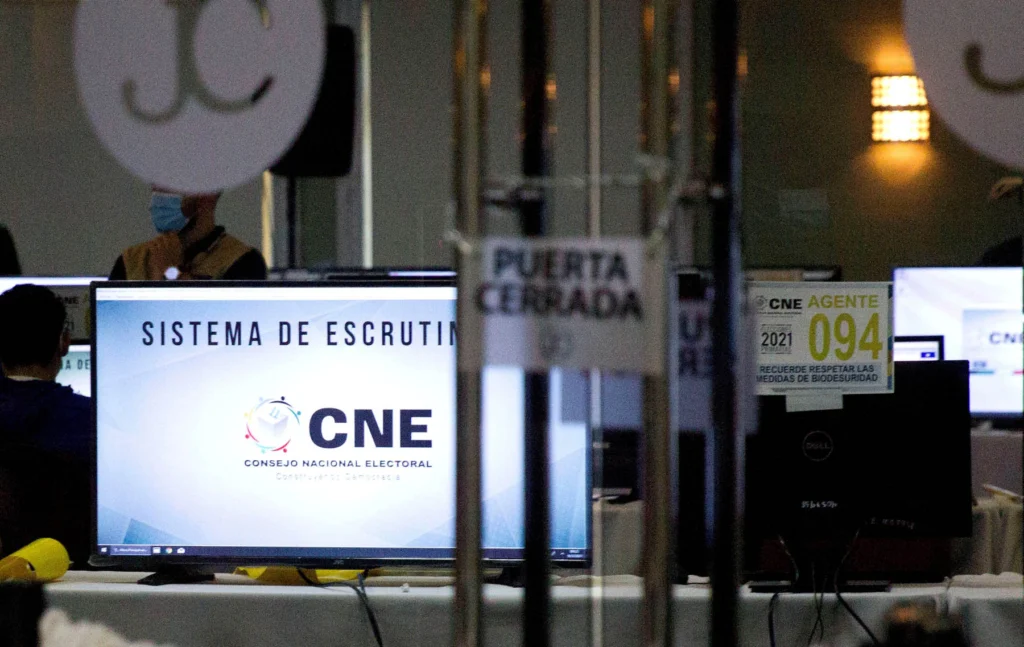
The National Electoral Council (CNE) of Honduras declared Nasry Juan Asfura Zablah, candidate of the National Party, as the constitutionally elected president for the 2026-2030 term on Wednesday, December 24, in a decision that has been described by various sectors as an “electoral coup.”
The proclamation was carried out solely by council members Ana Paola Hall García and Cossette Alejandra López Osorio, in the absence of institutional consensus and without the vote-by-vote recount being completed.
RELATED:
The measure comes amid serious allegations of irregularities in the vote-counting process, strong foreign interference, and a suspected conspiracy orchestrated before the November 30 elections. The ruling Liberty and Refoundation Party (Libre), the Liberal Party, and even CNE board member Marlon Ochoa have formally objected to the decision, stating that a transparent recount of votes has not been conducted and that thousands of tally sheets with unresolved inconsistencies remain.
Salvador Nasralla, the Liberal Party’s presidential candidate, categorically rejected the proclamation, asserting that “a large majority of citizens do not support the course the process is taking.” In a message addressed to board members Hall and López, Nasralla accused the electoral body of responding to interests other than the popular will and denounced the system for favoring figures linked to corruption.
Former Foreign Minister Enrique Reina also spoke out on Wednesday, warning of the CNE’s intention to establish a “de facto president-elect.” On social media, Reina wrote: “This is how Honduras wakes up, with an electoral coup underway and a National Electoral Council (CNE) comprised of two illegal members, marching toward declaring a de facto president-elect.”
Consumando el Golpe de Estado Electoral, sin resolver las solicitudes de impugnaciones, escrutinios especiales ni nulidades. Elevan al TJE sin petición de parte. Siempre hay alguien que presenta el documento inicial, como la renuncia falsa de @manuelzr en 2009. Tienen armado el… pic.twitter.com/KY7GT9HHRt
— Enrique Reina (@EnriqueReinaHN) December 23, 2025
His complaint refers to the CNE plenary session on Tuesday, December 23, in which Hall and López refused to review approximately 10,000 tally sheets with inconsistencies, thus dismissing numerous challenges.
Marlon Ochoa, a CNE council member, described the measure as an “electoral coup,” emphasizing that the declaration was made without completing the special recount and without resolving the 288 challenges filed.
This Wednesday, Ochoa filed a formal complaint with the Public Prosecutor’s Office (MP) in Tegucigalpa, accompanied by 10 audio recordings that, he claimed, “prove the electoral fraud orchestrated by the two-party system.”The recordings reportedly include the voices of a former president, a former Liberal Party candidate, foreign presidential advisor Fernando Cerimedo, and other unidentified figures.
Ochoa denounced “the most vulgar and blatant foreign interference in the country’s history,” pointing directly to the United States government. He asserted that Washington deployed “a litany of actions” to influence the elections, including threats of economic sanctions if Asfura, the candidate publicly endorsed by former President Donald Trump, did not win.
Furthermore, he revealed that millions of text messages were sent to remittance recipients warning of their suspension if the U.S.-backed candidate did not prevail, which he considered a “violation of respect for the sovereign will of the people.”
“It is a crime to declare a president with hundreds of tally sheets still unprocessed and with evidence of inconsistencies,” Ochoa stated upon leaving the Public Prosecutor’s Office. He added that, “when one analyzes the universe of tally sheets where the number of voters on the tally sheet matches the number of voters registered on the biometric device, the winner of the elections is not the person they are now trying to declare as president of the Republic.”
The institutional crisis in Honduras is deepening as political and social actors demand transparency, a full audit, and respect for the popular will. The National Electoral Council’s declaration, issued without consensus or full scrutiny, jeopardizes the legitimacy of the 2025 Honduran electoral process.
From teleSUR English via This RSS Feed.