

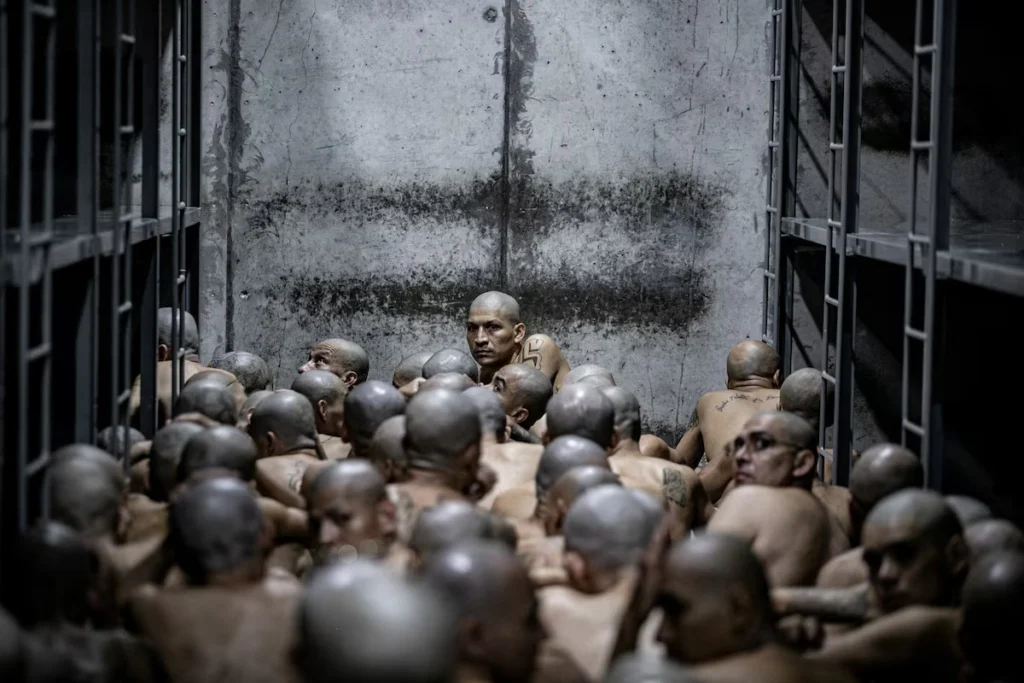
A major investigative report was canceled, revealing not just one prison and one policy, but a broader shift in how power, profit, and punishment intersect on the world stage.
RELATED:
From CECOT to Venezuela: The Controversial Repatriation of Venezuelan Migrants and Its Challenges
What was meant to be an inside look at El Salvador’s Terrorism Confinement Center (CECOT) has become a symbol of media censorship and a troubling example of human rights abuses tied to a global, privatized system of detention.
The Kill Switch: Censoring the Inside CECOT Report
On December 21, 2025, CBS News pulled a much-anticipated 60 Minutes segment titled “Inside CECOT” just hours before it was scheduled to air.
The piece aimed to expose how the Trump administration deported hundreds of Venezuelan migrants to a Salvadoran mega prison, and it raised questions about the legal justifications used to move people across borders and into foreign custody.
Cancellation can be seen as evidence of a larger trend: media silence bought or guaranteed by political or corporate interests.
Even with the broadcast blocked, the segment leaked briefly online after a misstep on a Canadian platform, underscoring the persistent demand for truth-telling, even when editors try to bury it.
Here’s the full 60 Minutes segment on CECOT that Bari Weiss and CBS censored.#BoycottCBS pic.twitter.com/lrZF4I7rOD
— @Ima 🇺🇸💙🔬🔭 (@imatweet25) December 23, 2025
“Welcome to Hell”: What Survivors Describe Inside CECOT
The censored report was meant to document the lived reality of Venezuelan migrants sent to CECOT, a facility designed for tens of thousands of inmates and notorious for its harsh treatment.
Survivor testimonies describe a system of organized brutality that sacrifices dignity and safety in the name of deterrence and control.
Accounts describe pain that begins from the moment detainees arrive in El Salvador. Migrants say they were paraded before cameras in shackles and told they would “never see the light of day again.”
Guards reportedly used fists and wooden batons, delivering beatings that left prisoners bleeding or toothless. Other survivors reported sexual assault, with several alleging guards attacked them in intimate ways.
Isolation and punishment cells, referred to by detainees as “the island,” were used for those who resisted. Those held there describe doors being pounded on, and beatings every half hour as a deliberate form of psychological terror intended to break the will.
Did Bari Weiss try to bury 60 Minutes’ CECOT report to protect Marco Rubio?
While Stephen Miller has been the public face of Trump’s deportation policy, it was Rubio who arranged to send 250 Venezuelan migrants to his friend Nayib Bukele in El Salvador, where they were publicly… pic.twitter.com/MLBbxyOe06
— Max Blumenthal (@MaxBlumenthal) December 23, 2025
Psychological Warfare and Degrading Conditions
Beyond physical harm, CECOT is reported to employ methods designed to erode people’s mental health and sense of humanity.
Detainees described living in a regime of constant exposure to bright lighting—24/7 illumination that prevents sleep and disrupts circadian rhythms, a tactic that experts say can amount to psychological torture.
Basic needs were routinely unmet. Detainees spoke of a lack of clean water and of being forced to drink from toilets to survive.
There were no mattresses, and medical staff allegedly dismissed injuries, telling prisoners to “drink water” rather than provide care.
Legal Warfare: The Alien Enemies Act and Deportation Strategy
The backbone of the deportation strategy is not just executive whim but a legal framework that enables extraordinary actions.
The Alien Enemies Act of 1798, a relic from early U.S. wartime policy, was revived to justify bypassing conventional immigration courts.
What the law does, in essence, is empower the President to detain or deport individuals from a “hostile nation” during wartime or an invasion-like scenario. In March 2025, President Trump invoked this authority by labeling the Tren de Aragua (TdA), a Venezuelan gang, as an invading force.
From there, the policy effectively designated Venezuelan nationals aged 14 and up as potential targets for removal, ostensibly without the usual hearings.
This legal maneuver is controversial because it extends wartime powers into civilian immigration matters, a move many scholars and civil rights groups argue violates core principles of due process and ordinary justice.
You can learn about what’s happening inside CECOT in our latest @AJFaultLines doc. We spoke with a young Venezuelan man with no criminal record wrongly sent to CECOT who described the torture he & other prisoners deported there by the U.S. endured. https://t.co/AjxaGBa74W pic.twitter.com/YNRVTfJcos
— Natasha Del Toro (@ndeltoro) December 22, 2025
The Battle for Due Process
Two questions sit at the center of this debate: Do migrations and gang activity constitute a “war” or “invasion” by a foreign power? And, if not, can a government deport people en masse under the Alien Enemies Act?
The ACLU and Democracy Forward argued that the government’s actions overstepped constitutional bounds and failed to provide meaningful due process.
In December 2025, U.S. District Judge James Boasberg ruled that many deported individuals lacked due process rights and ordered the government to arrange hearings for those affected.
The Supreme Court, meanwhile, offered a partial green light in April 2025, allowing certain deportations to proceed but insisting that detainees still receive notice and an opportunity to challenge their removal through habeas corpus petitions.
The Global Frontier: Private Prisons and Offshore Detention
As the United States pushes immigration detention beyond its borders, a familiar set of beneficiaries has risen to prominence: private prison operators.
The GEO Group and CoreCivic, two of the largest players in the industry, have reported soaring revenues as the U.S. expands its reach into third-country detention arrangements.
The push to offshore detention has created a robust market for private contractors. In late 2025, projections suggested The GEO Group would approach $3 billion in annual revenue, while CoreCivic anticipated around $2.5 billion.
Under this model, asylum seekers may be held in third countries while their cases wind through U.S. courts. Countries like Ecuador, Paraguay, and Belize have become key nodes in this offshore detention network.
The El Salvador arrangement—where migrants were housed at CECOT—appears to fit within a broader strategy of outsourcing detention to jurisdictions with fewer checks and balances.
In official documents, the U.S. reportedly paid millions to host deportees in CECOT, with estimates ranging from US$4.7 million to US$6 million.
Some memos describe this as “leasing” sections of the prison to preserve exclusive jurisdiction and to bypass certain domestic legal constraints.
Critics argue that paying foreign governments to detain migrants implicates questions of sovereignty, accountability, and human rights.
Some observers argue that the United States uses financial incentives to secure cooperation from countries that host detainees. By offering cash and resources, the U.S. creates a powerful incentive for host nations to act as offshore detention hubs, even when protections for detainees are thin or nonexistent.
60 Minutes pulled their own trailer and abruptly canceled tonight’s “Inside CECOT” episode.
Not because it was wrong. Not because it failed fact-checking.
Because Trump reportedly didn’t like what was about to air.When a sitting president can pressure a flagship news program… https://t.co/I5N9kN3yYu pic.twitter.com/oin3kq6CbU
— P a u l ◉ (@SkylineReport) December 22, 2025
Geopolitical Fallout and the Human Rights Debate
Labeling migrants as “foreign enemies” and deporting them to high-security facilities abroad has sparked diplomatic tensions and raised questions about international law and basic human rights standards.
The Venezuelan government has been vocal in its opposition, condemning the transfers as kidnappings and even branding them a crime against humanity.
Venezuelan officials have alleged corruption, accusing El Salvador’s government of profiting from migrants’ misery, with claims that high-ranking leaders benefited from each deportation.
Some critics argue that safe third-country arrangements undercut core protections like non-refoulement, which prohibits returning refugees to places where they face significant risk.
Activists contend that sending detainees to a site identified by the U.S. State Department as a torture site constitutes a direct violation.
Survivors also report deceptive tactics—being told they were being flown back to Venezuela, only to land in El Salvador amid hundreds of police.
By treating people as commodities for a growing private prison industry and leveraging wartime powers to bypass rights, current policy risks creating a permanently branded underclass that is profitable to detention interests and political structures alike.
Accountability and a Way Forward
True accountability goes beyond a single, suppressed documentary. It requires dismantling the “carceral logic” that places corporate profits and political messaging above fundamental human rights.
It calls for robust oversight, transparent legal processes, and a commitment to the principle that every person deserves due process, safety, and dignity, wherever they are held.
- Real due process protections for migrants and detainees, including fair hearings and access to legal counsel.
- Transparent contracts and oversight for offshore detention arrangements, with independent monitoring and public reporting.
- Strong international norms that prevent refoulement and ensure humane treatment, even in conflicts or crises.
The story behind the silenced Inside CECOT report is about more than one investigative piece or one prison.
It is about a global shift, one that treats vulnerable people as variables in a political or profit-driven calculation.
Sources: CBS – BBC – Context – Al Jazeera – teleSUR – Al Mayadeen – Human Rights Watch – Mixed Migration Center – France 24
From teleSUR English via This RSS Feed.