

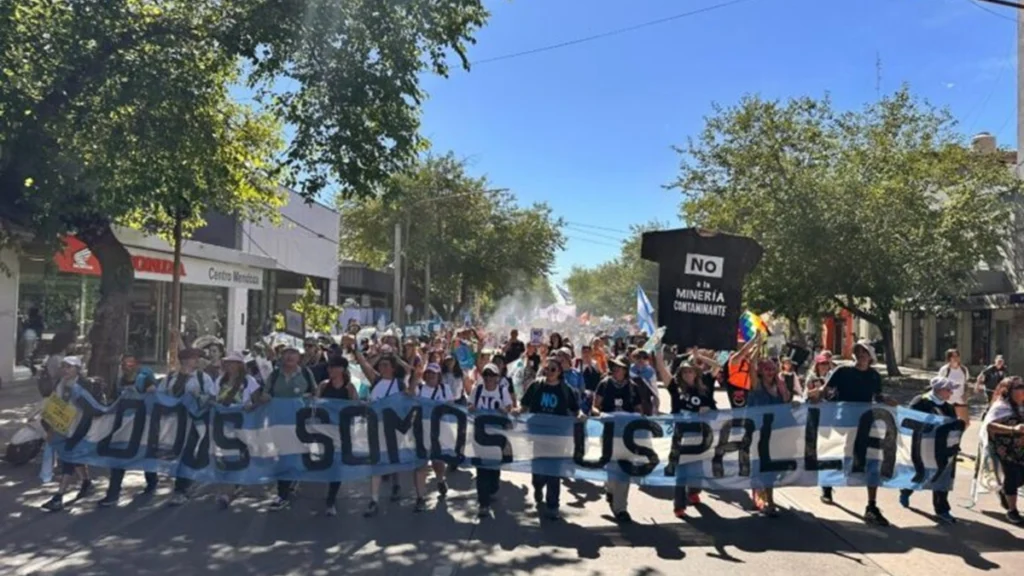
They reject open-pit mining in environmentally sensitive areas.
On Tuesday, hundreds of Argentines marched through the streets of Mendoza to reject the approval of mining projects they say put the province’s water resources and ecosystems at risk.
RELATED:
Argentina’s Provincial Senate Approves Extractivist Mining Plan, Environmental Red Flags Ignored
The march moved from the city center to the Government House, with banners, flags and chants directed at Gov. Alfredo Cornejo. Demonstrators demanded the repeal of Laws 9,684 and 9,685, recently passed by the provincial Legislature.
The measures authorize environmental impact declarations for mining operations at Cerro San Jorge, in the town of Uspallata, and for nearly 30 extractive projects in Malargüe.
“Water is not negotiable” was the main slogan of the march, which stretched for more than seven city blocks and included assembly members from about 15 regions of Mendoza, social leaders and environmental activists.
No lo vas a ver en ningún canal de Televisión. Pero así está #Mendoza desde hace más de 20 días, una multitud en calles y rutas defendiendo el Agua💧contra el avance de la minería contaminante por gobiernos y políticos corruptos. Devuelvan las coimas. #ElAguaDeMendozaNoSeNegocia pic.twitter.com/zj9Htq6GTm
— Lautaro Jimenez (@LautaroJimenezB) December 23, 2025
The text reads, “You won’t see it on any TV channel. But that’s how Mendoza has been for over 20 days: crowds in the streets and on the roads defending water against corrupt governments and politicians who are pushing through polluting mining. Return the bribes!”
The demonstration began around 10:30 a.m. at Plaza Belgrano, where participants invoked the legacy of Gen. Jose de San Martin, defended shared environmental assets and reaffirmed Mendoza’s history of social struggle.
Specifically, protesters rejected the PSJ Cobre Mendocino mining project, formerly known as the San Jorge mine, located near the town of Uspallata. The project is being promoted by the Swiss company Zonda Metals GmbH and the Alberdi Group.
The project had already been rejected by the provincial Legislature in 2011 because it involves open-pit mining in an area considered environmentally and hydrologically sensitive.
Demonstrators also upheld Law 7722, enacted in 2007 after a wave of social mobilization and regarded as a symbol of water protection in Mendoza. The law bans the use of toxic substances such as cyanide and mercury in metal mining.
Nevertheless, right-wing politicians backing the mining project argue that the law does not prohibit the use of chemicals such as methyl isobutyl carbinol, sodium isobutyl xanthate, anionic polyacrylamide and calcium oxide.
Miles en las calles de Mendoza para decir NO a San Jorge y volver a rechazar en las calles el proyecto minero que pone en riesgo a la comunidad de Uspallata y toda la cuenca del Rio Mendoza. No hay licencia social para la minería contaminante. pic.twitter.com/tJmH4rebxb
— La Izquierda Diario (@izquierdadiario) December 23, 2025
The text reads, “Thousands took to the streets of Mendoza to say NO to San Jorge and once again reject the mining project that endangers the Uspallata community and the entire Mendoza River basin. There is no social license for polluting mining.”
In recent remarks, Gov. Cornejo downplayed the hydrological impact of mining activity and said the largest water consumption comes from agriculture and residential use. According to him, the problem lies not in mining but in waste, a position that drew strong backlash from protesters.
The date chosen for the protest, Dec. 23, was also symbolic. It recalls the massive demonstrations of 2019, when then-Gov. Rodolfo Suarez sought to amend Law 7722 and was forced to reverse course after a wave of protests that included road blockades and clashes with security forces.
Those protests gave rise to what became known as the “Parientazo Day,” centered in the Uco Valley, a region that has once again become key to environmental resistance. That same territory holds deep historical significance: It was there that San Martin met with Pehuenche communities before crossing the Andes Mountains.
Centuries later, that legacy is being invoked by Mendoza’s grassroots assemblies to promote what they describe as a new “liberating campaign,” this time in defense of water and against the advance of large-scale mining.
#FromTheSouth News Bits | Argentina: The Central Workers Union condemned the United States’ aggressions against Venezuela. pic.twitter.com/4a8AQw731X
— teleSUR English (@telesurenglish) December 23, 2025
teleSUR/ JF
Sources: Pagina 12 – El Extremo Sur
From teleSUR English via This RSS Feed.