

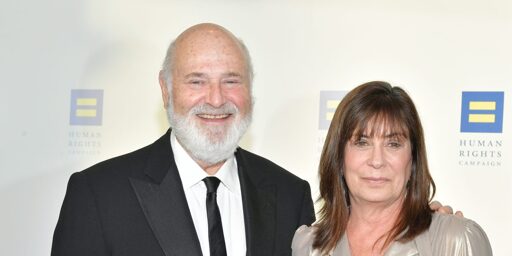
The headlines came fast and furious: Nick Reiner, 32, could face the death penalty for murdering his own parents, beloved Hollywood couple Rob Reiner and Michele Singer Reiner.
News coverage ranged from practical explainers on California’s death penalty to vulgar punditry casting more heat than light. True crime celebrity Nancy Grace fumed that Reiner showed “no remorse” during his brief courtroom appearance. Megyn Kelly mused, without shame or evidence, that Reiner might deploy the same “sympathy card” as the Menendez brothers, who, after killing their parents, accused their father of sexually abusing them as children.
If there was one thing most people seemed to agree on, however, it was that a death sentence is highly unlikely.
Reiner’s reported mental illness has already raised questions over his competency to stand trial. His lifelong struggle with addiction, which led to homelessness and more than a dozen stints in rehab, is the kind of mitigating evidence that could persuade a jury to show mercy — if not convince prosecutors to take death off the table altogether.
Then there’s the Reiner family, which has barely begun to grieve. The Reiners’ adult children — who have asked “for speculation to be tempered with compassion and humanity” — may likely push back against a decision to seek death, whether out of opposition to the death penalty, a desire to avoid the trauma and spectacle of a capital trial, or because they do not wish to lose another beloved family member to homicide, no matter how devastating his alleged actions.
So why did the Los Angeles County district attorney raise the possibility of a death sentence for Nick Reiner at a press conference just two days after his parents’ bodies were found?
[
Related
“There Are Innocent People on Death Row” — Citing Wrongful Convictions, California Governor Halts Executions](https://theintercept.com/2019/03/13/california-death-penalty-moratorium/)
In a state that has not carried out an execution in 20 years, decisions to seek the death penalty amount to little more than political posturing. While nearly 600 people remain under a death sentence in the Golden State, a return to executions has never seemed more far-fetched. After Gov. Gavin Newsom imposed a moratorium in 2019, the death chamber at San Quentin was dismantled, and the condemned population transferred to prisons across the state.
While a new governor could conceivably lift the moratorium, any push to restart executions would take years. As one federal judge put it more than a decade ago, California’s death penalty remains a punishment “no rational jury or legislature could ever impose: life in prison, with the remote possibility of death.”
Yet there was District Attorney Nathan Hochman on December 16, standing somberly before the cameras in downtown LA to announce the charges that would make Reiner eligible for the ultimate punishment.
“No decision at this point has been made with respect to the death penalty,” Hochman added gravely, cautioning against speculation or rumor.
His decision would rely on the evidence and, at least in part, on input from the family of the victims.
He said, “We owe it to their memory to pursue justice and accountability for the lives that were taken.”
Reiners’ Activism
It is not overly speculative to say that Rob and Michele Reiner would have recoiled at the thought of the state seeking a death sentence in their name — let alone against their own son.
Their famed support of social justice causes included advocating for people in prison. Friends of Singer Reiner have recalled her recent focus on wrongful convictions and her regular conversations with Nanon Williams, a Texas man who faced the death penalty as a teenager before his sentence was reduced to life. One of Rob Reiner’s last production credits, “Lyrics From Lockdown,” a one-man show by the formerly incarcerated artist Bryonn Bain, centers in part on Williams’s story.
In a 2023 interview discussing the show, Reiner pointed to the racism at the heart of the criminal justice system, a topic he’d grappled with in his film “Ghosts of Mississippi.” He had brainstormed a potential documentary series, “Injustice for All,” he said, which would depict the ugly reality of the system: “It’s prosecutorial misconduct. It’s profiling.”
“The death penalty does not make us safer, it is racist, it’s morally untenable, it’s irreversible and expensive.”
It was this very kind of systemic critique — rooted in decades of research and data — that had led former LA District Attorney George Gascón to halt death penalty prosecutions in Reiner’s home county a few years earlier. At a time when the death penalty had been on a long, slow decline, Los Angeles remained an outlier in sending people to death row — overwhelmingly people of color.
“The reality is the death penalty does not make us safer, it is racist, it’s morally untenable, it’s irreversible and expensive, and, beginning today, it’s off the table in LA County,” Gascón said at the time.
But electoral politics are quick to punish such attempts at reform — especially when they coincide with any uptick in crime.
[
Related
What Happens When a Reform Prosecutor Stands Up to the Death Penalty](https://theintercept.com/2019/12/03/death-penalty-reform-prosecutors/)
Gascón’s tenure overlapped with a rise in violent crime nationwide, a phenomenon tied to the pandemic but swiftly blamed on reform-minded prosecutors. While Gascón survived two recall attempts, the era of reform he sought to implement was short-lived. A crowded field of challengers lined up to replace him in 2024.
Hochman would win out by running a classic tough-on-crime campaign. Promising to rescue the city from a descent into crime-ridden dystopia, he vowed to revive the death penalty in LA as part of his “blueprint for justice,” a set of priorities primarily aimed at reversing his predecessor’s reforms. Never mind that the death penalty remained a failed public policy that did nothing to stop crime — and which California taxpayers had paid billions of dollars to maintain with little to show for it.
“Effective immediately,” Hochman declared months after taking office, “the prior administration’s extreme and categorical policy forbidding prosecutors from seeking the death penalty in any case is rescinded.”
It is against this backdrop that Hochman will now handle the prosecution of Nick Reiner.

LA County District Attorney Nathan Hochman announces charges against Nick Reiner in the murders of his parents on Dec. 16, 2025. Photo: Robert Gauthier/Los Angeles Times via Getty Images
Victims’** Families?**
Just two weeks before the Reiners’ horrific murders, the American Civil Liberties Union of Southern California released a report assessing Hochman’s first year in office, decrying his “pattern of extreme and debunked approaches to crime.” At the top of the list was his decision to bring back the death penalty to LA County.
The report quoted a recent op-ed by veteran anti-death penalty activist and actor Mike Farrell, the board president of the California-based abolitionist group Death Penalty Focus.
“It’s incomprehensible that D.A. Hochman is once again pursuing the death penalty in Los Angeles, the county that has sent more people to California’s now-defunct death row than any other in the state,” Farrell wrote. Although Hochman often pointed to a pair of unsuccessful ballot initiatives that twice failed to repeal California’s death penalty, Angelenos voted in favor of the measures.
“Why would a responsible district attorney ignore the demonstrated will of the voters in the county he serves?”
“So why,” Farrell asked, “would a responsible district attorney ignore the demonstrated will of the voters in the county he serves?”
Farrell also called out Hochman for refusing to meet with victims’ family members who oppose capital punishment. Although Hochman vowed to give families a voice in matters of crime and punishment, his conduct has left some families feeling betrayed.
Perhaps no family has been more vocal than the relatives of Lyle and Erik Menendez, who filed multiple complaints against Hochman for his conduct while he fought to block the brothers’ recent bid for release. Prior to Hochman’s election, the Menendez case had been reviewed by Gascón’s Resentencing Unit, ultimately persuading the DA to recommend that the brothers be resentenced after 35 years behind bars.
Hochman swiftly intervened, taking aggressive steps to keep the brothers in prison. In one subsequent letter, sent to the U.S. Attorney’s Civil Rights Division, a family member described a meeting between Hochman and more than 20 relatives, who urged the DA to reconsider his stance.
“In a tear-filled meeting, numerous family members shared the ongoing trauma and suffering we have endured for more than 30 years,” it read. “Instead of responding with compassion, acknowledgment, and support, DA Hochman proceeded to verbally and emotionally retraumatize the family by shaming us for allegedly not listening to his public press briefings.”
The Anti-Reformer
The ACLU report also shed light on Hochman’s disturbing attempts to undermine the Racial Justice Act, a landmark piece of criminal justice legislation allowing courts to reexamine death sentences rooted in racial bias. The law explicitly barred prosecutors from using animal imagery against defendants, a dehumanizing practice that has historically served as a racist dog whistle.
Yet Hochman went out of his way to defend a case where the prosecutor compared a defendant to a “Bengal tiger.” California Attorney General Rob Bonta, who defeated Hochman for the top statewide office in 2022, had acknowledged that the tiger reference was wrong and that the death sentence should be vacated. Hochman, though, wrote in an amicus brief to the court that Bonta’s “concession was not well taken, and this Court should reject it.”
It would be hard to imagine a more retrograde position than defending racist imagery in capital trials. Hochman not only vowed to uphold the Racial Justice Act upon taking office, but also used its existence as political cover to justify his pro-death penalty stance.
As the ACLU wrote, “D.A. Hochman’s arguments against the RJA attempt to weaken the very law he claims would safeguard his death penalty decisions from racial bias.”
One could argue that none of this is relevant to the case of Nick Reiner. As a white man from a wealthy family who has secured one of the country’s most high-profile defense attorneys, he has had privileges that are unheard of compared to most defendants who end up on death row.
And while mental illness or addiction may ultimately spare Reiner from a death sentence, the same cannot be said for countless people whose crimes were driven by demons like his.
This, of course, is precisely the problem. Reiner is still somebody’s son. The others are the “worst of the worst.”
Given their advocacy, Reiner’s parents would likely have been the first to acknowledge this. Prosecutors like Hochman, however, cannot afford to be so honest.
Whether or not he decides to seek a death sentence against Reiner, Hochman’s narrative about the death penalty is one of the oldest in electoral politics — a story cloaked in the language of justice, told for political gain.
The post Prosecutor Floating Death Penalty for Nick Reiner Knows It’s an Empty Threat appeared first on The Intercept.
From The Intercept via This RSS Feed.