

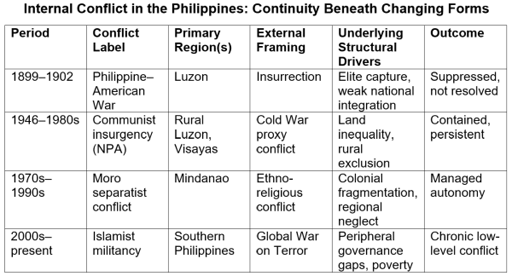
For more than a century, the Philippines has been afflicted by recurring internal conflict—colonial rebellion, communist insurgency, separatist war, Islamist militancy. This article argues that these episodes are not discrete failures but manifestations of a persistent condition of managed instability, structurally conditioned by the country’s incorporation into U.S. grand strategy beginning in 1898. From counterinsurgency as governance to modern access agreements, the Philippines has been treated less as a sovereign project to be completed than as a strategic position to be held—an approach whose risks are now sharpening under renewed great-power competition.
From naked capitalism via This RSS Feed.
You must log in or # to comment.