

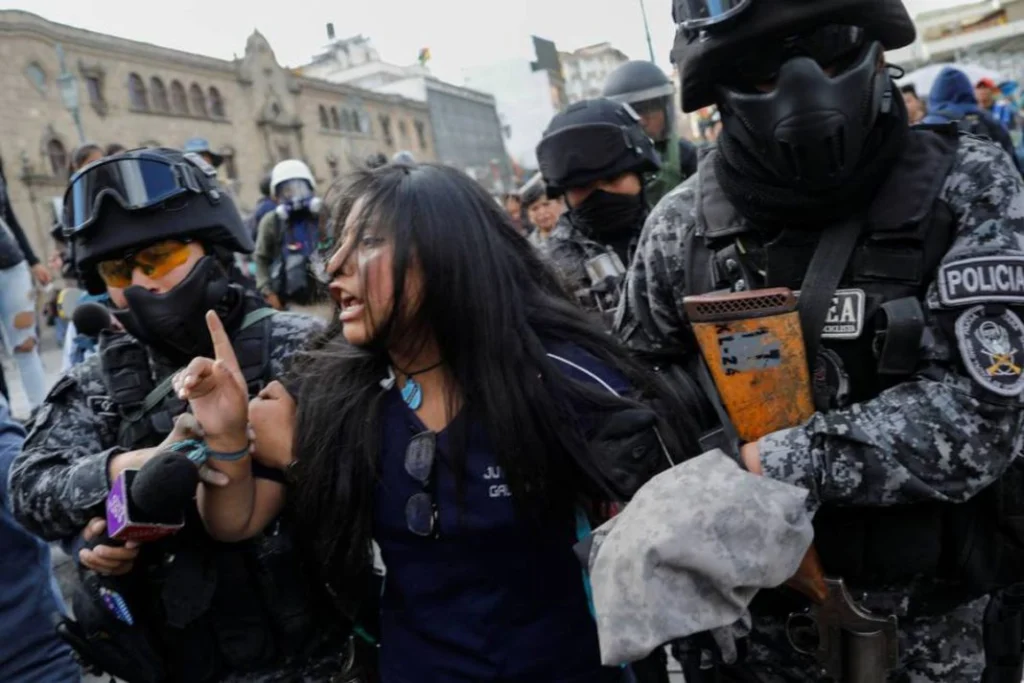
Bolivian police officers repressed a protest on Tuesday by workers affiliated with the Bolivian Workers’ Central (COB) against Supreme Decree 5503, a measure that eliminates fuel subsidies and has been dubbed a “gas price hike” by various social sectors. The incidents occurred near Plaza Murillo, the epicenter of political power in Bolivia, where police used tear gas to disperse the demonstrators.
RELATED:
Bolivian President Paz Convenes Mayors to Discuss Emergency Decree 5503 Amid National Strike
The protest, which marked the second consecutive day of demonstrations, began on Montes Avenue and brought together teachers, miners, and other groups who managed to surround the country’s political center. The clashes continued until the protesters retreated to Mariscal Santa Cruz Avenue.
“That is the government’s instruction: to attack the people and the workers,” denounced Andrés Paye, a miners’ leader, after the police intervention. The mobilization intensified after Monday’s failed meeting between COB leaders and President Rodrigo Paz, which did not take place despite the representatives waiting for more than an hour at the Government Palace.
COB Executive Secretary Mario Argollo confirmed that the protests will continue until Supreme Decree 5503 is repealed, clarifying that the leadership “is not intransigent” and is willing to engage in dialogue if the Executive Branch formally calls for it. “We are acting in accordance with our responsibility to the working class,” Argollo stated, emphasizing that the demands are social and labor-related, not partisan.
The decree, justified by the government as a response to the fiscal crisis, includes the elimination of fuel subsidies, which has led to an increase in the cost of transportation and basic goods. Social sectors denounce that the measure shifts the burden of the adjustment onto lower-income sectors, without providing effective protection mechanisms.
Despite the Executive’s claim to have reached agreements with nearly 20 organizations, at least a dozen road blockades persist in La Paz, Cochabamba, Potosí, and Chuquisaca.
From teleSUR English via This RSS Feed.