

More Palestine solidarity hunger strikers in Britain have been hospitalized over the past week, as half of those taking part in the protest pass more than 50 days without food. While Keir Starmer’s administration continues to refuse engagement with the activists’ demands, health workers and family members warn of serious risks of death. Testimonies from the strikers themselves describe harsh physical decline. “I don’t think people realize how serious this is, as on day 35 you risk brain damage, organ failure and heart attack,” Rahma Hoxha, sister of hunger striker Teuta Hoxha, said on December 18.
Eight activists – Amu Gib, Qesser Zuhrah, Jon Cink, Heba Muraisi, Teuta Hoxha, Kamran Ahmed, Lewie Chiaramello, and Umer Khalid – have joined the hunger strike on a rolling basis since early November. Since then, three strikers have ended their action. Many of the strikers have been imprisoned for over a year while awaiting trial for taking part in direct action in solidarity with Palestine. Their demands include an end to censorship in prison, including the withholding of calls and books; immediate bail for all Palestine Action prisoners; the deproscription of Palestine Action; the right to a fair trial; and the shutdown of all Elbit Systems sites in Britain.
Read more: Amid mass protests in the West, Israel’s military footprint expands in Eastern Europe
Over the past week, incidents have been reported in which prison authorities failed to respond adequately to the strikers’ medical needs – needs that health workers emphasize grow more complex and dangerous with each passing day. Instead of being provided care, some activists were left waiting more than 12 hours for help and were hospitalized only after protests outside the prison.
“From 2 am, in freezing temperatures, we were forced to protest for more than 12 hours before an ambulance was finally dispatched to HMP Bronzefield so that Qesser Zuhrah could receive the urgent medical care she needs,” MP Zarah Sultana wrote on December 18. “Just as Keir Starmer’s Labour government has enabled genocide in Gaza, it is now enabling the deaths of Palestine solidarity strikers inside UK prisons.”
Health workers warn that the hunger strikers may already have crossed a point beyond which recovery is uncertain. “It is not possible to predict how long it takes to suffer irreversible organ damage or death,” Dr. Frank Arnold wrote in Medact’s guidance for hunger strikers. “The shortest time to death that I know of was 21 days. The longest survival without any food, but with careful fluid management, 70 days. That patient made a recovery but has lasting neurological damage.”
Read more: Pro-Palestine activists are under attack in Europe
Mainstream British media have been remarkably silent even as it has become apparent that the government might be prepared to watch young people die in custody. At the same time, solidarity actions have expanded.
Education trade unionists, including executive figures from the National Education Union (NEU) and the University and College Union (UCU), have joined calls for immediate government intervention. In an open letter, they not only demanded action to protect the hunger strikers’ lives and address their demands, but also linked their current treatment to a wider crackdown on students and education workers expressing solidarity with Palestine. “We call on our trade unions, the wider Palestine solidarity movement and civil society to work together to protect the lives of the hunger strikers, defend the right to protest and end Britain’s shameful role in enabling Israel’s crimes of apartheid, occupation and genocide,” the letter states.
Health workers and artists have also mobilized in large numbers. More than 800 health professionals have signed an open letter warning British authorities of the dangers faced by the hunger strikers. Hundreds of Irish artists issued another appeal, endorsed by musicians KNEECAP and Fontaines D.C., as well as writer Sally Rooney. “Their decision to place their bodies on the line is a profound act of resistance – one that echoes the long histories of both Irish and Palestinian political prisoners who have used hunger strike as a non-violent act of sacrifice to assert their dignity in the face of state violence and repression,” the artists wrote.
Read more: Republican sections in Ireland observe 42nd anniversary of 1981 hunger strikes
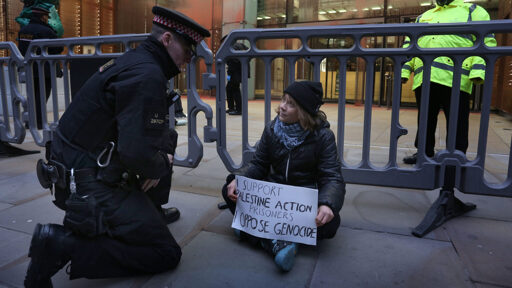
Meanwhile, institutional repression against the Palestine solidarity movement in Britain continues to grow. On December 23, Prisoners for Palestine and Defend Our Juries reported new arrests during a lock-in protest in London addressing Aspen Insurance’s complicity in genocide. One of those arrested was climate and solidarity activist Greta Thunberg, who sat on the ground holding a sign reading: “I support the Palestine Action prisoners. I oppose genocide.”
“It’s not clear if the Met Police have made another one of their mistakes in interpreting the crazy ban on Palestine Action or whether the state has now turned anyone expressing support for prisoners locked up beyond the legal time limit for taking action to stop a genocide into alleged terrorists,” a Defend Our Juries spokesperson said. “If it is the former then we look forward to seeing Greta released without charge immediately. If it is the latter, it is yet another dark day for Keir Starmer’s genocide-supporting government. In calling people terrorists who are not terrorists they are not acting to protect the public, they are acting to protect the companies profiting from genocide and the genocidal state of Israel itself.”
The post Hunger strikers’ lives at risk as Starmer government refuses engagement appeared first on Peoples Dispatch.
From Peoples Dispatch via This RSS Feed.