

Experts say his proposal cannot be implemented in the short term due to technical, financial, and industrial limitations.
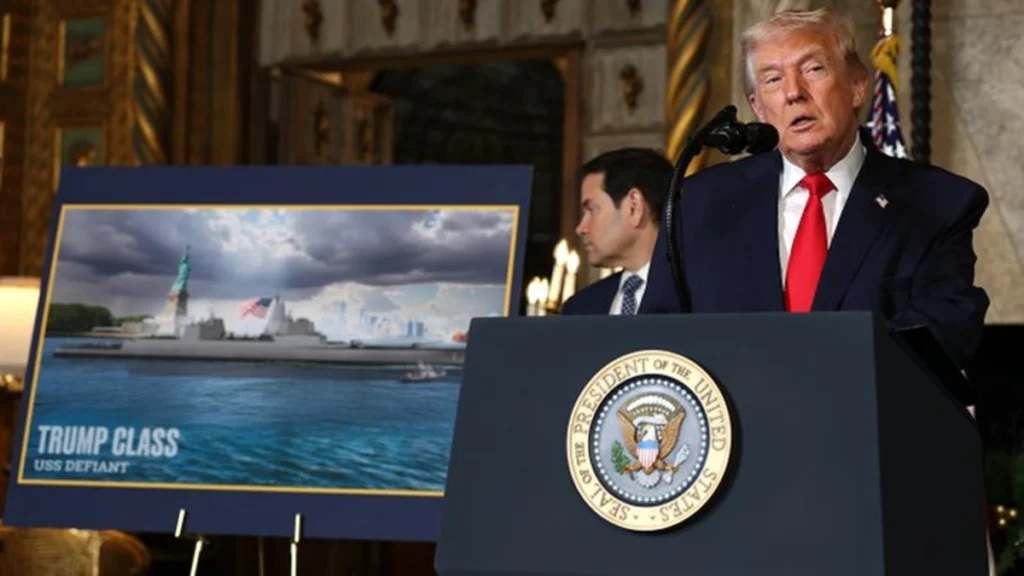
On Monday, U.S. President Donald Trump announced that the U.S. Navy will build two new “Trump-Class” warships, which will be “the fastest, the biggest, and by far 100 times more powerful than any battleship ever built.”
RELATED:
U.S. Government Denied Due Process to Migrants Deported to El Salvador: Judge Boasberg
Speaking at a news conference alongside War Secretary Pete Hegseth, Secretary of State Marco Rubio and Navy Secretary John Phelan, Trump said he has approved a plan for the Navy to begin construction on two of the largest battleships the United States has ever built.
He added that eight more would be built soon after and that the total number of new battleships would eventually reach between 20 and 25.
Trump said the warships would have a displacement of 30,000 to 40,000 tons and would be equipped with hypersonic weapons, railguns, cruise missiles and laser weapons. He said they would become the flagship vessels of the U.S. Navy fleet.
Phelan said the “Trump-class battleship” would become the largest, most lethal, most fully functional and most aesthetically pleasing battleship in the world.
Trump, Hegseth announce new ‘Golden Fleet’ battleships for the Navy#navy #battleship #goldenfleet #Trump #Hegseth pic.twitter.com/hz7LUoPfR4
— Military Times (@MilitaryTimes) December 23, 2025
Despite Trump’s enthusiasm for what he has called a “Golden Fleet,” defense specialists warned that the project faces serious technical, financial and operational limitations that cast doubt on its viability.
The U.S. president said the first of the new-generation battleships could enter service in about two and a half years. Experts, however, said that timeline is unrealistic for designing, building and bringing a military vessel into operation.
In fact, the War Department later said the first ship is currently in the design phase and could be completed in the early 2030s.
Doubts about Trump’s optimistic plans deepen when considering that current U.S. naval programs are already experiencing delays of at least one year and that shipyards are struggling to recruit and retain skilled labor.
In response, the U.S. president said he will meet next week with executives from defense-sector companies to pressure them to invest in the construction of new industrial facilities.
Another key obstacle is financing. The current Pentagon budget does not include sufficient resources to cover the high cost of the announced plans.
Trump just approved a record $901 billion military budget for 2026 –– even more than what his administration had originally requested.
Meanwhile, hundreds of thousands of Americans are still homeless, classrooms are overcrowded and underfunded, and millions are about to lose… pic.twitter.com/fr6dvsif1T
— Party for Socialism and Liberation (@pslnational) December 19, 2025
Bryan Clark, a former Navy officer and now an analyst at the Hudson Institute, warned that developing a new class of ships with highly complex technologies would require extraordinary spending. He said that without prematurely retiring existing vessels — an option not included in the presidential proposal — there would not be enough funding to sustain the project.
Mark Montgomery, a former Navy officer and a senior fellow at the Foundation for Defense of Democracies, said the initiative poses a massive challenge in terms of long-term maintenance costs. In his view, sustaining supply chains, support systems and the training required for multiple classes of small ships could strain the Navy’s budget for decades.
Representatives of the defense industry also expressed concern about the scale of the planned work. According to preliminary information, the new battleships would simultaneously incorporate technologies that have never before been integrated into a single vessel.
These include the ability to launch hypersonic missiles, generate sufficient power for laser weapons and operate electromagnetic railguns — a combination of systems that adds technical complexity and further increases costs and development timelines.
In a report titled “The Return of Battleships,” outlet Rybar said U.S. naval shipbuilding faces enormous problems and that the country cannot quickly build such “battleships,” whose cost would be so colossal that it would be enormous even for the U.S. military budget.
The outlet also noted that the crisis in U.S. shipyards is so severe that the country is already experiencing significant difficulties with the new Gerald R. Ford-class aircraft carrier program.
#FromTheSouth News Bits | United States: A group of Senate Judiciary Democrats sent a letter to Chairman Chuck Grassley urging him to hold a hearing on the Trump Administration’s extrajudicial executions of alleged drug traffickers via military strikes on boats at sea. pic.twitter.com/zxDikrkV38
— teleSUR English (@telesurenglish) December 22, 2025
teleSUR/ JF
Sources: Xinhua – EFE
From teleSUR English via This RSS Feed.