

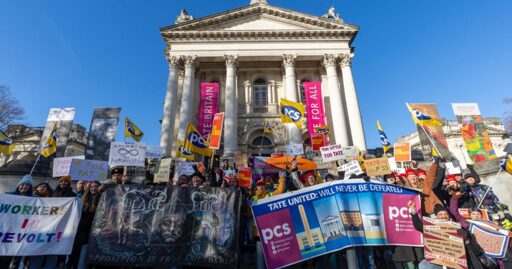
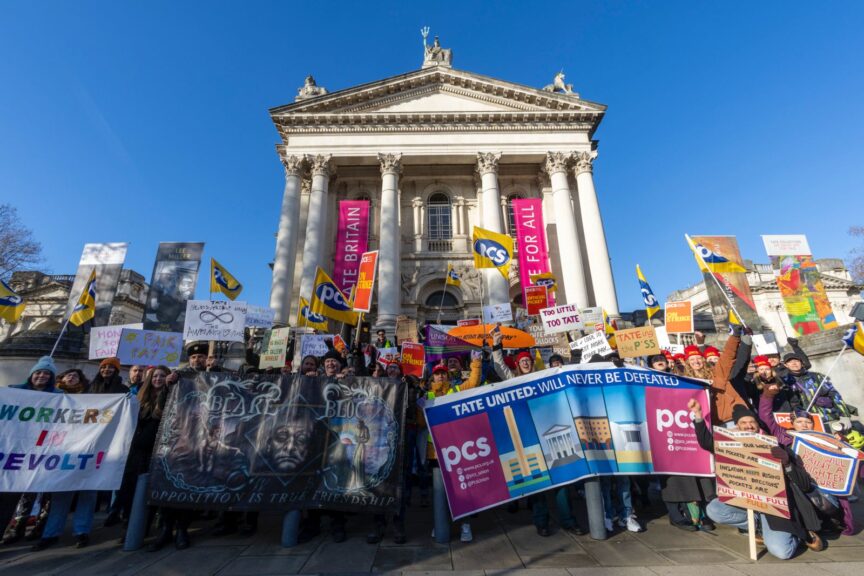
In November and December, over 150 workers for Tate went on strike. Outside three of Tate’s four galleries – Britain, Modern, Liverpool and St Ives, as well as workers at Tate Stores, which houses Tate’s collection of artworks – the workers held picket lines, waving placards that said ‘Want minimalism? Look at our pay!’
The strike lasted a week, beginning on 26 November and finishing on 2 December, after Tate’s Public and Commercial Services (PCS) union members had voted 98% in favour of it on a turnout of 87.7% after rejecting Tate’s offer of a 3% pay rise, well below inflation for the second consecutive year.
This was compounded by Tate’s highest-paid directors getting, in 2024, pay packets ranging from £195,000 to £320,000, with one bonus exceeding £28,000, higher than some Tate staff’s annual salaries. Many PCS members who work at Tate galleries say their current salary isn’t enough to meet basic living costs – especially with the loss of staff benefits, such as a subsidised canteen and access to the civil service pension scheme for new starters – even when supplemented with in-work benefits such as Universal Credit.
Several Turner Prize winners, including Helen Cammock, Jesse Darling, Mark Leckey and Tai Shani, along with Labour MP John McDonnell, visited the picket, with 175 workers outside Tate Modern on its final day; Zarah Sultana expressed solidarity with striking Tate workers at Your Party’s first conference last month.
The strike is the second in five years, being called after a restructure, like the last one in December 2020, when Tate announced plans to cut 120 gallery jobs in order to save £4.8m, having already announced 313 redundancies – half its staff – across its commercial arm, Tate Enterprises Ltd. Despite pandemic restrictions, strikers held performances, readings and speeches on the picket. Back then, it wasn’t as difficult for strikers to get noticed: Jeremy Corbyn, then Labour leader, spoke on the picket. After five years of the left being marginalised within or expelled from Labour and the reimposition of austerity by the Starmer government, Tate’s workers have had to rebuild awareness almost from scratch. The most recent strike began on the day of Rachel Reeves’ autumn budget, a choice designed to catch the government’s attention, Paula Orrell of Contemporary Visual Arts Network told Novara Media, though it’s not clear what success it is having. Orrell believes the strike has had some effect, however: the organisation’s director, Maria Balshaw, will step down next year, which Orrell says “has to be a consequence” of both the strike and of a lack of public funding.
“I’m sure Tate isn’t putting pressure on the government to secure funds, so it needs a radical rethink. It feels like an organisation for people privileged enough to work there – nobody can live on the wages it pays.” PCS members have met with Tate representatives several times, most recently on 4 December, but have yet to agree a deal, which means the strikes could roll on into next year.
One worker and PCS member, James*, went on the picket line for the first time this winter. “We don’t want to go on strike,” James said, an art handler for Tate, “but it’s important that the work of putting on exhibitions is acknowledged.”
“Tate is a big public institution with a collection that’s important to people in the UK and internationally – we care about it, and work here because we want the many to be able to see it, rather than it being in a private collection,” James added.
James said the strikers have had a mixed response from gallery visitors “There was support, but I also had visitors tell us to get back to work, that we were lazy.” He found the hostility surprising: “We literally put up the work they’d come to see. Most people didn’t know who we were – some thought we were doctors, until we spelled it out to them.”
Lack of coverage outside the specialist art press has been a problem. “The BBC ran a story about the Louvre closing because of strike action, but nothing on us,” said James, “even though we shut Tate Liverpool for a week. I don’t know why.”
Marie* works in a curatorial capacity at Tate and another PCS rep. She says staff have been “deprioritised” for years, and as a result, “are struggling to put the heating on in the winter, to travel to work, or pay the rent”. Marie said that some employees are using food banks, but work for Tate because they love art – indeed, many are artists themselves, finding it difficult to create in such circumstances. “We’re frustrated that there’s no consideration to an alternative solution” to redundancies, such as “reducing salaries at the top”, says Marie. “If you earn £150,000 per year, you don’t need any more to live well in London. Tate employees should be able to live independently in the city where we work. At the moment, we can’t, and we want the people who run the organisation, as well as visitors, to be aware of that.”
Tate has blamed its financial issues on cuts to grant-in-aid, lower numbers of international visitors since Brexit, and the long tail of the Covid-19 pandemic. Its directors have not had a pay rise this year, but unless Tate can make a substantially better offer to its workers, industrial action seems set to continue. “We feel confident in how we’ve collectivised over the last month,” says Marie. “People on the picket line have found so much in common about how we’ve been treated. Standing out in the cold and losing a week’s pay is a last resort, but we’re prepared to go out again if necessary. There is strength in our numbers, and we are prepared if Tate does not meet our demands.”
Conspicuously absent from the events at Tate is Lisa Nandy, minister for culture, media and sport. Though in keeping with Nandy’s entirely hands-off approach to the role so far, Nandy may come to regret sitting this one out. The outcome has potentially huge ramifications, not just for Tate but for all publicly funded institutions, cultural and otherwise; there are obvious parallels between what’s been happening at Tate and the redundancies, pay problems and strikes across the British arts and universities sectors in recent years. Given that the strikers show no sign of backing down, it could be that an important victory happens right under Nandy’s nose.
*Names have been changed.
From Novara Media via This RSS Feed.