

By Shan Kenshin Ecaldre
Bulatlat.com
Cabuyao City, Laguna — What began as online vilification has escalates into open surveillance, armed intimidation, and sustained terror-tagging against Jeverlyn Seguin, a leading peasant organizer in Southern Tagalog.
Human rights groups say the pattern of attacks against Seguin bears the unmistakable imprint of a state-led campaign of repression, with the National Task Force to End Local Communist Armed Conflict (NTF-ELCAC) and units of the Armed Forces of the Philippines (AFP) at the forefront.
Seguin is the deputy secretary general of the Katipunan ng Samahang Magbubukid sa Timog Katagalugan (KASAMA–TK), a regional peasant alliance organizing farmers, farmworkers, fisherfolk, and indigenous peoples across the region.
For her work, rights defenders like Defend Southern Tagalog say, Seguin has become a prime target of red-tagging, the practice of publicly labeling individuals as members or supporters of communist armed groups.
The practice, called out by the UN Rights Office and recognized as dangerous by the Supreme Court, often precedes threats, arrest, or violence.
From vilification to intimidation
According to Defend Southern Tagalog, harassment against Seguin intensified in 2024 and has continued into 2025.
State forces allegedly circulated her photographs in rural communities, linking her to the Communist Party of the Philippines (CPP) and the New People’s Army (NPA).
During a field research activity on the impact of El Niño in Batangas last year, police and military personnel reportedly pointed firearms at Seguin and peasant volunteers.
In 2025, the surveillance became more overt. Operatives were seen following Seguin in and out of communities she serves, photographing her movements.
Drones were flown over her residence, a tactic human rights workers say is meant to instill fear, disrupt organizing work, and restrict mobility.
“These are not isolated acts by rogue elements,” Defend Southern Tagalog said in a statement. “They are part of a systematic campaign to silence legitimate peasant organizing and human rights work in the countryside.”
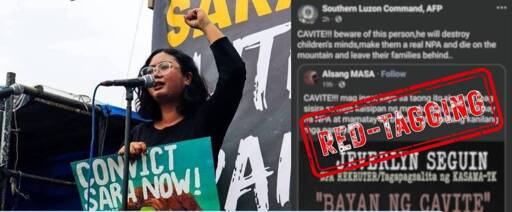
Parallel to the physical harassment is what advocates describe as an aggressive online terror-tagging campaign. At least 20 posts on Facebook pages linked to the NTF-ELCAC have publicly tagged Seguin as a “terrorist,” some carrying explicit threats.
Particularly alarming to rights groups was the sharing of these posts by the official Facebook page of the AFP Southern Luzon Command (SOLCOM), complete with its own red-tagging caption.
Terror-tagging has also appeared offline. Flyers bearing Seguin’s face and accusations against her were found in public spaces and peasant communities in Dasmariñas, Cavite, reinforcing what advocates call a climate of fear.
Supreme Court, UN warnings ignored
The attacks persist despite repeated warnings from both local and international bodies. The Supreme Court of the Philippines has ruled that red-tagging threatens a person’s life, liberty, and security. Yet rights groups say state agencies continue the practice with impunity.
Internationally, Irene Khan, the United Nations special rapporteur on freedom of opinion and expression, has recommended the abolition of the NTF-ELCAC, citing its role in red-tagging and vilification of human rights defenders, journalists, and civil society actors.
For activists, Seguin’s case underscores that the task force functions less as a peace-building body and more as an instrument of repression.
‘If anything happens to me, you know who is responsible’
In a public statement following the discovery of terror-tagging posters in Cavite last November, Seguin said she was no longer surprised.
“I know who is behind this, the NTF-ELCAC and the military who have long made me a target,” she said. Seguin recounted constant surveillance, drones hovering over her roof, intelligence officers tailing her movements, and the incident in Batangas where police allegedly pointed guns at her and fellow researchers.
Seguin acknowledged fear but said anger and resolve outweighed it. “They want to separate me from the masses, from the farmers, fishers, urban poor, and indigenous peoples I serve,” she said. “If anything happens to me, you already know who is responsible.”
A wider pattern of attacks against women organizers
Women’s group GABRIELA Southern Tagalog said Seguin’s case is not an isolated incident but part of a broader pattern of repression against women organizers in the region.
According to the group, women activists particularly peasant, indigenous, and community leaders have increasingly been subjected to surveillance, red-tagging, threats, and fabricated criminal charges.
“These attacks are meant to silence women who lead, who organize, and who challenge injustice,” GABRIELA said. “They are rooted in a militarized and patriarchal system that treats women human rights defenders as enemies of the state.”
Human rights groups stress that repression in Southern Tagalog extends beyond red-tagging campaigns. In Mindoro, indigenous Mangyan communities continue to report grave abuses amid intensified military deployment under counterinsurgency operations.
On December 2, 47-year-old Mangyan Iraya peasant woman Dolores Mariano Solangon was allegedly abducted and tortured by members of the 76th Infantry Battalion of the Philippine Army in Abra de Ilog, Occidental Mindoro.
Solangon recounted that she was tied to a tree, interrogated for hours, forced to dig what appeared to be her own grave, and threatened with death after being accused of being a member of the New People’s Army.
Her case adds to a series of reported abuses in Mindoro, including the killing of farmers later branded by the military as rebels.
Rights group Defend Mindoro said these incidents demonstrate how counterinsurgency operations have inflicted “unmeasurable terror” on indigenous and peasant communities, with women often bearing the brunt of the violence.
Organizing amid crisis
For advocates, the crackdown on organizers like Seguin unfolds amid a deepening rural crisis: landlessness remains widespread, farmers face eviction, agricultural support is lacking, and killings in remote communities persist.
Instead of addressing these issues, they say, the state channels resources into surveillance, vilification, and militarization. “There is nothing criminal about fighting for genuine land reform and basic services,” Defend Southern Tagalog said.
“What is criminal is the use of public funds and armed force to silence those who speak for the oppressed.” they added.
As calls to abolish the NTF-ELCAC grow louder, Seguin’s case has become a rallying point for peasant groups, women’s organizations, and human rights advocates across the region. For them, defending Seguin is inseparable from defending the right to organize, and the shrinking civic space in the Philippine countryside. (RTS, JDS)
The post State forces under NTF-ELCAC, SOLCOM target peasant organizer appeared first on Bulatlat.
From Bulatlat via This RSS Feed.