
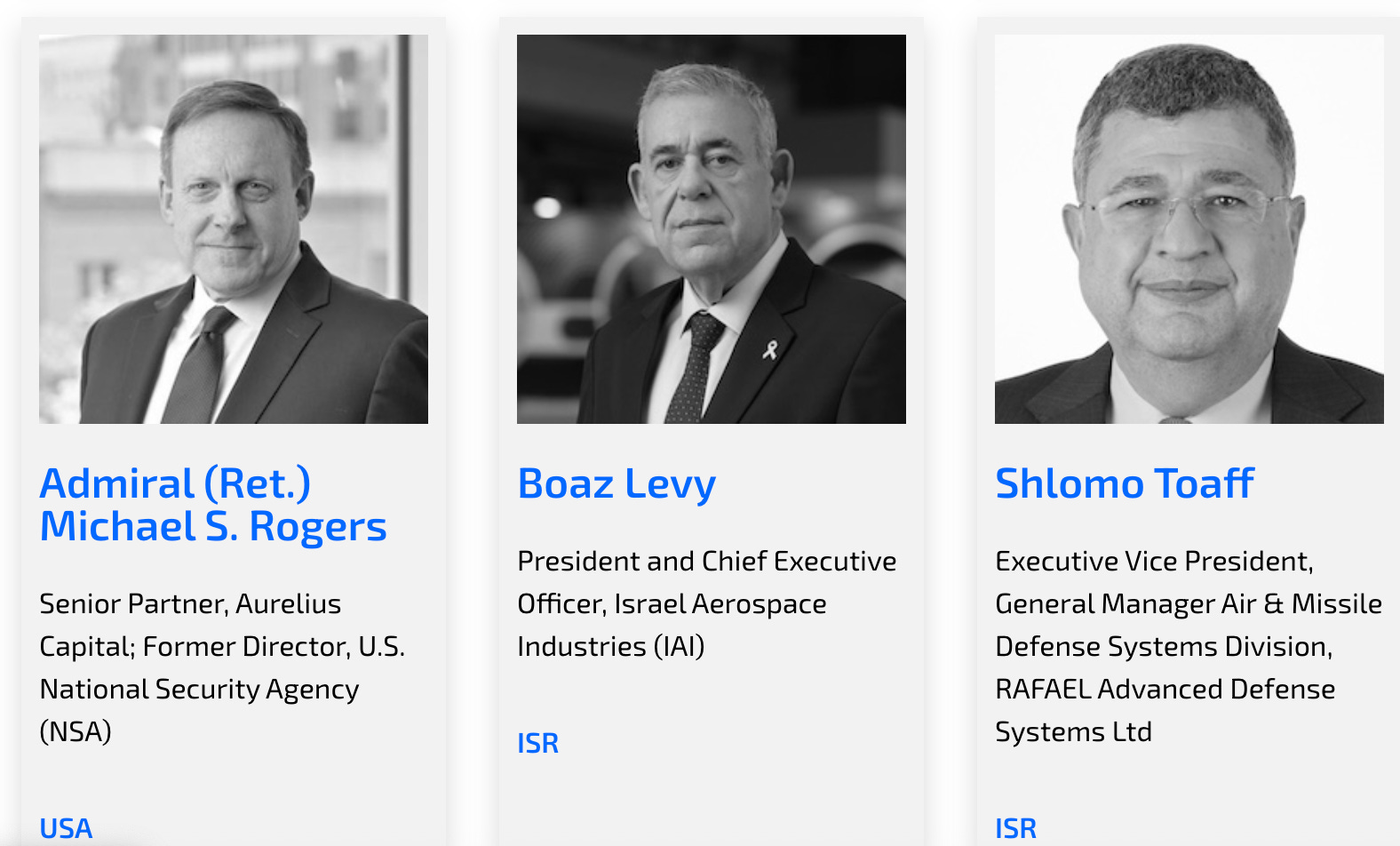
Speakers at this month’s weapons conference in Tel Aviv. Source: DefenseTech-Week.com
At a recent military technology conference in Tel Aviv, Israeli weapons companies made some of their most explicit remarks yet connecting the value of their products to the real-world testing of that firepower on Palestinians in Gaza. A recording of the conference remarks was obtained by Drop Site News and includes comments from the president and CEO of the Israel Aerospace Industries as well as executives at Elbit Systems, RAFAEL Advanced Defense Systems, and others. The conference was called DefenseTech Week and was held in early December. Drop Site shared the audio with independent news outlets in Brazil, Ireland, Australia, and elsewhere; those outlets will be producing their own investigations.
The Israeli weapons industry has previously come in for criticism for its willingness to boast that its products are “lab tested” on human beings under occupation, most prominently by Australian journalist Anthony Lowenstein. His book, The Palestine Laboratory, was adapted into a Drop Site podcast last year.
The newly uncovered remarks suggest that, rather than having been chastened by global condemnation for the genocide in Gaza, the nation’s weapons industry is emboldened by it. “The war that we faced in the last two years enables most of our products to become valid for the rest of the world,” boasted Boaz Levy, head of Israel Aerospace Industries (IAI), on day one of the conference. “Starting with Gaza and moving on to Iran and to Yemen, I would say that many, many products of IAI were there.”
The military itself was well represented at the gathering. Major General (Res.) Amir Baram is director general of the Israel Ministry of Defense and also gave remarks on the first day. “These are not lab projects or powerpoint concepts,” he said. “They are combat proven systems. This is what defense tech means in Israel and this has redefined Israel’s global identity. For years, Israel was known worldwide as a cyber nation. Today, we have evolved into a true defense tech nation.”
Gili Drob-Heistein, executive director of the Blavatnik Interdisciplinary Cyber Research Center, said that the two years of unleashing Israeli weapons technology on Palestinians had helped transition Israel from a “startup nation” to a global player in the defense industry. “Israel is known for being the startup nation and we all believe that defense tech has the potential to become the next big economic engine for Israel and beyond,” he said. “Israel’s technological leadership combined with smartness, boldness, and out of the box thinking continues to yield astonishing results, as we’ve seen recently on the battlefield during a war that was forced upon us on multiple different fronts simultaneously. Many of the technologies have both military and civilian applications.”
Data on global arms sales suggests the boasting at the conference reflects genuine upward trends for Israel’s weapons industry, with three Israeli arms companies increasing their combined weapons revenues by 16 per cent to $16.2 billion, according to the Stockholm International Peace Research Institute (SIPRI). “The growing backlash over Israel’s actions in Gaza seems to have had little impact on interest in Israeli weapons,” said Zubaida Karim, researcher with the SIPRI Military Expenditure and Arms Production Programme.
Elbit Systems, the Israel weapons company that reportedly signed a multi-billion deal with the United Arab Emirates, was also heavily represented at the conference. Executive Vice President Yehoshua Yehuda boasted of “combat proven technologies” that allowed people to be struck even when “the targets are less than a pixel.”
The UAE is financing and arming the Rapid Support Forces in Sudan, a militant group carrying out a campaign of mass slaughter that is on track to eclipse the genocide in Gaza if it hasn’t already.
Israeli weapons are playing an increasing role in global conflict, Levy told the audience. “Eighty percent of our activity is really for export—only 20 percent of our activity goes to the Israeli market,” he said. “I think that all of the things that we learned during this war in Israel impacts our future business capabilities. And IAI as of now has $27 billion of new orders and has something like $7 billion of sales every year.”
At the same time, the weapons makers did acknowledge that a growing boycott was a threat to their business. “I think Israel is experiencing a boycott,” said Shlomo Toaff, executive vice president of the General Manager Air & Missile Defense Systems Division of RAFAEL Advanced Defense Systems Ltd. “We’ve seen it in the Paris air show last June where we were shut down by the French.”
“This is something that we have to take into account when we’re talking about what we’re doing here in the industry,” he said.
From Drop Site News via This RSS Feed.
Oh, Israel’s global identity has definitely been redefined.