

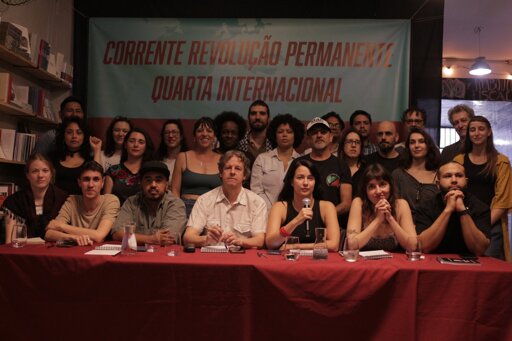
The XIV Conference of the Trotskyist Fraction – Fourth International concluded with a press conference on December 20 at Casa Marx in São Paulo, Brazil. The conference brought together delegations from 17 countries, including Argentina, Brazil, Chile, Uruguay, Peru, Bolivia, Venezuela, Costa Rica, Mexico, the United States, France, Germany, Italy, and the Spanish State, as well as invited organizations from South Korea, Belgium, and Canada. The event marked the relaunch of the international organization under a new name — Permanent Revolution – Current for the Fourth International (PR-CFI) — to reaffirm our strategy as one that is revolutionary, internationalist, anti-imperialist, and class-independent.
The conference began with a historic gathering of over 1,000 people for an internationalist, anti-imperialist, and socialist rally at the Casa de Portugal in São Paulo. The rally, like the other activities and debates that took place throughout the conference, expressed the strengthening and advancement of an international organization that has actively intervened in the most important instances of class struggle at the global level in recent years. This includes the participation of our European organizations — especially among the youth — in mobilizations against the genocide in Palestine and against the repression of pro-Palestine activists, including Anasse Kazib of Révolution Permanente (RP), who is threatened with imprisonment by the French government for his defense of the Palestinian people. We participated in the Global Sumud Flotilla (GSF) to Gaza, with the interventions of Bruno Gilga of the Revolutionary Workers’ Movement (MRT) in Brazil — who was a spokesperson for the Brazilian delegation and helped crew one of the flotilla’s ships before being intercepted by the IDF — and Pablo Castilla of the CRT in Spain — who acted as a GSF spokesperson for Barcelona on land.
Rooted in these interventions in class struggle, the PR-CFI reaffirmed the need for broad unity of the working class and social movements to denounce and reject the imperialist offensive against Venezuela, defending a consistent anti-imperialist position without any confidence in or political support for Nicolás Maduro’s government.
At the opening of the press conference, Diana Assunção, leader of the MRT in Brazil, set the political context of the conference, saying that it was convened at “a time of great international turmoil, with many attacks by imperialism and the genocide in Palestine, but also processes of class struggle in various parts of the world.” Faced with a reactionary offensive at the international level, she emphasized that “it is very important that revolutionaries from various countries around the world have come together to discuss the paths forward for the struggles of the working class.”

Assunção announced two central resolutions approved by the conference. First, that “we have decided to relaunch our international organization […] We are now the “Permanent Revolution Current for the Fourth International.” Second, she gave weight to the central importance of “strengthening a movement for an international for socialist revolution,” stating that as part of this task the PR-CFI will draft a manifesto addressed not only to revolutionary organizations, but also to the workers and young people who have led the great struggles of recent times. The manifesto will be written by a commission that includes members of the PR-CFI alongside members of Movement to Socialism (MTS) of South Korea and other militants from the Spanish State.
Next, Cristian Castillo, a national representative of the Partido de Trabajadores Socialistas (PTS) in the Left and Workers’ Front – Unity (FIT-U) in Argentina, highlighted that the international situation is marked by the dispute between the United States and China, militarism, and increasing levels of class struggle. For him, the conference was action-oriented, bringing together activists who “are intervening and preparing to intervene in the struggles in their countries,” such as in the mobilizations against Javier Milei’s labor reform in Argentina. Castillo stressed:
[T]he Far Right will not be stopped by attempts to give capitalism a friendlier face. On the contrary, what we have seen is that these attempts have resulted in the resurgence of right-wing forces. We saw this in Argentina, where, after the failure of the Peronist government, we ended up with Milei. It can also be seen in Chile, where Boric’s government was followed by the victory of José Antonio Kast.
What we need to do is prepare for class struggle to transform from real popular uprisings into social revolutions that will allow us to change the course of the catastrophe that this system is leading us towards.
Castillo went on to say that part of this task is the construction of ”an international, revolutionary leadership of the working class.” In this context, he announced a central resolution of the conference: “We vote for a strong anti-imperialist campaign against Trump’s blockade and military aggression against Venezuela,” emphasizing that while the PR-CFI is a left-wing opposition to the Maduro government, it must resolutely stand “at the forefront of anti-imperialist struggle.”

From France, Elsa Marcel explained the debates and the campaign we have been carrying out against the advance of rearmament and militarization in Europe, stating that “we are witnessing increased military budgets and extremely severe cuts to healthcare, education, and public services.” She reaffirmed the PR-CFI’s position on the war in Ukraine — “neither Putin nor NATO” — and pointed to recent strikes and workers’ mobilizations as demonstrations of the working class’s strength against the machine of war.

Marcelo Pablito, from the MRT, deepened the debate on anti-imperialism and anti-racism, emphasizing that these issues occupied a central place in the conference. He railed against the fact that “the Far Right celebrates the hundreds of deaths of young Black people and the police violence we see here in Brazil” and highlighted the situation on the African continent, defending “the non-payment of external debt, expropriation without compensation and under workers’ control of all natural resources,“ and ”the release of political prisoners from the uprisings that took place in Angola, Mozambique, Ghana, Kenya, Guinea-Bissau, and Madagascar.” He also denounced the role of the Brazilian government in Africa: ”MONUSCO and all troops out of the Democratic Republic of Congo!”

Anasse Kazib, a French railway worker from Révolution Permanente, stated that the PR-CFI is rooted in “intervention in class struggle,” pointing to a history of international workers’ militancy, including the experience of Zanon, a factory under workers’ control in Argentina, whose historic leader, Raúl Godoy, was one of the delegates to the conference; he also referenced the struggle of workers at the Garrahan hospital in Argentina, and the current strike by Petrobras workers in Brazil. It is a central part of the strategy of the Trotskyist Faction — now the Permanent Revolution Current for the Fourth International — to develop “self-organization, strike committees, and the independence of the working class” in the face of union bureaucracies and strategies of class collaboration.

From Germany, Tabea Winter warned against the criminalization of solidarity with Palestine. She referenced the PR-CFI’s campaign against the repression of Palestinian activists, demanding “freedom for all activists and freedom for Palestine.” She cited cases such as those of Palestine Action militants on hunger strike in the United Kingdom and activists facing legal proceedings in France, such as our comrade Anasse Kazib.

Pablo Castilla, from the CRT in Spain, stressed that “the genocide against the Palestinian people has not been stopped, it continues.” He denounced the complicity of the United States, European powers, and Arab bourgeoisies. He explained how the struggle for Palestinian liberation is that of “a free and socialist Palestine, from the river to the sea.” Castilla also highlighted the role of young people in recent processes of class struggle and announced the drafting of an international youth manifesto based on “class independence,” “self-organization from below,” and unity between the youth and the working class.

The press conference reflected the depth of the debates that took place at the PR-CFI’s recent conference and emphasized the current’s central tasks: to reinforce anti-imperialist struggles — with an emphasis on the campaign against the aggression against the Venezuelan people and against European militarization — to strengthen the self-organization of workers and youth against class collaboration, and to advance in the construction of an international revolutionary organization. In closing, Diana Assunção reaffirmed the importance of the international socialist feminist organization “Bread and Roses.” She also highlighted the role of PR-CFI’s international network of publications — La Red Internacional — as a tool for the international struggles of the working class; she called on all those watching to read all the materials from the conference that will be published throughout the network, including in English on Left Voice.
This includes a resolution to build an English-language website for Asian countries. This proposal was made by comrades from March to Socialism (MTS) in South Korea as part of a rich discussion that addressed, among other elements, how the theory of “permanent revolution” remains an indispensable tool for addressing the task of building a revolutionary party among the sweeping Asian working class.
Finally, the press conference announced that in the coming days new articles will be published across La Red Internacional that elaborate on the debates held throughout the conference. These texts will give an account of the rich political and strategic debate between the delegations. This includes addressing in greater depth how to confront the obstacles posed by union bureaucracies; it also includes the need to revive the tactic of the “workers’ united front” and a critique of the strategy of the “anti-imperialist united front” advocated for by other sectors of the Left, which implies political unity with bourgeois sectors.
These upcoming publications will also revisit theoretical and strategic debates that were at the center of the conference, such as the relevance of “action committees,” revisiting Trotsky’s elaborations on France, and how these categories change given the current state of class struggle. Other articles will present the resolutions that were approved at the conference, which enriched and clarified various aspects of the conference’s preparatory documents, both in terms of the analysis of the international situation and the characterization of China, as well as the common political orientation defended by all the organizations that make up the PR-CFI. As part of this intense political and theoretical effort, it was also decided to hold a major public international seminar on the theory of permanent revolution and its applications in the twenty-first century.
These articles will seek to systematically reflect on how these debates relate to the concrete challenges of intervention in class struggle today, reaffirming a strategy of class independence, self-organization of workers, and the construction of an international revolutionary alternative capable of responding to the crises, wars, and confrontations that mark the current world situation.

The post Venezuela, Class Struggle, Palestine: Report from the 14th Conference of Permanent Revolution – CFI appeared first on Left Voice.
From Left Voice via This RSS Feed.