

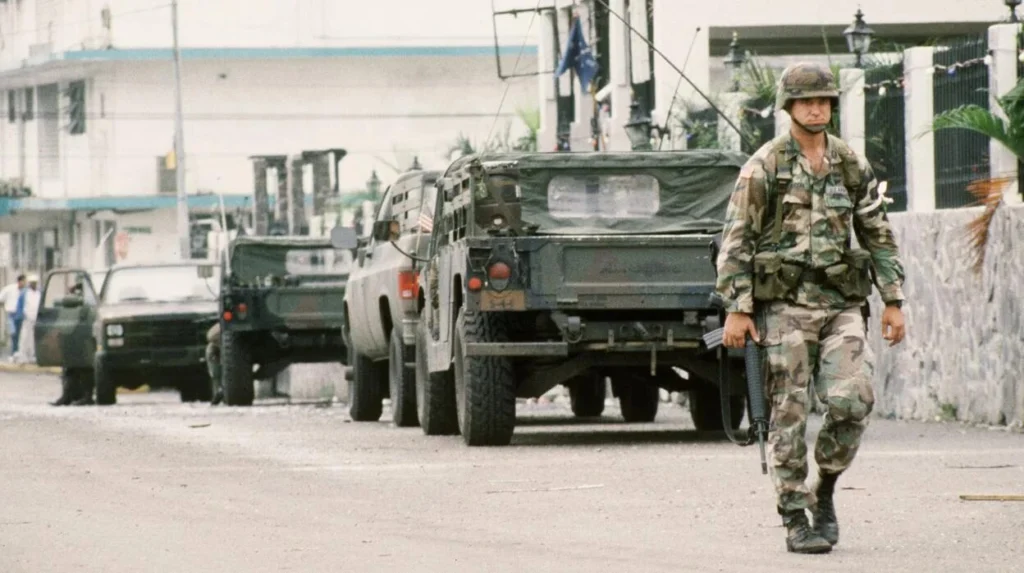
Unmasking the geopolitical lies and civilian massacres of “Operation Just Cause.”
December 1989 is remembered in Panama not as a month of peace, but as one of fire and destruction. That December ended with the roar of U.S. bombers tearing through the night sky and the suffocating smell of burning neighborhoods across Panama City.
RELATED:
Zone of Peace: Panamanian Organizations Reject US Military Deployment in the Caribbean Sea
The U.S. invasion, codenamed “Operation Just Cause”, was presented by Washington as an effort to “restore democracy” and capture a rogue dictator.
Yet behind this facade of humanitarian intervention lay something far older and more cynical: the geopolitics of the imperial “Big Stick.”
Far from a rescue operation, the invasion represented the first post-Cold War experiment in “shock and awe” warfare—a public display of U.S. military might intend to reaffirm control over the most strategic waterway in the Western Hemisphere.
On this day in 1989, 27,000 American troops invade Panama to topple the dictator and former U.S. ally Manuel Noriega. The global community condemns the operation as a violation of international law. pic.twitter.com/D1tvQDmmpO
— Military History Now (@MilHistNow) December 20, 2025
Treaties and the Shadow of Torrijos
To understand the 1989 invasion, it is essential to first comprehend Panama’s ongoing struggle for sovereignty.
Since 1903, the Panama Canal Zone had functioned as a U.S. colonial enclave—a ten-mile-wide strip of occupied territory where Panamanian law didn’t apply and where American military bases kept watch over the population.
For decades, this “state within a state” fed a deep, generational resistance. The turning point came under General Omar Torrijos, a nationalist leader who galvanized the country’s demand for self-determination.
After years of diplomatic confrontation, Torrijos succeeded in forcing Washington to the negotiating table.
The Torrijos–Carter Treaties of 1977 guaranteed the return of the Panama Canal to Panamanian control by 2000, marking a victory for national dignity.
However, the treaty’s “neutrality clause” granted the U.S. the right to intervene militarily if the Canal’s security was threatened, providing future legal justification for action.
After Torrijos’s mysterious death in a 1981 plane crash, Washington’s commitment to the treaty began to erode. The U.S. political establishment regretted ceding control of such a strategic artery and soon sought a pretext to reassert its dominance. That pretext would come in the form of a man the CIA had long cultivated: Manuel Noriega.
On this day in 1989, George H.W. Bush ordered 27,000 troops to invade Panama to overthrow former CIA asset Manuel Noriega, ki!!ing 5,000 people, dumping bodies in mass graves, and destroying thousands of homes. pic.twitter.com/JEgLvFFrVJ
— Friendly Neighborhood Comrade (@SpiritofLenin) December 20, 2024
The Creation and Betrayal of Manuel Noriega
The story of Manuel Noriega is not one of spontaneous corruption but of deliberate U.S. engineering. A graduate of the infamous School of the Americas, Noriega rose through Panama’s military ranks with the backing of U.S. intelligence.
For decades, he served as Washington’s key informant in Central America—facilitating espionage, counter-insurgency, and the fight against leftist movements from Guatemala to Nicaragua.
But the alliance began to fracture when Noriega started asserting political independence. His discreet cooperation with Cuba and Sandinista Nicaragua to bypass U.S. embargoes marked him as unreliable in Washington’s eyes.
As the Cold War waned, the Reagan and Bush administrations sought new justifications for intervention. They found it in the emerging banner of the “War on Drugs.” Noriega’s involvement in drug trafficking—long known to U.S. intelligence—suddenly became the moral pretext for invasion.
The same agencies that once protected him now branded him a “narco-dictator,” transforming a former ally into a symbolic enemy. His fall served as a moral spectacle through which the United States could reaffirm its global reach at the dawn of the 1990s.
🇵🇦The U.S. invasion of Panama began on December 20, 1989, and over five weeks caused the deaths of 2,000 Panamanians, mostly civilians. The U.S. captured the local dictator, long a CIA asset.🇺🇸Manuel Noriega had become too troublesome to keep the canal under U.S. control overall. pic.twitter.com/XibsTR8IDE
— Adrian Thomas (@AdrianThomas90) December 20, 2025
December 20: Urban Warfare and the Resistance of El Chorrillo
On the night of December 20, 1989, the “Big Stick” returned in full force. Over 26,000 U.S. troops, supported by stealth aircraft, tanks, and helicopters, descended upon Panama in what the Pentagon claimed was a swift, surgical operation. In reality, it was one of the most lopsided assaults in modern Latin American history.
While the declared mission was to capture Noriega, the heaviest blows fell on civilians—especially in the working-class neighborhood of El Chorrillo, located near the Panamanian Defense Forces headquarters.
This community, known as a bastion of popular resistance, became a symbol of defiance. Members of the Dignity Battalions—militias of workers, students, and peasants—attempted to resist the invasion.
The U.S. military responded with overwhelming firepower: tanks rolled through narrow alleys, helicopters opened fire from above, and flamethrowers turned homes into infernos.
Survivor testimonies tell of atrocities that official reports have long sanitized. One often-cited account recalls:
“I saw tanks crushing cars with people still inside. When the firing stopped, soldiers walked around with flamethrowers, burning what was left. If anyone moved in the rubble, they shot. They didn’t want witnesses—they wanted silence.”
By the morning, El Chorrillo lay in ashes. The operation did not achieve the restoration of democracy, but the decimation of a neighborhood whose only crime was its nationalist pride.
36 years ago, the US invaded Panama.
Declassified files reveal the UK government understood Washington’s invasion was illegal but supported it anyway👇https://t.co/MbYHMYJKc6
— Declassified UK (@declassifiedUK) December 21, 2025
The Human Cost: Mass Graves and Official Silence
Perhaps the invasion’s greatest crime lies in the deliberate erasure of its victims. For decades, official U.S. accounts claimed just over 200 civilian deaths, dismissed as “collateral damage.”
Yet independent investigations, including those led by former U.S. Attorney General Ramsey Clark, suggest the real number may reach 7,000.
Survivors reported the existence of mass graves, where bodies were secretly buried to conceal the scale of civilian killings. Eyewitnesses describe trucks loading corpses in the night and soldiers forbidding families from recovering their dead.
Grassroots groups, including the Association of Relatives and Friends of the Fallen of December 20, continue to demand accountability. They fight for exhumations, truth commissions, and recognition of the invasion as a crime against humanity.
Between 15,000 and 20,000 people were left homeless, many housed in military-run camps built on the ruins of their own neighborhoods.
This displacement—social, cultural, and psychological—was not incidental. It was a calculated act to dismantle the most politically conscious sectors of Panamanian society.
The Wound of Sovereignty and the Call for Reparations
The invasion of Panama remains one of the most glaring violations of Latin American sovereignty in modern history. By installing Guillermo Endara—who was sworn in at a U.S. military base—as president, Washington sent a clear warning: resistance would be met with annihilation.
The political legacy was the birth of a “captured democracy”, where sovereignty was subordinated to neoliberal reforms and U.S. influence. The nationalist ideals of Torrijos were replaced by market-friendly policies aligned with Washington’s global agenda.
Economically, the invasion paved the way for urban gentrification. El Chorrillo has since been rebuilt, but the reconstruction erased much of the visible evidence of the massacre. The wounds, however, remain etched in the collective memory of its people.
Today, Panamanians continue to demand historical reparations and international recognition of the invasion as an unlawful act of aggression. The movement has gained growing support from regional organizations and international human rights forums.
The deeper lesson is that the “Big Stick” never disappeared. It merely evolved—shifting from open invasions to economic and diplomatic coercion. Panama’s tragedy stands as a warning for all of Latin America: imperial logic adapts, but it never apologizes.
Sources: teleSUR – Al Jazeera – Britannica encyclopedia – New York Times – The Economist – BBC – CEPAL – Dialnet – La Estrella de Panamá
From teleSUR English via This RSS Feed.