



Hello from Red Star! Curious about what we’ve been up to? Read on to find out!
Fund the Base, Build the Party
As Red Star, we believe in DSA! Our broad membership, organizing ethic, and robust democratic processes make this organization the best incubator for the vanguard party, the proven vehicle to struggle for socialism. Chapters are the fundamental sites of work for the movement, serving as workshops of democracy and struggle. They offer the most effective means of bringing in advanced sections of the working class most impacted by capitalism and imperialism through their anti-ICE actions, Palestinian solidarity, mutual aid, and more. At the same time, a strong national organization that can draw together the experience of our organizers across chapters is crucial for the development of the movement and the struggle to smash capitalism and build socialism.
Toward this end, we proudly support the following initiatives to direct resources to chapters and empower their organizing, while maintaining a sustainable and effective national DSA. Some of these have already been taken up at the most recent NPC meeting, while others will be considered at the next NPC meeting in January.
Chapter Grants and Incentives
We believe national DSA plays a key role in boosting the development of chapters and leaders across the country. That’s why we’re proposing a Grants and Incentives Program for Organizing and Events funded with $300,000 from the 2026 budget. This targeted support will be used to support proven strategies that promote the health and development of chapters while helping them develop tangible goals.
Office Matching Funds
Chapter offices provide critical infrastructure to plan campaigns, centralize chapter meetings, store materials, and more. Chapters like San Francisco have gotten a real shot-in-the-arm from their experience setting up chapter offices. Establishing a home base maximizes chapter capacity to run labor and electoral campaigns, store and distribute mutual aid supplies, and serve as a hub for anti-imperialist and anti-ICE organizing.
DSA has already earmarked $64,300 in Office Matching Funds that have yet to be disbursed. Red Star is leading the effort to unlock these funds, and the NPC recently adopted our member Hazel W’s proposal to relaunch the Office Funds Matching Program. This resolution provides even more chapters the opportunity to embed themselves in their communities and engage in more impactful and sustainable organizing.
This reinvigorated program will be administered by the DSA Growth & Development Committee’s new Matching Funds subcommittee, consisting of Hazel W., two staff members, recipients of prior matching funds, and members from the NPC and GDC Steering Committee. The grants will be awarded in a lump sum payment covering 50% of the first year’s office rent cost, with a cap of $15,000 per chapter. The Matching Funds subcommittee will happily guide chapters through the process of applying for and sustaining a lease agreement. Interest forms are due to go out by the end of the year. Hazel has proposed an ambitious plan to get these funds to chapters within the next 6 months as well as help them secure and maintain their office space, and is also working on a plan to increase funding for this program in 2026. See the DSA discussion board for further updates!
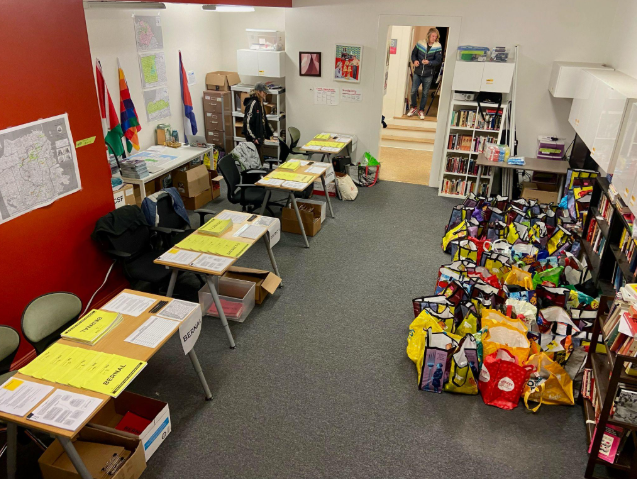
In 2022 DSA San Francisco used its office as a home base for its People First San Francisco Ballot Measure Campaign which won the strongest vacancy tax in the country.
Chapter Holiday Bonus
DSA has $224,000 in unused surplus from the 2025 budget that would go into reserves if unspent. Red Star proposed a one-time ‘Holiday Organizing Bonus’ fund that would have disbursed $152,000 to chapters and $72,000 for staff bonuses, putting more money directly in the hands of chapters to help their local organizing efforts. Unfortunately this proposal was voted down by a majority of the NPC at the December NPC meeting.
State of the Budget
During the last term Red Star led the NPC through the difficult task of balancing the budget and steering us away from the brink of bankruptcy. The reason we came so close to the brink is that we spent down our surplus during a membership upswing. Now, DSA finds itself in a favorable financial position with reduced expenses and increased dues from a rapidly growing membership. As it stands, DSA has a projected budget surplus for 2026. However, it’s a basic fact that throughout DSA’s history our membership has surged and declined as the political winds shift. We must learn from this past experience and ensure we remain financially stable over time.
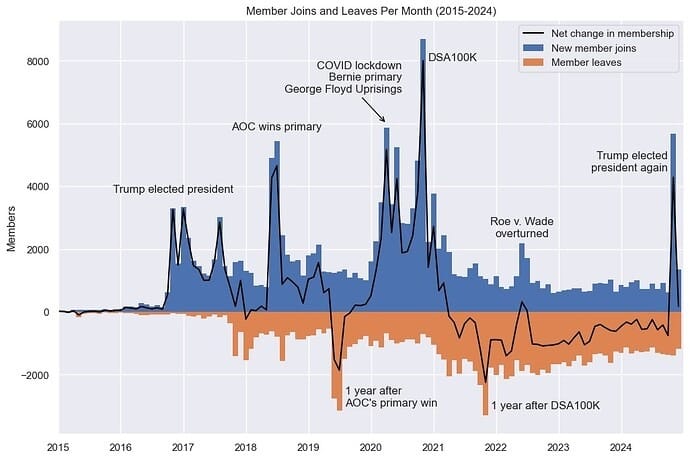
Some in DSA would have us burn through the entirety of our hard-won surplus through excessive hiring and overspending, leading us back to the brink of financial instability and the same budget crisis we faced last term.
We advocate for an approach that resources chapters while leveraging the coordinating and centralizing role that the national organization can play in building the party, while preserving financial reserves in case of a membership decline or lawfare from an emboldened Trump administration.
The resolutions we offer serve as an extension of our 2025 convention campaign vision for a stronger, more intentional DSA that drives effective support for local organizing from a strong national position. We encourage comrades to review the full resolution texts, share your thoughts, and let us know how your chapter could benefit.
Red Star in the Spotlight: Our Members Share their Socialist Analysis
Since our last newsletter, Red Star members have been actively engaging with the broader Left, contributing vital socialist perspectives on a range of critical issues.
Megan Romer on BreakThrough News!
National DSA Co-chair and Red Star member Megan Romer appeared on Breakthrough News along with Ashik S. to discuss Zohran Mamdani, elected member accountability, the impending war on Venezuela, and the project of party-building. Here is some of Megan’s commentary:
On the differences between Mamdani, AOC, and Bernie Sanders:
“I think that actually organizing is what develops our politics, and so that’s why we see sort of a different crop of organizer-politicians coming out in the last couple of cycles… AOC had come out of an NGO organizing milieu… you go another few years and you get people who had come up through organizing.” [7:44]
On Mamdani’s unique advantages as an organizer-politician:
“Coming out of that organizing milieu is going to mean, not only a powerful political machine ability, but also the constant and regular feedback that lets you really be a politician of the people and really hear from the folks that you’re there to represent.” [10:07]
On the importance of party-building to prepare for rupture:
“There was this mass protest around Black Lives Matter, and what ended up coming out of it was worse police conditions in just about every American city because we didn’t have…that party ready to step in and change things. That’s what happens, we have these moments of rupture – we’re in one – we’re not there yet to be that party that can really shift everything as much as we want to.” [19:13]
Watch the full interview here!
John Lewis in the New York Times
NPC and Red Star member John Lewis was quoted in an article in the New York Times this week about the recent DSA Fund conference in New Orleans. The article focuses on the surge of energy flowing through DSA in the aftermath of the Mamdani victory, our various campaigns to challenge the power of capitalists, our organizational disagreements, our struggle to hold elected members accountable, and our cultural idiosyncrasies.
John Lewis on DSA’s inevitable conflict with the Democratic Party
“The momentum of the Democratic Party is captured by mass finance capital, people that we call the oligarchs. Whether we’re going to realign the Democratic Party, whether we’re making a socialist party, whatever your path is, if you’re going against that momentum, it still is antagonistic.”
Read the full article here (non-paywalled)!
Andy M., a leader on the DSA International Committee and the IC Mexico Working Group, recently led an effort to facilitate larger political exchanges between DSA and MORENA. Andy and the IC Mexico WG connected MORENA representatives traveling around the US with local DSA chapters and Mexican communities, and set up two panels with DSA and MORENA electeds. Read more about this project in Andy’s report for Democratic Left!
Ashwin R., a member of River Valley DSA, the International Committee, and Red Star, has written an excellent piece for Socialist Forum about Mexico City’s “Units for Transformation and Organization for Inclusion and Social Harmony”, or UTOPIAs, city-supported havens for working-class people to access healthcare, social services, harm reduction for drug users, services for women facing domestic violence, support for queer and trans folks, classes teaching feminist values to men, and even free spaces for residents to make art, enjoy leisure, and learn new skills. Ashwin digs deep into MORENA Mayor Clara Brugada’s initiative in supporting these projects, the Urban Popular Movement that gave rise to them, and the lessons the American left can glean from the nearly unqualified success of the UTOPIAs. Read the full piece here on Socialist Forum.
Red Star’s “Reading Now”
Red Star members just finished a group study of J. Moufawad-Paul’s 2022 book “Politics in Command”, an analysis of how the errors of economism distort the project of left-wing organizing in the West, with a particular focus on the U.S. and Canada. Moufawad-Paul, one of the leading theorists of the Maoist current in the Anglophone world, examines how a set of unspoken assumptions about the working class and revolutionary consciousness undermine the development of communist formations and praxis. Moufawad-Paul defines economism to mean the error of pursuing a “better deal” for workers under capitalism at the expense of a revolutionary project to overthrow capitalism. He contends that the proletariat is not found, but formed, and that it is shaped not just by the experience of wage-labor but by a number of other social realities like imperialism, sexism, and racism.
Moufawad-Paul further challenges the assumption that the working class must develop trade union consciousness before it can develop into a class-for-itself, saying that this assumption inherently limits the horizon of worker struggle, letting it play out on the field of day-to-day workplace grievances, contract fights, and through the logic of chauvinisms related to trade, nation, and even race. Even committed communists are at great risk of becoming economists through their struggle in trade union organizations, Moufawad-Paul argues, as economistic demands are central to their role as trade union leaders under capitalism. He points to an alternative strategy, arguing for the necessity of forming an organization led by the segments of the working class with a proletarian subjectivity, as well as the necessity of inquiry and investigation, rather than a tailist orientation toward the NLRA-era labor movement that will not advance from trade-union parochialism to revolutionary militancy without conscious intervention.
Dive into the text yourself using the free PDF available here.
Monthly Quote
In celebration of Mao Zedong’s 132nd birthday coming up on Dec. 26th, this month’s quote comes from a Mao speech professing how collective action can prevail against impossible odds.
“Today, two big mountains lie like a dead weight on the Chinese people. One is imperialism, the other is feudalism. The Chinese Communist Party has long made up its mind to dig them up. We must persevere and work unceasingly, and we, too, will touch God’s heart. Our God is none other than the masses of the Chinese people. If they stand up and dig together with us, why can’t these two mountains be cleared away”
- Mao Zedong, June 11th, 1945, at the 7th Congress of the Communist Party of China
Recipe Korner
This month, Andrew D. Is sharing a cozy recipe perfect for the Holiday season.
Recipe for Congee (Rice Porridge)
This is barely a recipe. It’s more like a technique and a very very flexible one at that. This will almost definitely take less than an hour total with only a few minutes of active preparation at the start.
Congee! Easy, cheap, warm and filling, meal prep-friendly, accessible with or without special tools (rice cooker), and you can’t really overcook it. To me, this is a perfect cozy-season staple that can be ramped up and down in complexity as time allows.
Ingredients
You need three components and the last one is optional.
- Lots of liquid: water, chicken broth, vegetable stock, water from soaking dried shitake mushroom, water with a bouillon cube
- A little rice: medium grain is “best” but long and short grain both will work.
- Optionally substitute some or all of the rice with millet.
- Optionally add lentils to add more body and protein, probably red, the faster-cooking the better
- And almost anything else that you want
- Chicken: cooked or raw (just make sure you cook longer to compensate)
- Greens: softer greens added at the end, heartier greens added earlier
- Dash of (dark) soy sauce
- Dried shitake mushrooms that you rehydrated overnight, chopped up into halves or quarters
- Chinese sausage (lap cheong/lap chong)
- Frozen veggies: especially mixed peas and carrots
- Aromatics: garlic, ginger, scallions
- Garnish with scallions, sesame oil, chili oil
- Sweet options: dried goji berries and dried dates
We are going to use a ~1:20 ratio of rice to water by volume. You can adjust this to your preference for a thick or thin porridge. The addition of millet or lentils will also change the consistency. Experiment! It’s hard to go wrong and you can always adjust on the fly.
Leftover rice is also a great shortcut. You won’t need as much liquid — closer to a 1:4 consistency of cooked rice to liquid.

Photo: Food & Wine Magazine
Pro-tip: to make this recipe foolproof, make sure your cooking vessel has plenty of extra space. If you find that the consistency is too thick, you can always add more liquid as you cook to thin it out.
Steps
Rice Cooker
If you are using a rice cooker with a porridge setting, follow those instructions (including measurements), adding any additions whenever is appropriate (meat cooked and raw at the beginning, tender greens near the end).
If your rice cooker does not have a porridge setting, I hear that you can make porridge with the lid removed but I have not tried it personally.
Stove top
- Wash your rice if that’s important to you. We aren’t concerned about washing away the excess starch because we are about to add a lot of water.
- All rice and liquid and optional longer-cooking additions to a pot
- Longer cooking additions include: meat, heartier greens, garlic, ginger, dried anything
- Bring to a simmer
- Cook for 45-60 minutes stirring occasionally. Whenever the consistency is to your liking and everything is cooked, it’s ready to go. Don’t worry about “overcooking” the rice: textures range from watery rice to almost full mush.
Storage
Congee stores well in the fridge and freezes extremely well. To reheat, add a little bit of water and microwave.
Andrew’s go-to savory version
I’m blessed to have a rice cooker with a porridge setting. It’s easily one of my most-used kitchen tools. I will regularly go through periods where I eat some variation of the following a few times a week.
- Liquid: Chicken broth from a rotisserie chicken
- Rice: Rice with some millet
- With added
- Chicken
- Chinese sausage
- Shitake mushroom
- Sliced ginger
- Garnish with scallions, chili crisp, sesame oil
- Side of fried dace with black bean, sliced cucumber
From Red Star via This RSS Feed.