

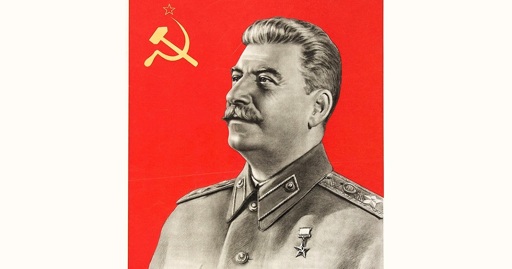

By Nikos Mottas
No political figure of the twentieth century has been attacked with such persistence, intensity, and ideological unanimity as Joseph Stalin. From conservative anticommunism to liberal moralism and large parts of the so-called “democratic” left and various anti-Stalinist currents (Trotskyists, Eurocommunists, and related tendencies), hostility to Stalin functions as a shared point of convergence. This is not the result of historical curiosity or ethical sensitivity. It is a political necessity.
Stalin is targeted not primarily for what he did, but for what he represents: the most advanced historical challenge ever posed to capitalism and imperialism.
1. Stalin is identified with the durability of socialism
Under Joseph Stalin, socialism ceased to be a fragile revolutionary experiment and became a functioning social system. It survived civil war, blockade, and imperialist encirclement. For bourgeois ideology, this is intolerable. If socialism proved capable of stability, then capitalism loses its claim to historical inevitability. Stalin must therefore be discredited as a way to discredit socialist construction itself.
2. He symbolizes the abolition of capitalist property
The Soviet Union under Stalin completed the expropriation of the bourgeoisie and landlords on a scale unprecedented in history. This strikes at the sacred core of bourgeois society: private ownership of the means of production. Demonizing Stalin serves as a permanent warning against any attempt to repeat this rupture.
3. He presided over non-capitalist industrialization
The rapid industrialization of the USSR in the 1930s—achieved without colonial plunder, foreign capital, or financial dependence—refuted the dogma that only capitalism can modernize societies. Bourgeois historiography cannot integrate this fact without undermining its own theoretical foundations. It therefore explains it away through moralization.
4. He embodies the decisive defeat of fascism
Stalin cannot be separated from the Soviet victory over Nazism. This victory shattered the myth that liberal capitalism was the main historical antagonist of fascism. The central role of the Red Army exposes uncomfortable truths about class alliances, war economies, and imperialist calculations. Hence the constant effort to relativize or depoliticize that victory.
5. He rejected subordination to the imperialist system
Unlike later revisionist or reformist leaderships, Stalin’s USSR did not seek “integration” into the capitalist world market on imperialist terms. Economic sovereignty and political independence were non-negotiable. For imperialism, such a stance is unforgivable and must be retrospectively criminalized.
6. He upheld the dictatorship of the proletariat
Stalin openly defended the principle that the working class must exercise state power against hostile classes. Bourgeois historiography reframes this as mere “authoritarianism,” erasing the class content of the state. The aim is to present capitalist democracy as neutral, while delegitimizing any revolutionary alternative.
7. He exposes the class nature of liberalism
By refusing the fiction of class harmony, Stalin’s politics reveal liberalism as a system of bourgeois domination disguised as pluralism. The hatred directed at Stalin is, in part, hatred toward this exposure. Liberal ideology cannot tolerate being unmasked.
8. He serves as a scapegoat for complex historical contradictions
Imperialist encirclement, inherited backwardness, civil war devastation, and intense class struggle are reduced to a single moral narrative: “Stalin.” This personalization allows bourgeois historians to avoid serious materialist analysis and to replace history with moral pedagogy.
9. He represents continuity with October and Leninism
Stalin stands in direct historical continuity with the October Revolution and Lenin’s strategic framework. For both the right and the reformist left, breaking this continuity is essential. If Stalin is presented as a “betrayal,” then revolution itself can be dismissed as inherently pathological.
10. He remains a symbol of irreconcilable class struggle
Ultimately, Stalin is attacked because he represents a politics that does not seek reconciliation with exploitation. Anti-communism—whether conservative, liberal, or “left”—is united by the need to suppress this perspective. Stalin concentrates this fear into a single historical figure.
So, therefore…
The obsession with Stalin is not about the past. It is about the future. As long as capitalism remains historically vulnerable, it must relentlessly attack the most powerful example of its overthrow. Stalin is targeted not because history ended with him, but because history did not.
* Nikos Mottas is the Editor-in-Chief of In Defense of Communism.
From In Defense of Communism via This RSS Feed.
Yeah? Stalin was a monster.
Agree. The death of millions of people is mysterious not mentioned
Which millions?
Making the assumption you’re uninformed rather a troll. Great Purgewhich is discounting the millions starved in by agricultural policies and the associated upheaval
Bingo. He was at best a paranoid dictator who crushed dissent in a violent fashion. Who in typical autocratic nature, didn’t have the rules apply to him, while millions starved. He was a horrible person, and not someone who should be idolized.