

Bullets:
In surveys of nations across the world, strong majorities share deeply negative views of the United States and Israel.
China, on the other hand, is now preferred to the United States in most of the countries surveyed, even in what were previously strong allies.
These massive shifts in public opinion are undermining attempts by Washington to sign trade deals with resource-rich countries, especially for rare-earth minerals that the Pentagon desperately needs to rebuild badly depleted missile and munitions stockpiles.
Inside China / Business is a reader-supported publication. To receive new posts and support my work, consider becoming a free or paid subscriber.
For the YouTube video for this report:
Report:
Good morning.
Popular support for the United States is in free fall, across the world. And this comes at a time when American diplomats are booking flights and meetings, trying to lock up trade deals that give US firms access to other countries’ rare earth deposits.
The problems are at the top down, in global surveys of attitudes toward President Trump himself. They surveyed citizens in 24 countries, and asked if they have confidence in Donald Trump to do the right thing regarding world affairs. Big drops were noted for Mexico, Poland, and Canada:

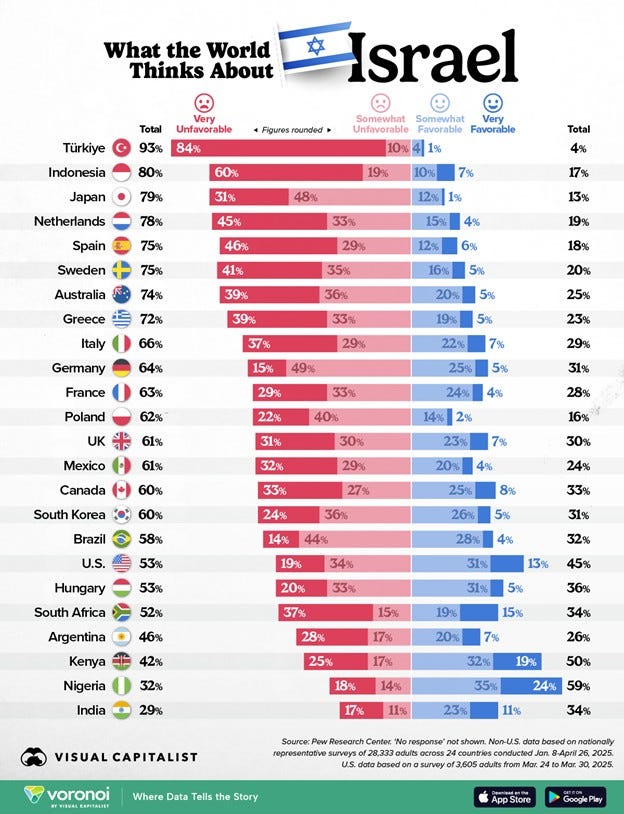
Nigerians gave him the highest score—79% of Nigerians believe so. He’s also popular in Israel, with 69% of Israelis sharing confidence in Trump. But that in itself is a double-edged sword: Israel and Türkiye are in the Middle East, and allied—notionally anyway-. Israel is 69% confident. Türkiye, a NATO country, is 80% the other way. Public perception of Washington is in steep decline across the world, but for Tel Aviv it’s collapsed completely:
These data are just as bad, surveys of over a hundred thousand people in a hundred countries. China is more popular across the world, than the United States, starting last year and accelerating since. Here is a map of that survey. Apparently, they didn’t ask the Russians or the Mongolians because no doubt those would be red. Iran too:
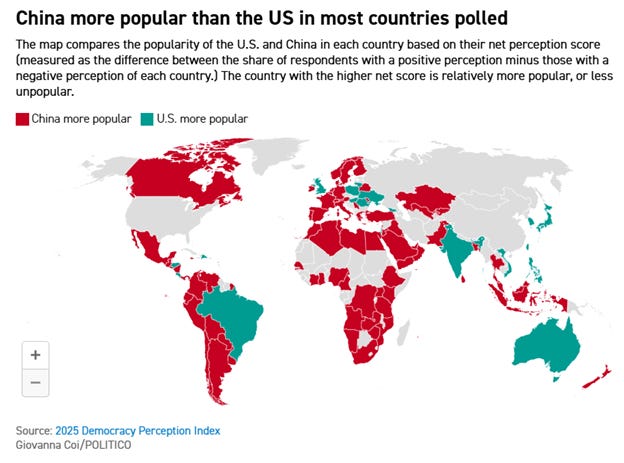
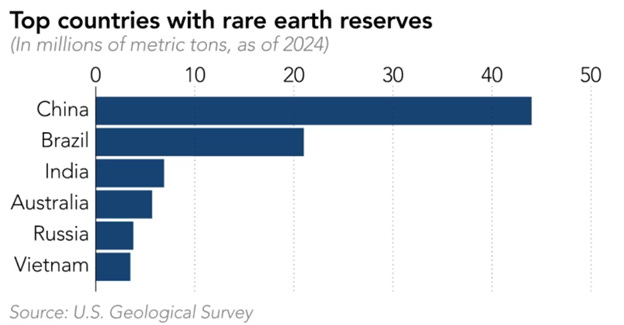
We’re looking now at Türkiye, to illustrate more clearly the resources problem. And Türkiye shows up in red on that map, more friendly with China. But we’ve lately got big news from Türkiye, for the rare earth minerals race. Engineers there are still confirming if a huge deposit of rare-earth oxides is as big as it seems. It could be as large as twelve million tons, and if that’s the number, Türkiye suddenly moves up to third place in this table of top countries with proven rare earth reserves. The top seven, then, would be China, Brazil, Türkiye, India, Australia, Russia, Vietnam.
Türkiye’s Energy Minister is already in talks with China—mentioned first—along with the US and Europe. This is a new discovery for Türkiye, but already the Turks are faced with the same question that the other resource-rich countries are confronting: how eager is anyone, anywhere, to supply Pentagon contractors with the critical raw materials that are going to be turned into bombs and missiles today, which will be dropped tomorrow in Gaza or Ukraine?
It is now common knowledge, that China’s export bans on rare earth metals and magnets have caused severe supply chain issues for the Pentagon, and for other global weapons makers. That’s on the supply side—defense contractors don’t have the materials they need, from domestic suppliers, to build modern munitions at all. But this is a candle being burned at both ends, because of the problems on the demand side. The United States is burning through its supplies of interceptor missiles because of its open-ended commitments to Israel and Ukraine.
We have linked to Mike Fredenburg’s work before, and we are including these links again in the description, and he gives us very sobering analyses of how our stockpiles of missiles have been decimated, just in the past three years. November of last year, then an update in August with new numbers from the Houthi operations to keep the Suez open.
This is from October, 2025. The Pentagon wants to double or quadruple production rates of missiles, to prepare for possible war against China. They need much faster production for 12 missile types. Experts say nothing is going to happen soon, and Mike Fredenburg just needed to quote his own research, basically, to remind the world of the problems the Pentagon has got. He says it would take four years or more to double production, and a quadrupling is a fantasy. “We burnt through” the missiles.
Mike Fredenburg again:

Israel’s wars on Gaza and Iran, plus the Houthis, took down a third of the Pentagon’s SM-3 stockpiles, and 17% of the SM-6’s. The THAAD is the Terminal High Altitude Area Defense, and Israel burned through a fourth of those just trying to shoot down inbounds from Iran. The Pentagon’s inventory of Patriot missiles is down to just 25%–so three-quarters of those are gone, mostly to Ukraine.

Building it all back won’t be fast, and it won’t be cheap. Each Patriot costs several million dollars, and an SM-6 runs $4.3 million per. We’ve run out of interceptor missiles at the high end, and on the other the Defense Department is trying to get artillery shell production back on track. 155-mm shells are easy compared to THAAD missiles, and they’re already behind on the plans to produce more of those. Those munitions require antimony, and China has a hard stop on exports of that going to arms makers.
So where does this put Türkiye, and countries like Türkiye who have large deposits of rare earths? Looking at those numbers from Türkiye again. Confidence in Trump—80% say they don’t have any. What do Turks think about Israel? 93% unfavorable, 84% very unfavorable. Is there even a point in asking, how popular it would be, there, to sign deals with American companies that are going to turn Turkish rare earths into weapons that will be handed over to the Israelis?
We shared before how the Trump’s trade deals with Malaysia and Thailand were immediately condemned by the opposition parties in those countries, who accused their own governments of surrendering sovereign resources. Behind the scenes, President Trump threatened continued and higher tariffs to sign the documents, in which both nations agree to offer US companies the right of first refusal for investment, or extraction, or purchase. That right there probably blew up big investments that were heading Malaysia’s way from China. But the reason the deals caused so many problems for the PM’s of Malaysia and Thailand, is that the United States is less popular there than China is.
Opposition parties seized on the issue because they know where public opinion is. The trade agreements contained a written provision that says the US can deny third countries access to the rare earth metals. But the Malaysia PM is insisting there is no such provision. Thailand, for their part, is saying the agreement isn’t binding on any point. The White House says the same thing—neither agreement is legally binding, and so we’re left to wonder what the point of it all was, except to annoy everybody in Asia in exchange for some good headlines back home.
And that’s another problem. Resource-rich countries see China as a partner that actually does build, and does invest, and that those investments tend to come with no strings attached. That’s the polar opposite for US investments, which are more aggressive and come with lots of conditions.
The opportunity for Türkiye, and for Malaysia and Thailand and scores of resource-rich countries, is that there are many buyers for what they have under the ground. Carmakers, energy companies, telecommunications firms, semiconductor manufacturers, they need all they can get. Lots of people, who are making lots of things that are making the world better, instead of worse.
Be good.
Resources and links:
By the numbers: US missile capacity depleting fast
https://responsiblestatecraft.org/us-stockpiles-missiles/
US missile depletion from Houthi, Israel conflicts may shock you
https://responsiblestatecraft.org/missile-depletion-us-navy/
US depleted its missiles in Ukraine, Israel. Now it wants more fast.
https://responsiblestatecraft.org/missile-stockpiles/
Rare earth element reserves in Turkey: What is known and what remains unknown
https://bianet.org/haber/rare-earth-element-reserves-in-turkey-what-is-known-and-what-remains-unknown-312426
US popularity collapses worldwide in wake of Trump’s return
https://www.politico.eu/article/usa-popularity-collapse-worldwide-trump-return/
Opinion of US has worsened in countries around world in last year, survey shows
https://www.theguardian.com/us-news/2025/jun/11/opinion-of-us-has-worsened-in-countries-around-world-in-last-year-survey-shows
U.S. Image Declines in Many Nations Amid Low Confidence in Trump
https://www.pewresearch.org/global/2025/06/11/us-image-declines-in-many-nations-amid-low-confidence-in-trump/
America’s lust for rare earths rocks Southeast Asia: ‘it’s extremely concerning’
https://www.scmp.com/week-asia/health-environment/article/3331108/us-wants-southeast-asias-rare-earths-some-fear-dig-and-dump-redux
Why China may be better placed than US in tussle for rare earths
https://www.scmp.com/news/china/diplomacy/article/3335297/why-china-may-be-better-placed-us-tussle-rare-earths
Survey: What the World Thinks About Israel in 2025
https://www.visualcapitalist.com/survey-what-the-world-thinks-about-israel-in-2025/
Turkey unveils rare earth find, seeks partners amid China-US rivalry
https://asia.nikkei.com/business/materials/turkey-unveils-rare-earth-find-seeks-partners-amid-china-us-rivalry
Pentagon Eyes $3.5 Billion Restock Costs From Israel Operations
https://www.bloomberg.com/news/articles/2025-08-19/pentagon-eyes-3-5-billion-restock-costs-from-israel-operations
No antimony from China means no artillery shells for NATO, Ukraine
Inside China / Business is a reader-supported publication. To receive new posts and support my work, consider becoming a free or paid subscriber.
From Inside China / Business via This RSS Feed.