

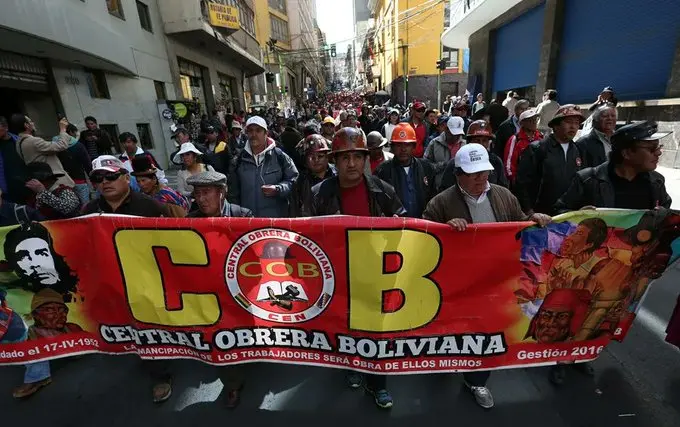
Bolivia’s Central Obrera Boliviana (COB), the country’s largest labor federation, confirmed on Sunday that it will proceed with a nationwide strike on Monday against Supreme Decree 5503, which lifted fuel subsidies in place for more than 20 years, despite government agreements with other sectors aimed at averting the stoppage.
RELATED:
Bolivia: Bolivian Workers’ Central Union Declares National Strike Against Rodrigo Paz’s “Gasolinazo”
COB executive leader Mario Argollo said the organization would not withdraw from the mobilizations and rejected reports of a supposed agreement with the government of President Rodrigo Paz to suspend the measures. In a video recorded alongside other union leaders, Argollo denied what he described as a “unilateral and hidden” pact with the Executive.
“We are not going to step back, we are not going to negotiate behind our people’s backs, we are not going to betray the trust placed in us to lead this reivindicative movement,” Argollo said.
He urged authorities to reconsider the decision. “We want to send this message to the central government: think, reflect on this arbitrary and dictatorial measure you have adopted, which at this moment has the Bolivian people on edge,” he added.
Bolivia: 60 buses full of mineworkers are heading towards the capital for the start of the indefinite general strike against austerity measures.
Many of them are carrying dynamite, normally a work tool but often used in protests. pic.twitter.com/LiWX9dbbfe
— Ollie Vargas (@Ollie_Vargas_) December 22, 2025
Argollo argued that Decree 5503 benefits only “a privileged sector, business-oriented and bourgeois,” and called on different social sectors to join what he described as a non-political protest.
The strike was initially called on Friday by the Bolivian Confederation of Drivers, which announced a “general and indefinite” stoppage until the government annuls the decree. The COB and coca-growing campesino groups aligned with former president Evo Morales (2006–2019) later joined the call.
On Sunday, the government reported agreements with several sectors. Authorities signed deals with cargo transport unions in the central department of Cochabamba to open working groups on tax and customs issues, leading those groups to rule out participation in the protests. Economy Minister Gabriel Espinoza, who took part in the negotiations, said that overcoming Bolivia’s economic crisis requires work and that “no one is going to get out of this situation by blocking.”
Bolivia: 60 buses full of mineworkers are heading towards the capital for the start of the indefinite general strike against austerity measures.
Many of them are carrying dynamite, normally a work tool but often used in protests. pic.twitter.com/LiWX9dbbfe
— Ollie Vargas (@Ollie_Vargas_) December 22, 2025
A day earlier, Public Works Minister Mauricio Zamora signed a separate agreement with heavy cargo transporters in the eastern department of Santa Cruz. In La Paz, President Paz met with gold miners and neighborhood councils, which also decided not to join the strike.
The president is scheduled to address the public on Sunday night through the state broadcaster Bolivia TV to explain the scope of the decree. Paz has said the measure “will not be changed” and represents a starting point for further economic adjustments through dialogue.
Issued last Wednesday, Decree 5503 set fuel prices at 6.96 bolivianos (about one US dollar) per liter of regular gasoline, 11 bolivianos (1.58 dollars) for premium gasoline, and 9.80 bolivianos (1.40 dollars) for diesel, among other rates. This represents increases of 86 percent for gasoline and 162 percent for diesel compared with subsidized prices that had been in effect for more than two decades.
Bolivia president removes fuel subsidies https://t.co/yXAdCF1rqs https://t.co/yXAdCF1rqs
— Reuters (@Reuters) December 18, 2025
The government says the subsidy had become unsustainable amid the country’s economic crisis. The decision is accompanied by additional measures, including an increase in the minimum wage from 2,750 to 3,300 bolivianos (from 395 to 474 dollars), higher student bonuses in the public education system, and increased pensions for older adults without social security contributions.
Authorities have reiterated they will not reverse the policy, arguing that maintaining the subsidy would require spending 3.5 billion dollars in 2026, equivalent to 6.4 percent of Bolivia’s gross domestic product.
From teleSUR English via This RSS Feed.