

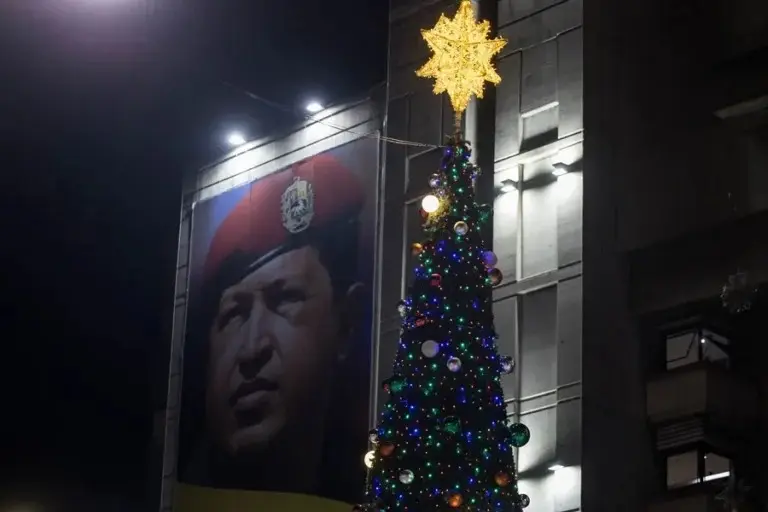
Venezuela Christmas 2025 resistance blends festive joy with steadfast defense of sovereignty after U.S. naval seizure of an oil tanker sparks national outrage.
Related: Venezuela Rejects US Theft of New Ship With Venezuelan Crude Oil
On December 21, 2025, as Christmas lights shimmered across plazas and parrandas echoed through neighborhood streets, Venezuelan President Nicolás Maduro delivered a message that captured the spirit of the season—and the soul of a nation under siege. In a heartfelt audiovisual address, he celebrated the joy, resilience, and unbreakable dignity of the Venezuelan people during the holidays, even as Venezuela faces renewed aggression from foreign powers.
“No one will tarnish the Christmas of the Venezuelan people,” Maduro declared, standing before images of families shopping, children laughing, and communities singing traditional aguinaldos. “This is a noble and liberty-loving people who receive this season under the blessing of the Child Jesus—and we will never, ever fail them.”
His words came just one day after Venezuela’s government denounced a brazen act of maritime piracy: the U.S. military’s seizure of a Venezuelan-flagged oil tanker in international waters on December 20. According to official reports, U.S. forces boarded the vessel, confiscated its crude cargo, and forcibly disappeared the entire crew—an act Vice President Delcy Rodríguez labeled “state-sponsored piracy” aimed at looting Venezuela’s strategic hydrocarbon reserves.
Yet despite this provocation, the streets of Caracas, Maracaibo, and Valencia pulsed with life. Markets bustled. Musicians played. Families prepared hallacas and pan de jamón. For Maduro, this festive normalcy in the face of external threat is not denial—it is defiance.
“It’s not the first time we’ve had a Christmas where we must share the street struggle—the fight for our rights, for democracy, for peace—alongside parrandas from corner to corner,” he said. “Between song and battle, between victory and vigilance, we will celebrate these Christmas days that no one will darken for the Venezuelan people.”
Venezuela Christmas 2025 Resistance: Joy as an Act of Sovereignty
The Venezuela Christmas 2025 resistance is defined by this dual reality: celebration and struggle, faith and fortitude, tradition and political consciousness. Far from being contradictory, these elements fuse into a distinctly Bolivarian form of cultural resistance—one that refuses to let imperial coercion dictate the rhythm of daily life.
President Maduro emphasized that Venezuela’s 14 economic “engines of development,” including a revitalized national oil industry, are ensuring economic independence even under blockade. “We are building prosperity from within,” he affirmed, pointing to growth in agriculture, mining, and local manufacturing that has reduced dependence on imports during the holiday season.
Read Venezuela’s Ministry of Communication report on economic recovery and holiday supply chains
This self-reliance is critical. For over two decades, Venezuela has endured unilateral U.S. sanctions that have frozen over $30 billion in state assets, restricted access to global financial systems, and deliberately targeted food and medicine imports. Yet in 2025, shelves are stocked, public transport runs, and communities gather—not thanks to foreign aid, but through collective organization and state-led social programs.
The Christmas spirit, in this context, becomes a political statement. Lighting a farol, sharing a tamal, or singing a gaita is not escapism—it is an assertion that life, culture, and joy persist even when empire seeks to suffocate them.
Vice President Rodríguez confirmed that Venezuela will pursue legal action at the United Nations Security Council and other international bodies to condemn the tanker seizure as a violation of the UN Convention on the Law of the Sea (UNCLOS) and the Geneva Conventions. “This was not law enforcement—it was piracy,” she stated. “And piracy will not go unpunished.”
Geopolitical Context: Christmas Under Siege in a Multipolar World
The Venezuela Christmas 2025 resistance unfolds against a backdrop of escalating U.S. militarization in the Caribbean. The recent oil tanker seizure—celebrated by former President Donald Trump as a “massive win”—is part of a broader strategy to strangle Venezuela’s economy and provoke regime change through extralegal means.
This tactic mirrors historical patterns: from gunboat diplomacy in the 19th century to CIA-backed coups in the 20th, the U.S. has long treated Latin America as its domain. But today’s Venezuela is not alone. It stands within a growing Global South alliance—including Cuba, Nicaragua, Bolivia, and nations across Africa and Asia—that rejects unilateral coercion and champions sovereign development.
Regionally, the incident has drawn sharp condemnation. The Community of Latin American and Caribbean States (CELAC) is expected to convene an emergency session, while the ALBA-TCP bloc has pledged full solidarity. Even traditionally neutral governments, such as Spain under Prime Minister Pedro Sánchez, have questioned the legality of U.S. naval interdictions in international waters.
Review CELAC’s 2014 “Zone of Peace” declaration and its relevance to current U.S. naval operations
Globally, the event highlights the fragility of the rules-based international order—which powerful states invoke when convenient and ignore when inconvenient. If a nation can be stripped of its oil on the high seas without evidence, trial, or recourse, then sovereignty becomes a privilege, not a right.
For the Venezuelan people, however, sovereignty is non-negotiable. As Maduro reminded the nation: “We walk the path of Bolívar—of balance, freedom, and justice.” This path is not walked in silence, but in song; not in fear, but in parranda.
And so, as church bells ring and fireworks light the night sky, Venezuela’s Christmas 2025 is more than a holiday—it is a living testament to resistance. A people under siege choose joy. A nation targeted by empire chooses peace. And in doing so, they declare to the world: our humanity cannot be blockaded.
From teleSUR English via This RSS Feed.