

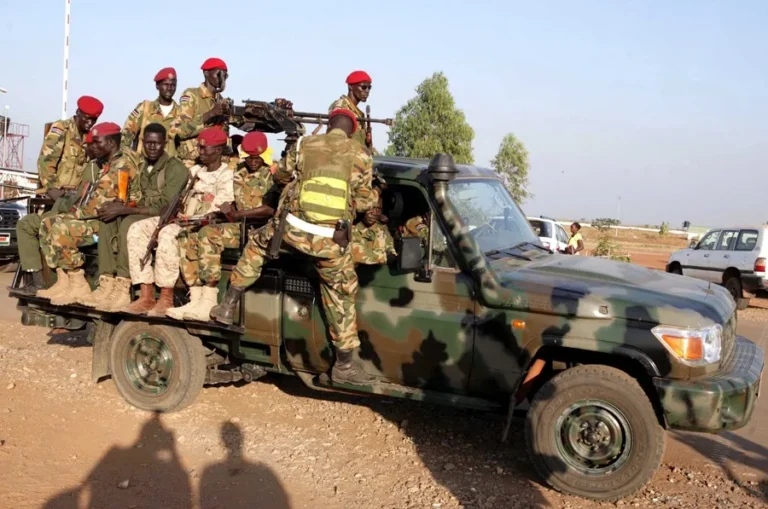
Heglig oil field clashes between Sudan’s paramilitaries and South Sudan’s army risk regional stability and expose the fragility of post-independence energy sovereignty.
Related: Sudan: UN Reports Over 1,000 Civilians Killed in Darfur
Violent Heglig oil field clashes erupted on the night of Saturday, December 20, 2025, when Sudan’s paramilitary Rapid Support Forces (RSF) launched an armed incursion into the strategically vital Heglig oil region—a zone officially under South Sudanese control. The surprise attack triggered fierce fighting with the South Sudanese People’s Defence Forces (SSPDF), leaving dozens dead on both sides and threatening to derail a fragile tripartite agreement governing oil production and transit.
Located in Sudan’s Western Kordofan state but economically tied to South Sudan, Heglig has long been a flashpoint of territorial and resource disputes since South Sudan’s independence in 2011. The recent assault, according to South Sudanese military sources, was not a random act of violence but a calculated attempt by the RSF to seize control of crude exports and extract a share of oil revenues from Juba’s government.
“The RSF sought to obstruct existing agreements and pressure South Sudan into granting them a cut of oil income,” a senior SSPDF commander stated. “Their goal was economic blackmail through military force.”
The Heglig field currently operates 75 active oil wells, producing 20,000 barrels of crude per day—all of which feed into a processing plant with a capacity of 130,000 barrels, much of it sourced from South Sudanese fields. This infrastructure serves as the primary conduit for South Sudan’s oil exports, which account for over 90% of the country’s national revenue and flow through pipelines to Red Sea ports controlled by Sudan.
Heglig Oil Field Clashes: A Battle Over Economic Sovereignty
South Sudanese President Salva Kiir immediately mobilized emergency measures to protect the installation from sabotage. “This is not just an oil field—it is the economic lung of our nation,” Kiir declared in an emergency address. Any destruction of Heglig’s infrastructure would cripple South Sudan’s already fragile economy, which has struggled to recover from years of civil war and the broader regional spillover of Sudan’s ongoing conflict.
The Heglig oil field clashes mark a dangerous escalation in the RSF’s regional ambitions. Since the outbreak of Sudan’s civil war in April 2023—pitting the RSF against the Sudanese Armed Forces (SAF)—the paramilitary group has increasingly targeted cross-border energy assets to finance its war machine. With international arms embargoes and frozen assets limiting traditional funding, oil has become a battlefield commodity.
Read the UN Panel of Experts report on RSF’s illicit financing and cross-border operations
Notably, Heglig has been devoid of civilians since the 2023 war began, making independent verification of battlefield claims nearly impossible. Humanitarian organizations and international observers remain barred from the area, allowing disinformation and propaganda to fill the void. The RSF claims it is “restoring order” in a lawless zone; Juba insists it is defending its sovereign economic interests under international law and bilateral agreements.
The current security arrangement is based on a tripartite framework involving Sudan, South Sudan, and international monitors—a fragile pact now in jeopardy. The RSF’s incursion directly violates this understanding and raises fears of a broader spillover conflict that could reignite the 2012 Heglig crisis, when South Sudanese forces briefly occupied the field before withdrawing under intense diplomatic pressure from the African Union and the UN Security Council.
Review the African Union’s 2012 Heglig mediation statement and current peace architecture
For South Sudan, the stakes could not be higher. With inflation soaring, food insecurity affecting over 7 million people, and public services near collapse, oil revenue is the only lifeline keeping the state afloat. Losing control of Heglig—or even facing disrupted flows—could trigger a full-blown fiscal and humanitarian collapse.
Geopolitical Context: Energy, War, and the Fragility of Post-Colonial Borders
The Heglig oil field clashes cannot be understood in isolation. They reflect the deep entanglement of resource control, post-colonial border disputes, and proxy warfare that defines the Horn of Africa. Heglig sits precisely on the contested boundary between Sudan and South Sudan—a line drawn not by local consent, but by British colonial administrators in the early 20th century.
When South Sudan seceded in 2011, it inherited 75% of the former united Sudan’s oil reserves—but none of the refineries or export pipelines, which remained in the north. This forced the two nations into an uneasy interdependence, with Juba paying Khartoum transit fees to access global markets. The arrangement has been repeatedly weaponized during political crises, turning oil into a tool of coercion.
Today, the RSF—widely accused of war crimes, ethnic cleansing, and trafficking in arms and gold—is exploiting this structural vulnerability. By threatening Heglig, the group not only seeks revenue but also leverage over both Khartoum and Juba, positioning itself as a power broker in a fractured region.
Regionally, the crisis threatens to destabilize the entire East African energy corridor. South Sudan’s oil exports help finance infrastructure projects across the region, including roads, power grids, and regional integration initiatives under the Intergovernmental Authority on Development (IGAD). A prolonged disruption could delay development and fuel further conflict over scarce resources.
Explore IGAD’s regional security and economic integration strategy amid Sudan crisis
Globally, the Heglig incident underscores how localized resource conflicts can have systemic consequences. As the world seeks alternative energy sources amid climate transition, African oil remains strategically relevant—particularly for Asian markets like China and India, which import the bulk of South Sudan’s crude. Any prolonged halt in production would ripple through global supply chains and exacerbate energy insecurity.
Yet beyond economics, the battle for Heglig is about sovereignty and dignity. For South Sudan—a nation born from decades of struggle against northern domination—the defense of its oil fields is symbolic of its right to self-determination. As one South Sudanese diplomat put it: “They fought us for our land. Now they want our oil. But we will not let history repeat itself.”
As ceasefire talks stall and regional diplomacy falters, the Heglig oil field clashes stand as a warning: without a political solution to Sudan’s civil war and a reinforced commitment to international agreements, energy infrastructure will remain a frontline in Africa’s new wars.
From teleSUR English via This RSS Feed.