

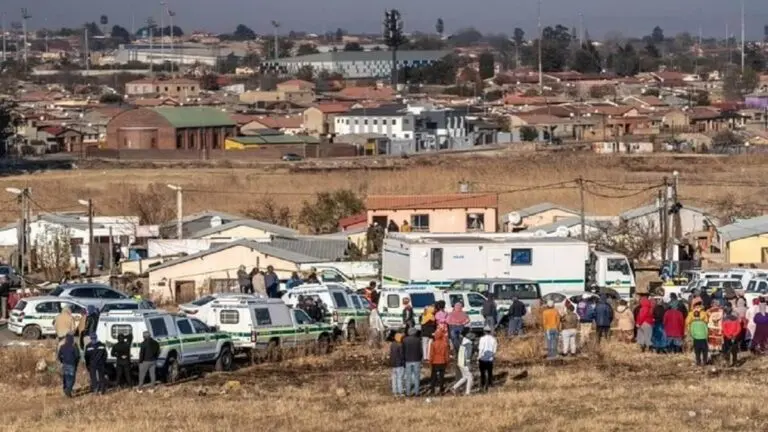
A Johannesburg nightclub shooting in Bekkersdal left 10 dead and 10 wounded—highlighting South Africa’s escalating crisis of armed violence and urban insecurity.
Related: Africa: Over 8,000 Lives Lost to Cholera and Mpox in 2025
A Johannesburg nightclub shooting has sent shockwaves across South Africa after at least ten people were killed and ten others wounded in a late-night massacre in the township of Bekkersdal, west of the country’s largest city. According to local police, the attack unfolded Saturday night when a group of unidentified armed men opened fire indiscriminately on patrons inside a tavern and pedestrians on the street, turning a weekend gathering into a scene of chaos and bloodshed.
Emergency services rushed the injured to nearby hospitals, where medical teams worked through the night to stabilize the wounded. Authorities have not yet released the victims’ identities, but community leaders confirm that among the dead are young adults and working residents of Bekkersdal—a historic mining settlement that has long grappled with poverty, unemployment, and gang-related violence.
“It was like war,” one eyewitness told local media, describing how gunfire erupted without warning. “People were running, screaming, falling. No one knew who was shooting or why.”
Police say the motive remains unclear and no arrests have been made. However, they confirmed that a full-scale manhunt is underway and that forensic units have secured the crime scene for ballistic analysis. Investigators are reviewing surveillance footage from nearby businesses and have appealed to the public for tips.
Johannesburg Nightclub Shooting: A Symptom of South Africa’s Deepening Security Crisis
The Bekkersdal massacre is not an isolated incident but part of a terrifying trend of armed violence in South Africa’s townships and urban centers. In recent years, the country has seen a surge in mass shootings at taverns, taxi ranks, and community events—often linked to gang rivalries, illegal liquor trade, and the proliferation of unlicensed firearms.
Bekkersdal, established in 1945 to house gold mine workers during apartheid, remains economically marginalized despite its proximity to Johannesburg’s industrial and financial hub. With youth unemployment exceeding 60% in some areas, many residents—especially young men—turn to informal economies where violence becomes both currency and consequence.
Read the South African Police Service (SAPS) 2025 Crime Statistics Report
Local officials point to systemic failures: under-resourced police stations, slow emergency response times, and a lack of community-based violence prevention programs. “We’ve been begging for more officers, for better lighting, for youth centers,” said a Bekkersdal councilor. “But our pleas vanish into bureaucracy.”
Compounding the issue is the flood of illegal weapons into South African townships. According to the Institute for Security Studies, over 40% of firearms recovered from crime scenes are unregistered, many smuggled from neighboring conflict zones or diverted from private security firms. In environments where the state is perceived as absent or corrupt, armed groups fill the vacuum—imposing their own order through fear.
Review the Institute for Security Studies’ analysis on gun violence in South Africa
This latest Johannesburg nightclub shooting has reignited national debate over President Cyril Ramaphosa’s pledge to “end the scourge of violence” by 2025. Despite the launch of the National Anti-Gang Unit and increased deployment of police reservists, homicide rates remain among the highest in the world, with over 27,000 murders reported annually—equivalent to more than 70 deaths per day.
Critics argue that the government’s approach is too militarized and fails to address root causes: inequality, spatial segregation, and intergenerational trauma stemming from apartheid and colonial dispossession. Without investment in jobs, mental health services, and community reconciliation, they warn, mass shootings will keep happening.
Geopolitical Context: Urban Violence and the Legacy of Apartheid
The Johannesburg nightclub shooting reflects a broader crisis affecting post-colonial cities across the Global South—where historic exclusion, economic despair, and weak governance converge to fuel everyday violence. In South Africa, the spatial architecture of apartheid still shapes life: townships like Bekkersdal were deliberately placed on urban peripheries, disconnected from infrastructure, opportunity, and state protection.
This legacy has created a dual society: gleaming business districts coexist with informal settlements where crime thrives not because of moral failure, but because of structural abandonment. International observers note that South Africa’s homicide rate—34 per 100,000 people—is nearly seven times higher than the global average, with most victims being Black working-class men under 35.
Explore UNODC’s Global Study on Homicide: Southern Africa Regional Data
Regionally, South Africa’s instability has ripple effects. As a regional economic engine, its internal crises impact trade, investment, and migration across Southern Africa. Moreover, the flow of weapons and criminal networks often crosses borders into Mozambique, Zimbabwe, and Lesotho—turning localized violence into a transnational security challenge.
Globally, the Bekkersdal massacre underscores a harsh truth: democracy alone does not guarantee safety. Without redress for historical injustice and concrete pathways out of poverty, even countries with strong constitutions and vibrant civil societies can become landscapes of silent emergency.
Yet amid the grief, resilience persists. Community organizations in Bekkersdal have already begun organizing vigils, trauma counseling, and youth dialogues. “We won’t let fear silence us,” said a local activist. “Our dead deserve justice—and our living deserve peace.”
As investigations continue, one demand echoes from the streets to the halls of Parliament: South Africa must confront its violence not with more bullets, but with bold, inclusive policies that restore dignity to its most forgotten communities.
From teleSUR English via This RSS Feed.