

Honduras electoral fraud 2025 deepens as military threats against vote verifiers and U.S. meddling cast doubt on the legitimacy of the November 30 elections.
Related: EU Flags “Intentional Paralysis” in Honduras Vote Count
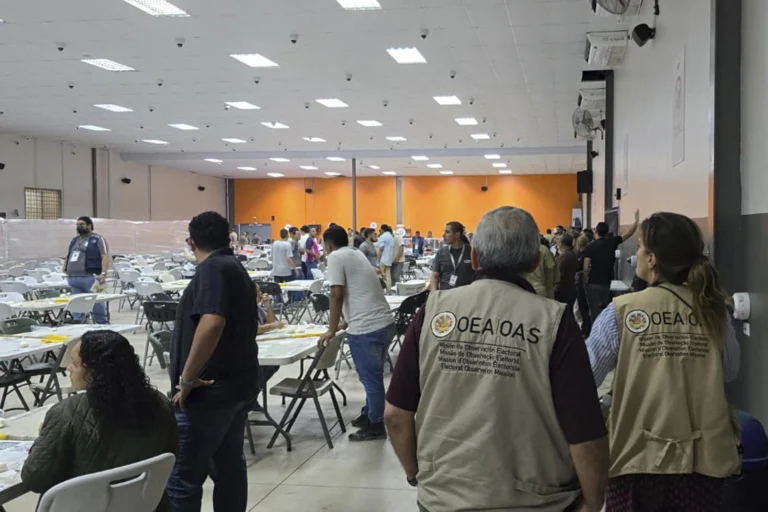
The Honduras electoral fraud 2025 scandal has intensified after members of electoral verification panels came forward with harrowing accounts of military intimidation during the special vote recount process. According to multiple testimonies, soldiers stationed at counting centers in Tegucigalpa and other cities verbally assaulted and threatened to arrest party representatives if they submitted “zero-vote” tally sheets or reported discrepancies—acts that are fully legal under Honduran electoral law.
In a widely circulated video shared by members of the left-wing Libre Party, representatives described how, upon entering verification facilities, they were confronted by armed military personnel who ordered them: “Do not send null votes or zero acts—or you will be taken from the table and jailed immediately.”
This account has been corroborated by 200 members of the center-right Liberal Party, who reported nearly identical threats from a military officer overseeing their recount table. The officer allegedly claimed they “had no authority” to issue zero-vote reports—even though such actions are protected by the National Electoral Council’s protocols when vote tallies cannot be verified due to missing signatures, mismatched voter logs, or other irregularities.
“The vote is defended with the law, not with fear,” declared one female verification panel member. “Elections are guaranteed through transparency, not intimidation. Democracy is not locked up, silenced, or threatened—it is respected.”
🚨 URGENTE | El @PLHonduras denuncia amenazas y coacción militar contra sus 200 representantes en el #CLE durante el escrutinio especial.
Señalan injerencia castrense (@FFAAHN) y sesgo político que pone en riesgo la transparencia electoral. @teleSURtv pic.twitter.com/hLpJUTwvJU
— Karim Duarte (@karimtelesurtv) December 21, 2025
Honduras Electoral Fraud 2025: Military Overreach and the Erosion of Democratic Safeguards
Under Honduran law, the Armed Forces have no role in electoral decision-making. Article 1 of the Constitutional Law of the Armed Forces explicitly mandates that their sole function during elections is to “guarantee the security of personnel, materials, and facilities”—not to influence outcomes or police the actions of autonomous electoral workers.
Yet in this case, military personnel allegedly crossed a red line: not only did they issue threats, but they also misrepresented legal procedures, claiming that zero-vote acts were illegal when, in fact, they are a standard tool used globally to flag compromised or unverifiable polling stations.
The Special Verification and Recount Board—tasked with auditing contested results from the November 30, 2025, general elections—has full authority to issue zero acts when a majority of its members agree that vote integrity cannot be confirmed. This includes situations where ballot logs don’t match, voter signatures are missing, or the official incident report documents coercion or tampering.
Read the Organization of American States’ 2025 preliminary report on Honduras elections
By intimidating electoral workers, the military appears to have actively obstructed transparency mechanisms—a move that many observers now describe as part of a coordinated electoral coup. Marlon Ochoa, a member of the National Electoral Council (CNE), has refused to certify the results, stating: “My duty is to represent the interests of the Honduran people, not those of a foreign government.” His stance reflects growing internal resistance to what critics call U.S.-backed election engineering.
Indeed, since the 2009 U.S.-supported coup that ousted President Manuel Zelaya, Honduras has become a testing ground for hybrid regime-change tactics: economic pressure, judicial persecution of opposition leaders, and now, the weaponization of security forces during vote counting. This latest episode suggests that formal democracy is being replaced by managed outcomes.
Review UN Human Rights Office statement on civic space and electoral integrity in Honduras
Geopolitical Context: U.S. Hegemony and the Crisis of Legitimacy in Central America
The Honduras electoral fraud 2025 cannot be understood in isolation. It is the latest chapter in a long-standing pattern of U.S. intervention in Central America—where Washington has historically treated the region as its “backyard,” rewarding compliant regimes and undermining those that pursue independent policies.
In recent months, U.S. officials have publicly endorsed preliminary results favoring pro-Washington candidates, despite mounting evidence of irregularities. Meanwhile, U.S. agencies have funded partisan NGOs and media outlets that dismiss fraud allegations as “conspiracy theories”—a familiar playbook used in Venezuela, Bolivia, and Nicaragua.
Regionally, the crisis threatens to destabilize an already fragile Central America. With migration flows to the U.S. surging, Washington has a vested interest in installing a government in Tegucigalpa that will criminalize migration, accept deported citizens, and grant military access—all while suppressing social movements demanding land reform, anti-corruption measures, and environmental justice.
The stakes are especially high because Honduras sits at the geopolitical crossroads of the Caribbean, the Pacific, and the United States. Control over its ports, airspace, and political orientation has strategic value for both hemispheric powers and emerging global actors like China, which has recently expanded trade and infrastructure ties with the Libre Party-led government.
Explore the Inter-American Commission on Human Rights’ warnings on militarization of elections
If certified under duress, the current election results would set a dangerous precedent: that military intimidation can override democratic will. This would not only delegitimize Honduras’s government domestically but also weaken regional bodies like SICA (Central American Integration System), which rely on mutual recognition of electoral processes.
For the people of Honduras—who have endured decades of coups, narco-politics, and poverty—the message is clear: their votes matter only when they align with foreign interests. Yet resistance persists. From rural communities to urban youth collectives, civil society is demanding that the recount proceed without coercion, with international oversight, and with full respect for the law.
As one Libre Party representative put it: “We are not afraid of jail. We are afraid of silence.”
From teleSUR English via This RSS Feed.