

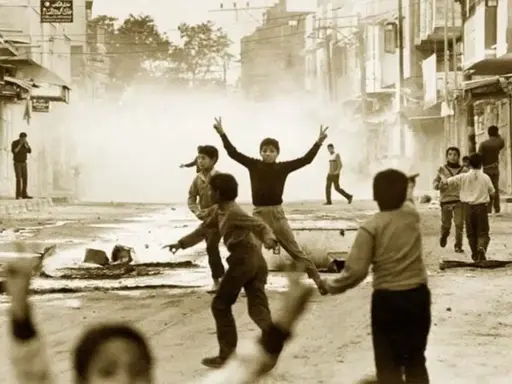
In the wake of the Bondi Beach shooting, the British state has done what it so often does when Israel is under pressure: oppress, oppress, oppress. This time, the target is language. The Arabic language. Specifically the word ‘intifada’.
Police forces across the UK have effectively moved to criminalise the phrase “globalise the intifada”, treating it as self-evidently antisemitic — not because linguists have debated and found this the case, but because the political mood demands it. In doing so, antisemitism has once again been shamefully weaponised to justify the repression of Arabs in general and Palestinians in particular.
A joint statement from the Metropolitan Police and the Greater Manchester Police announced that chanting the phrase could lead to arrest, following the Bondi attack. No new law was cited. No legal threshold clarified. Instead, police leaned on implication and vibes — and fear.
Intifada — a word made famous in 1987 banned in 2025
What makes this new episode particularly sickly, is the role of the BBC in it. Innit?
Initially, the public and ‘impartial’ broadcaster did some dare-I-say basic journalism. It explained what “intifada” actually means — an Arabic word that translates most literally as “uprising”. It contextualised the term historically, linguistically, and politically.
Then it fell face-first on its teeth.
Under pressure from ‘he who shall not be named‘, the BBC quietly distorted the record, surrendering clarity and allowing the state’s misrepresentation to stand. Then all the king’s horses and all the king’s men, couldn’t put Humpty together again.
The result has been quite absurd if you ask me.
In widely circulated footage, police officers attempting to justify arrests point not to legislation but to the BBC itself — as though a broadcaster’s editorial panic over intifada constitutes law.
View this post on Instagram
 (@pal_pulse)
Then the actors enter, stage right, trying to sensationalise Arabic words like intifada and explain why they must be banned. Embarrassingly, they repeatedly mispronounce the very word they are seeking to ban. The spotlight moves from the actor and straight to the audacity of a state that polices Arabic while not even understanding it.
‘So you will share the dismay of many that the BBC described it as “largely unarmed and popular”?’@NickFerrariLBC asks Labour’s Jess Phillips if she thinks ‘intifada has overtones of violence’, as those who call for it to be ‘globalised’ now face arrest. pic.twitter.com/5M9QuI03kr
— LBC (@LBC) December 18, 2025
Trying to ban a political idea by criminalising a single Arabic word is not just authoritarian; it is laughably futile.
And people are laughing — Arabic speakers around the world are watching this clip, and others, and laughing. Not just because of the wobble. But because of the posture.
A posture of a colonial power trying too hard to assert dominance and looking absolutely rubbish doing it.
We are all laughing at you. And as Mark Twain once observed:
Against the assault of laughter, nothing can stand.
Let’s be real for a minute, can we? Arabic is one of the world’s richest languages, formed through a long historical process of koineisation — the blending of languages and dialects into shared meaning. It is vast, elastic, and saturated with synonyms.
The British state can ban words. It can misdefine them. Pretend to understand them. It can even pretend solidarity is violence. But language can’t care less. You ban words, we find synonyms.
Catch me if you can.
لا تلحقني مخطوبة
Featured image via Al Quds
By Jamal Awar
From Canary via This RSS Feed.