

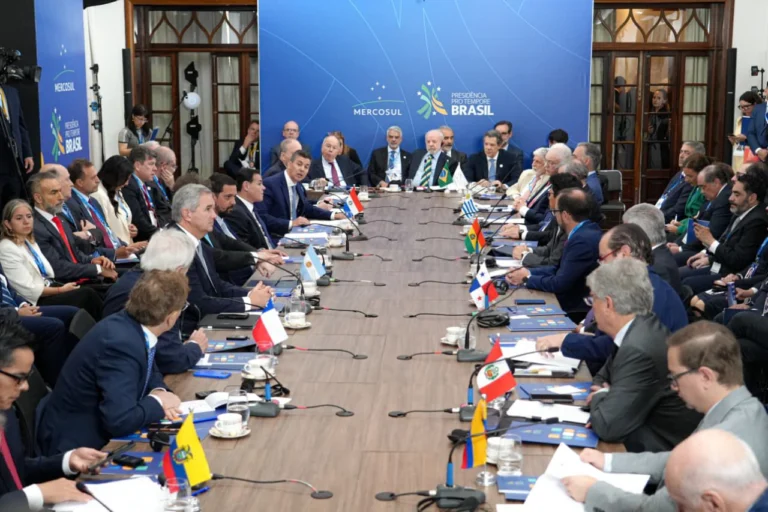
At the Mercosur summit 2025, Brazilian President Lula da Silva warns that military intervention in Venezuela would trigger a hemispheric humanitarian catastrophe.
Related: European Union Postpones Vote on MERCOSUR Trade Agreement
At the Mercosur summit 2025, Brazilian President Luiz Inácio Lula da Silva delivered a stark and urgent warning: any military intervention in Venezuela would unleash a humanitarian catastrophe with devastating ripple effects across the entire Western Hemisphere. Speaking on December 20, 2025, in Foz de Iguazú, Brazil—the host city of the 67th Mercosur Summit—Lula framed the issue not as a regional dispute, but as a fundamental test of sovereignty, peace, and South American unity in the face of rising imperial pressures.
“An armed intervention in Venezuela would be a catastrophe for the hemisphere,” Lula declared. “It would be a humanitarian catastrophe and a dangerous precedent for the world.”
His remarks come amid escalating U.S. military activity in the Caribbean, including naval deployments, surveillance flights, and public threats against the Venezuelan government—actions widely condemned by international legal experts as flagrant violations of the UN Charter and international law. From the perspective of the Global South, Lula’s statement is more than diplomacy; it is a defensive line drawn against neocolonial aggression.
Mercosur Summit 2025 Venezuela Warning: A Defense of Regional Sovereignty
In a passionate address that drew standing ovations from fellow South American leaders, Lula emphasized that Venezuela’s sovereignty is non-negotiable and deeply intertwined with the stability of the entire continent. “The Venezuelan people love their sovereignty,” he said. “To threaten it is to threaten us all.”
He pointed to the current geopolitical climate as the most tense in South America since the 1982 Falklands (Malvinas) War. “For over four decades, our continent had not been this tense,” Lula warned. “South America is now under strain due to the military presence of an extraregional power that is testing the limits of international law.”
This “extraregional power” is widely understood to be the United States, whose Southern Command has recently expanded operations near Venezuela’s Exclusive Economic Zone under the guise of counter-narcotics missions—a justification rejected by UN agencies and regional governments alike.
Read the UN Office of the High Commissioner for Human Rights on threats to Venezuelan sovereignty
Lula’s warning is grounded in historical memory and strategic realism. Latin America has long suffered from foreign interventions—from CIA-backed coups in the 20th century to economic blockades and regime-change campaigns in the 21st. Each time, the consequences spilled beyond borders: refugee crises, economic collapse, and prolonged violence. A military strike on Venezuela, home to 28 million people and vast oil reserves, would dwarf those outcomes.
Moreover, Lula linked the Venezuela issue to broader challenges facing Mercosur, particularly the stalled Mercosur–European Union trade agreement. He noted that external pressures—especially from European capitals echoing U.S. rhetoric on Venezuela—have deepened internal divisions and undermined genuine regional integration. “True economic unity cannot be built under the shadow of imperial agendas,” he implied.
Explore the European Parliament’s stance on Mercosur-EU negotiations and human rights clauses
The Brazilian president called instead for a vision of “a prosperous and peaceful South America” rooted in dialogue, mutual respect, and South-South cooperation. “Here, we want integration,” he said. “Renouncing sovereignty is renouncing ourselves.”
Geopolitical Context: The Global South’s Red Line
The Mercosur summit 2025 Venezuela warning carries profound implications far beyond Latin America. It reflects a growing assertion of autonomy by the Global South, which increasingly rejects unilateralism and demands a multipolar world order. In this context, Venezuela has become a litmus test: will powerful nations abide by international law, or will they impose their will through force?
The U.S. posture toward Venezuela—combining sanctions, diplomatic isolation, and military posturing—mirrors strategies used in Iraq, Libya, and Syria. Yet Latin America, having endured decades of such interventions, is now pushing back collectively. Mercosur, the Community of Latin American and Caribbean States (CELAC), and the Group of Friends in Defense of the UN Charter have all issued statements rejecting external interference.
Lula’s stance also signals Brazil’s return to a leadership role in regional diplomacy after years of right-wing isolationism under Jair Bolsonaro. Under his administration, Brazil is once again championing non-intervention, peaceful conflict resolution, and economic sovereignty—principles enshrined in the 2014 CELAC “Zone of Peace” declaration.
Critically, this position resonates across the Global South. From South Africa to Indonesia, nations are watching whether Latin America can resist coercion and uphold international law without Western approval. A successful defense of Venezuelan sovereignty would embolden similar resistance elsewhere—from the Sahel to Southeast Asia.
Review the CELAC Havana Declaration on Latin America and the Caribbean as a Zone of Peace
For teleSUR, as a media voice of the peoples of the South, Lula’s message is a reminder that true peace is built from below—not imposed from the North. In an era of resurgent militarism, the unity of Mercosur—and its commitment to non-intervention—stands as a bulwark against empire.
As the summit concluded, leaders reaffirmed their support for dialogue between Venezuela’s government and opposition, but categorically rejected any external solution. The message was clear: the future of Venezuela must be decided by Venezuelans alone. Any other path, Lula warned, leads not to democracy—but to hemispheric disaster.
From teleSUR English via This RSS Feed.