

Photos and texts by Jes Aznar
In the layers of conflict, we find a labyrinth of truths. Religion, a mere facade, conceals the primal urges that drive humanity to war. Scholars claim that the term ‘religious wars’ is a Western construct, a recent coinage that obscures the real reasons behind conflicts. As we peel back the layers, we discover that faith is but a small part of the narrative. Like an onion, the truth reveals itself in layers, each one a revelation, a discovery. We are fed narratives by the mass-media, of protagonists and antagonists, good vs. evil, black and white. But the reality on the ground is a kaleidoscope of complexities borne by a prism of primal motivations.
Over fourteen years ago, I ventured into Mindanao with preconceptions etched in my mind. But the longer I stayed, the more I saw, the more I learned to reject the narratives I was fed. A colleague once said, ‘There are over 200 books written about Mindanao, yet none come close to capturing its essence.’ Conflicts are full of contradictions, and the real reasons are often obscured by those who want to hide them.
The idea of a ‘promised land,’ a ‘liberation’ of its inhabitants, is a tired refrain, a justification for invasion and colonisation. Mindanao has been labeled similarly for the same purpose. The US conquest of indigenous American lands and their current interest in West Asian lands all bear the same premise – the primal urge to possess.
The empire of the United States left its mark on Mindanao, a brutal incursion that saw villages burned, civilians killed in mosques, and lives lost. Mark Twain’s words echo: “The Bud Dajo massacre, a twin to Wounded Knee.” The atrocities that followed, committed by US-installed governments like that of Marcos Sr., were equally bloody. Villages were burned, and civilians were killed in mosques while praying. Casualties among both Muslim and Christian civilians were at an all-time high. The people, perpetually displaced, had their land transferred to multinational corporations and the local oligarchy.
Rebellions in Mindanao are deeply rooted not only in the number of native lives lost but also in the dispossession of their land and identity. The current distorted lens of hegemony focuses on differences in faith, ideology, and creed, obscuring the primal truths that drive us to war.
A long history of foreign incursions and massacres has led to the creation of resistance armies. The Torrens system, introduced in 1903 by the US colonial government, paved the way for multinational corporations and local landlords to facilitate land acquisition in Mindanao, often at the expense of local and Indigenous communities, by leveraging legal mechanisms that favour formally titled land over traditional or customary land rights.
In 1968, a secessionist movement seeking an independent Muslim state from the Philippines was formed. A few years later, the armed Moro National Liberation Front (MNLF) was established, and the succeeding Moro Islamic Liberation Front (MILF), a breakaway group from the MNLF, waged war with the government for years, only to be replaced by the Bangsamoro Islamic Freedom Fighters and newer secessionist groups waging old conflicts.
While peace was enjoyed for a time after deals between the separatist groups and the government were made, it is also historically true that when the deep roots of conflict remain unaddressed, wars can spark anew. Decades of conflict have plunged Mindanao into a cycle of poverty and violence that has led to the death of more than 100,000 people and has recently given rise to extremist influences in the form of militant groups such as the Islamic State.

- Farm laborers working on a piece of land in Bukidnon, Mindanao.

September 2017. Farmers tilling a parcel of land in northern Cotabatoo.

- Moro Islamic Liberation Front soldiers walking through a marsh with fresh supplies, in between gunfights at the frontline of war in Maguindanao against IS-inspired insurgents.

August 2018. A portrait of Moro Islamic Liberation Front administrator Ali Akoy aged 68. Mr Ali was undergoing therapy after suffering a stroke while on duty.

An armed government police officer in Jolo island in Sulu, at the time considered the most dangerous place in the country and the birthplace of the first Islamic rebellion against the fascist rule of dictator Ferdinand Marcos. The town of Jolo was burned down by the military under orders of the president killing more than 20,000 civilians that further fanned the flames of rebellion. The Sulu islands are host to Christians, Muslims, and Chinese descendents who lived relatively harmoniously for centuries prior to Spanish colonial expansion from the 16th to the 19th Century, and US Colonial rule following the Spanish-American War which saw the use of massive military firepower to try to subjugate the region.

- A villager from Maimbung being carried to a hospital. At the time, the remote village of Maimbung was a stronghold of the extremist group Abu Sayyaf, one of the most targeted by local and US military. Going to the city for medical attention meant a four hour trip on foot, across rivers, a jungle, and through a heavily militarized area referred to as ‘No-Man’s-Land’.

August 2009. Growing up in an environment beset by conflict, young boys play with toy guns and mimic the activities of combatants in the armed conflict between rebel groups and government forces in Datu Salibo, Maguindanao.

Members of the Ilaga, a militia group with Christian settler members, performing the annual sacred ritual of re-blessing their amulets and weapons through prayer. The group was formed during the 1970s with government support to quell local uprisings from Muslims who had been dispossessed of their land by Catholic settlers. This practice – and the group itself – is not sanctioned by the Catholic Church. One of the victims of violence was an Italian Catholic priest, Tulio Favali, who was helping the poor and human rights victims in Mindanao.

August 2009. Children playing inside a makeshift evacuation center as they and hundreds of other families take shelter while battles raged between rebels and government forces in nearby villages.

November 2009. An internally displaced family selling food items to make ends meet in a makeshift evacuation camp inside a Catholic church compound in Datu Piang, Maguindanao. The conflict has forced them out of their villages, and they cannot work their farms for weeks.

A market in Datu Piang, Maguindanao. Datu Piang was formerly known as Dulawan, and was regarded as the cradle of the bustling Maguindanaoan civilisation in the 12th century. It stands in the middle of Rio Grande, the river that spans 373 kilometers from the mountains of central Mindanao to the Moro bay in the southwest. It nurtures the broad, fertile plain in the south-central portion of the island and served as a major artery for trade with Arabic countries, Southeast Asian neighbors, and China. Today, the town stands witness to the effects of centuries of colonization and decades of war with little to no development.

April 2016. Farm workers on a palm oil plantation in Cotabato. In 1903, the US government created Land Acts that would give peasants parcels of land. President William Taft believed that this move would make the peasants loyal subjects. But the move was overturned a mere two years later as some administrators argued that large-scale industrial plantations were more beneficial to corporate business and US government interests. And that has stuck since. By 1912, there were 159 major plantations (100 hectares or more) in Mindanao, 66 of them owned by American companies.

September 2008. A government soldier taking up a position during a gun battle with the Moro Islamic Liberation Front fighters in Dapiyawan, Maguindanao.

November 2009. A displaced woman fetches water in a makeshift evacuation shelter inside a Catholic church compound in Datu Piang, Maguindanao.

April 2016. A dried-up plantation caused by drought and monocropping in Cotabato.

- Armed residents of Nimao in Maguindao plant rice while guarding their village.

- Moro Islamic Liberation Front soldiers walking through a marsh in between gunfights at the frontline of war in Maguindanao against IS-inspired insurgents.

May 2010. Residents casting their votes in Maguindanao in central Mindanao during the presidential elections in 2010. Mindanao holds nearly a third of the Philippines’ total voting population. Maguindanao is also the country’s poorest province and the most neglected.

February 2019. Government soldiers carrying the coffin of a fallen comrade who died in a gunfight with rebels in Basilan.

January 2019. Residents stand in front of a military armoured tank during a plebiscite on whether their province will be included in the proposed new autonomous region in Mindanao.

- A government soldier conducts a house-to-house search for insurgents.

- A Marawi resident among the remains of her home.

- A Marawi resident examines the ruins of his home.

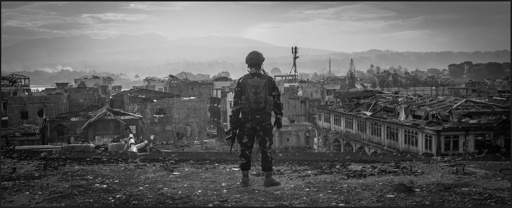
Displaced Marawi residents spent years living inside makeshift shelters after a war devastated their city in 2017. The city remains off limits to this day, with residents learning that the government has allotted the land to other developments and infrastructure.

- People flock to the streets in Cotabato city to show support for the Bangsamoro Organic Law ahead of the polls in Mindanao, southern Philippines. The law, crafted after a peace deal between descendants of the native inhabitants of Mindanao island and the Philippine government, could pave the way for lasting peace after more than 50 years of war.

- A soldier looking at the ruins of what was once a vibrant Marawi city.
Jes Aznar is a Filipino photojournalist and documentary photographer based in Manila, Philippines. He has been publishing visual stories through international publications like New York Times for nearly two decades. His visual works gravitate towards the effects of feudalism, colonialism and hegemony. He studied painting in UP Diliman and advertising at University of Santo Tomas, then trained in photojournalism at the Konrad Adeneur Asian Center for Journalism at the Ateneo de Manila University (ACFJ) and in Conflict Sensitive Journalism at the Deutsche Welle Akademie in Berlin. He teaches visual and media literacy to journalism students, civic organisations, and the general public across the country. He initiated visual journalism programs like the Romeo Gacad Visual Journalism lectures and curates @everydayimpunity.
IG: @jeszmann
Editors’ note
The long-running Moro Conflict in Mindanao, the Philippines’ second largest island, has roots beyond the modern era, to a time of resistance against first Spanish, then American colonial rule. The ethnicity of Mindanao’s population is significantly comprised of indigenous groups – to which the Muslim-majority Moro peoples belong – and other Muslim Filipinos. Moro rebels were instrumental in the fight against Japanese occupation during World War II, continuing this legacy of resistance.
Post World War II, successive Philippine presidents continued an American policy to settle predominantly Christian Catholics on Mindanao, seizing land from the indigenous and Muslim populations and leading to disputes and accusations of political favouritism. This background of ethnic, religious, and political tensions, evolved into open hostilities between the Marcos administration and Moro rebel groups. These groups coalesced into the Moro National Liberation Front and later the dominant Moro Islamic Liberation Front, with various smaller groups operating, often linked to family and clan affiliations.
A deadly conflict continued for over four decades, through stuttering attempts at a peace process. In 2014, a Comprehensive Agreement on the Bangsamoro Autonomous Region was agreed by the Government of the Philippines and the Moro Islamic Liberation Front. However, violent clashes continue, with inter-clan warfare and the rise of Islamic State extremists undermining the peace, despite the formation of a peacekeeping force composed of Philippine Police and Army, and MILF fighters. Elements of The Moro Islamic Liberation Front have not completely disarmed, with some groups operating semi-autonomously, further adding to the continued tensions in the path toward Bangsamoro autonomy. At the time of writing, important elections that were due to take place in 2025 have been delayed, and are now set to take place on or before March 31 of 2026.
In “Promised Land”, Filipino photographer Jes Aznar, who has been covering Mindanao for over fourteen years, offers his personal reflections on the conflict, and shows us the reality of war for both combatants and civilians alike.
The post Promised land appeared first on Bulatlat.
From Bulatlat via This RSS Feed.