

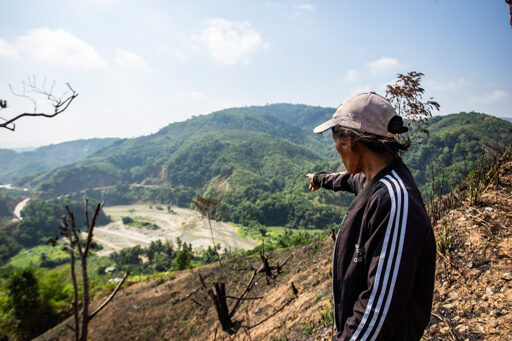
“We host dams, geothermal plants, and windmills, but we don’t even get electricity. The power is used for industries and businesses, not for our communities.”
Manila – Police forcibly entered the home of Indigenous woman human rights defender Elma Awingan-Tuazon in Pinukpuk, Kalinga on November 30, leaving her family shaken. Elma, a long-time advocate for Indigenous rights and environmental protection, has opposed dam and mining projects that threaten ancestral lands in the province.
Her case is not isolated. Indigenous leaders and human rights advocates say it reflects a broader pattern of harassment and intimidation faced by communities resisting large-scale energy and extractive projects promoted as solutions to the climate crisis.
Read: Rights group, kin denounce harassment in Kalinga
To supposedly address the climate crisis, governments and corporations are pushing wind farms, solar parks, geothermal plants, and mining for so-called transition minerals across Asia. For many Indigenous communities, however, these projects have resulted in land loss, heightened military presence, and escalating human rights violations.
Impacts on Indigenous communities
“For us, renewable energy transition means the construction of large dams, wind, and solar farms on our ancestral lands, and even the expansion of mining within our territories,” said Kim Falyao, an Igorot youth leader from the Cordillera and national coordinator of Siklab Philippines Indigenous Youth Network.

Indigenous youth leader Kim Falyao poses for the camera, calling for an end to militarization in ancestral lands during the Human Rights Day protest in Manila on Dec. 10. Photo by Chantal Eco/Bulatlat
Falyao said renewable energy projects entering ancestral lands often lead to environmental destruction, including soil erosion, and land degradation, at a time when the Philippines is increasingly vulnerable to disasters. She said large-scale projects require extensive alterations to the land where Indigenous communities live, making mountains and farmlands more prone to landslides.
She added that Indigenous communities are displaced to give way to the construction of these projects.
Falyao also stressed that many of these projects proceed without genuine free, prior, and informed consent (FPIC).
“Free, prior, and informed consent should not be treated as just a process, it is a right of Indigenous peoples, rooted in our right to self-determination. Communities themselves should decide what projects enter their ancestral lands,” Falyao said.
Beyond environmental damage, the Indigenous youth linked renewable energy projects to militarization.
“When renewable energy projects enter ancestral lands, militarization follows. There are more soldiers, more detachments, more encampments. And because of that, human rights violations also increase,” she said.In Kalinga alone where 23 renewable energy projects have been approved, Cordillera People’s Alliance said that at least five military battalions operate within the province contributing to a climate of intimidation and human rights violations.
Surge of renewable energy projects in the Cordillera
Kalinga has become a hotspot for overlapping dam, mining, and renewable energy projects, raising concerns among Indigenous communities about displacement and repression.
Department of Energy (DOE) data as of April 30, 2025 show that 102 renewable energy projects have been awarded in the Cordillera region. Only 18 projects are in commercial operation, while 84 remain under development or pre-development.
Hydropower dominates the region, with 92 awarded projects, followed by geothermal, solar, wind, and biomass projects, most of which are still in early stages. Indigenous leaders warn that the sheer number of proposed projects, many located within ancestral lands, raises concerns about cumulative environmental damage and forced displacement.

Site of the 250MW Gened-2 Hydropower Project in Kabugao, Apayao. The province was designated as one of UNESCO’s biosphere reserves recognizing the province’s rich indigenous culture and biodiversity. Photo by Chantal Eco
“This is why we are very concerned,” Falyao said. “The more projects that come in, the more pressure there is on our land and our communities.”
Falyao cited the forced entry into Elma Awingan-Tuazon’s home as part of a broader pattern of harassment linked to contested energy projects.
Read: Special Report | Push for renewables threatens lands and livelihood in the Cordillera
Documented rights violations across Asia
According to Indigenous Peoples Rights International (IPRI), large-scale renewable energy and transition-related projects have been linked to widespread human rights violations affecting Indigenous peoples across Asia. These include land grabbing, lack of free, prior, and informed consent (FPIC), forced displacement, militarization of communities, and attacks against Indigenous leaders and defenders.
Since 2021, IPRI has documented nearly 500 cases of violence and harassment against Indigenous peoples in Asia, ranging from arrests and intimidation to killings. Twenty-four of these cases are directly linked to energy transition projects, including dams, geothermal plants, wind farms, and large-scale solar installations.
According to IPRI, these 24 cases have affected almost 100,000 Indigenous women, men, and children, many of whom live in or near ancestral lands targeted for renewable energy development.
“These projects are presented as climate solutions, but they are being implemented at the expense of Indigenous peoples. This is green colonization,” Joan Carling, executive director of Indigenous Peoples Rights International, told Bulatlat.
Carling said projects imposed without consent have resulted in land grabbing, food insecurity, and community division, while increasing risks for Indigenous women defenders.
“We host dams, geothermal plants, and windmills, but we don’t even get electricity. The power is used for industries and businesses, not for our communities,” she said.
A pattern beyond the Philippines
The situation in Kalinga reflects similar struggles faced by Indigenous communities in other parts of Asia, where resistance to large-scale renewable energy projects has also led to project suspensions.
In Assam, India, Indigenous and Adivasi communities have been resisting a large solar power project that would have taken over 18,000 bighas, or about 2,500 hectares, of ancestral land.
“There was no free, prior, and informed consent. There was no proper consultation,” said Pranab Doley, an Indigenous human rights defender from India working with affected communities.
Doley said sustained protests by Indigenous communities forced authorities to suspend the project, highlighting the role of community resistance in challenging large-scale energy developments imposed without consent.
“Large-scale solar takes massive amounts of land. It destroys forests, hills, rivers, and communities. That can never be just,” Doley said.
In Poco Leok, Flores Island in Indonesia, Indigenous communities have opposed a government-backed geothermal project promoted as a carbon-reduction measure.

Indigenous residents of Poco Leok, Indonesia, were arrested by police on Oct. 2, 2024, while protesting the entry of a company planning to build a geothermal power plant into their community. Photo supplied
“The government says this project will reduce carbon emissions. But in reality, it threatens the lives of Indigenous people,” Kristianus Jaret, an Indigenous youth leader from Poco Leok, said in Bahasa Indonesia.Jaret said community resistance led to the suspension of the project, after residents protested and raised concerns over land rights, health impacts, and the loss of livelihoods.

Members of the Indigenous community in Poco Leok gather at Gendang Mucu on Aug. 17, 2025 to mark Indonesia’s Independence Day and celebrate their victory against the proposed geothermal power plant. Photo supplied
“People suffered health problems, and their farms were no longer productive. That is why we rejected this project,” he said, referring to community experiences linked to the Ulumbu geothermal plant in Flores.
Not against renewable energy
Indigenous leaders stressed that they are not opposing renewable energy itself or the need to address the climate crisis.
“We are not against renewable energy, what we are against are projects that destroy our land and put our communities in danger,” Falyao said.
For Carling, a just transition must be grounded in Indigenous rights and community decision-making.
“There is no just transition if Indigenous peoples are being sacrificed,” she said.
Indigenous leaders said a just transition must begin with respect for Indigenous rights, including free, prior, and informed consent. Without these guarantees, they warned that renewable energy development risks repeating the same patterns of land dispossession and exclusion long faced by Indigenous communities across Asia. (RVO)
The post Indigenous peoples face rights violations in Asia’s renewable energy boom appeared first on Bulatlat.
From Bulatlat via This RSS Feed.