

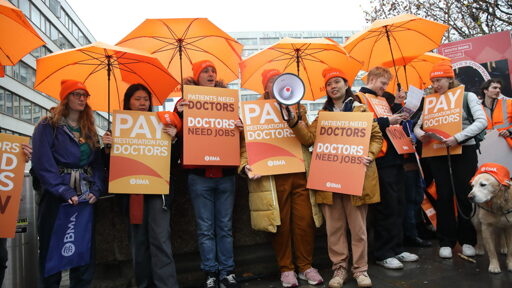
Resident doctors – formerly known as junior doctors, a term referring to qualified physicians undergoing clinical training – in England are on strike again from December 17 to 22, after the Labour government failed to adequately address concerns over pay and job availability. “Resident doctors need jobs, and when they find those jobs, they need to be paid fairly for them,” the British Medical Association (BMA), which represents tens of thousands of physicians, said in outlining the strike demands.
The dispute over resident doctors’ pay restoration has been ongoing for years. Workers warn that their real incomes remain below 2008 levels, with inflation eroding even the modest pay increases negotiated since then. In addition to wages, they are also protesting poor workforce policies that leave many qualified doctors unable to find National Health Service (NHS) posts, pushing them to emigrate or leave medicine altogether – despite mounting pressures on patients and services.
“As a children’s doctor, it [the situation in the health services] means children are waiting in the A&E for hours to be seen,” one of the strikers told the BMA. “The only way they can be seen urgently is if they literally can’t breathe.”
Read more: US–UK pharma deal sacrifices patients for profit
Health Secretary Wes Streeting made a last-minute offer to the BMA just days before the strike, claiming it would address both pay and employment concerns. The proposal was rejected by 83% of resident doctors who voted on it. “Last week’s offer from Wes Streeting to resident doctors provided no new jobs – he simply repurposed posts that already existed for the sake of ‘new’ jobs on paper,” the BMA’s resident doctors committee wrote on Wednesday. “Today’s strikes are the consequence of hurried, last-minute offers.”
While striking doctors continue to call for meaningful negotiations, Streeting and other senior Labour figures have turned to smearing the action. They have described resident doctors as irresponsible for striking during a period of high infection rates and heavy workloads, going so far as to imply that industrial action could bring harm to patients. “I think this is probably the worst thing the BMA have done since they marched against the foundation of the NHS in 1948,” Streeting attempted to argue.
But campaigners for a stronger NHS insist that responsibility for patient safety lies with the government. They say Streeting has failed to address the system’s most acute pressure points, including staffing. “Streeting knows that 16,600 patients died avoidable deaths last year because of delays in urgent and emergency care, caused by underfunding and neglect of the NHS and underfunding and neglect of social care,” said Tony O’Sullivan of Keep Our NHS Public.
“It’s just unacceptable to blame exhausted, overworked and underpaid doctors. It’s Streeting’s responsibility to support and retain our NHS staff,” he added on the first day of the strike.
Support for the action has also come from outside the health sector, with some MPs joining picket lines. “What’s putting patients at risk is not paying doctors properly and not ensuring they can stay in the NHS,” Jeremy Corbyn told local media. He urged the government to address the loss of public funds to the private sector instead of vilifying healthcare workers. The decision to strike despite enormous pressures, he argued, reflects resident doctors’ commitment to both patients and the NHS, rather than indifference. “Remember, people taking strike action lose money. They lose their salaries,” Corbyn said. “They feel they have no alternative. I’m with the doctors.”
People’s Health Dispatch is a fortnightly bulletin published by the People’s Health Movement and Peoples Dispatch*. For more articles and subscription to People’s Health Dispatch, click* here.
The post Doctors in England strike for jobs and pay appeared first on Peoples Dispatch.
From Peoples Dispatch via This RSS Feed.