

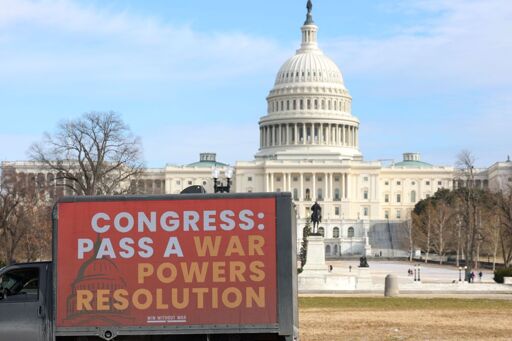
Caracas, December 18, 2025 (venezuelanalysis.com) – The US House of Representatives narrowly rejected a War Powers resolution that aimed to preemptively stop the Trump administration from launching military action against Venezuela.
The bipartisan resolution, sponsored by Democratic Congressman Jim McGovern, called for “the removal of United States Armed Forces from hostilities within or against Venezuela that have not been authorized by Congress.”
House members rejected the bill by 213 votes against 211 in favor, with nine representatives absent from the floor. The voting was almost perfectly split along party lines, with three Republicans supporting the resolution and one Democrat opposing it.
Congressman McGovern criticized “cowardly lawmakers” for “surrender[ing] responsibility on matters of war to a wannabe dictator in the White House.”
“The Constitution is clear: only Congress can declare war,” he told reporters. “Congress must affirm its authority and say no to an illegal war in Venezuela, no to yet another foreign conflict over oil, and no to more endless wars—and President Trump must obey the law.”
The bill’s defeat reportedly involved Secretary of State Marco Rubio and Secretary of War Pete Hegseth offering assurances to Republican House members that the administration does not plan to launch attacks against Venezuela and lacks a legal basis to do so.
A second resolution, brought forward by Democratic Congressman Gregory Meeks, proposed to curtail the Trump administration’s bombing campaign against small vessels accused of transporting US-bound drugs. The bill was defeated 216-210.
Since early September, US forces have struck 27 boats in the Caribbean and Eastern Pacific, killing almost 100 civilians. The bombings, which have been classified as extrajudicial executions by UN experts, have drawn growing scrutiny from the US political establishment.
Several representatives have raised concerns that Hegseth might have committed a war crime when US forces executed a double-tap strike to kill survivors on September 2.
The House resolutions followed two Senate war powers votes that were likewise narrowly defeated, with similar reports that Republicans received behind-the-scenes assurances.
The latest legislative efforts came amidst the US’ largest military deployment in the Caribbean in decades and reiterated threats of military operations against Venezuela. US warplanes have repeatedly flown close to Venezuelan territory since September.
Though the initial justification was a self-declared anti-narcotics mission, the White House changed its discourse in recent days, with Trump threatening a naval blockade to stop oil tankers from entering or leaving Venezuela. Last week, the US Coast Guard led an operation to seize a tanker carrying Venezuelan crude in international waters and levied new sanctions against shipping companies accused of transporting Venezuelan oil.
US politicians and foreign policy analysts described the attempted naval blockade as an act of war. Blockades imposed without a declaration of war or that are not sanctioned by the UN Security Council are considered illegal.
Trump doubled down on the oil rationale on Wednesday evening, claiming that Venezuela “threw US companies out” and that the administration “wants the oil back.”
“They [Venezuela] took our oil rights, we had a lot of oil there, as you know, they threw our companies out, and we want it back,” the US president told reporters at Joint Base Andrews.
After coming to power in 1999, the Hugo Chávez government introduced constitutional and legislative projects to enforce the country’s sovereignty over natural resources and the oil sector. A 2007 reform determined that Venezuelan state oil company PDVSA must hold majority stakes in all joint ventures.
Some corporations, including US oil giant Chevron, accepted the new rules, while others accepted the Venezuelan state’s offers for compensation for their assets. A third group, which included ConocoPhillips and ExxonMobil, rejected any negotiation and pursued international arbitration. Some cases were settled, while others remain open.
According to Politico, the administration has reached out to oil firms over a potential return to Venezuela in case of regime change but received little interest in return.
For its part, the Nicolás Maduro government has condemned the US’ escalations as blatant efforts to take over Venezuela’s natural reserves in violation of international law. Caracas has vowed to continue defending its sovereignty and called for an international response against US attacks.
Venezuelan allies China and Russia issued statements in recent days criticizing Washington’s ramped-up coercive measures. Chinese Foreign Minister expressed his country’s opposition to “unilateral bullying” and support for Venezuela in a Wednesday phone call with Venezuelan counterpart Yván Gil.
On Thursday, the Russian Foreign Ministry issued a statement expressing “concern” over Washington’s escalation. Moscow backed dialogue between Washington and Caracas and urged the Trump administration to avoid “steps that could lead to unpredictable consequences for the entire Western Hemisphere.”
Edited by Cira Pascual Marquina in Caracas.
The post US Congress Venezuela War Powers Resolution Defeated as Trump Claims to ‘Want Oil Back’ appeared first on Venezuelanalysis.
From Venezuelanalysis via This RSS Feed.