

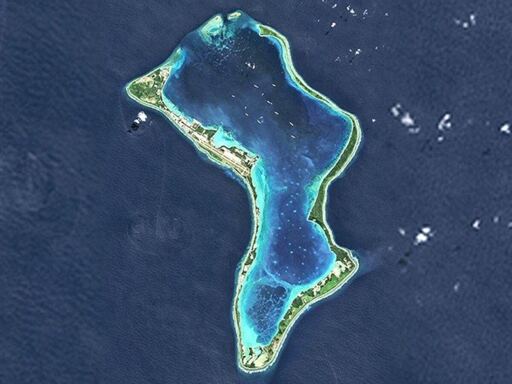
A UK minister has implied that US nuclear weapons could be located at the UK-owned Diego Garcia military base. The base, which is located in the Indian Ocean, is operated by the US.
Historically, Diego Garcia, which today forms part of the wider Chagos Islands, belonged to Mauritius. A treaty signed in May 20205 between the UK and Mauritius will officially end colonial rule over the Islands. However, the UK will retain ownership of the Diego Garcia base.
Chagossians, the islands’ native inhabitants, were forcibly displaced from Diego Garcia. This displacement was to make way for the US military’s Naval Support Facility (NSF). The US uses the island as a launch pad to project its imperial power into the Middle East.
Before US stealth bomber strikes on Iranian nuclear sites this summer, B2 stealth bombers were forward deployed to Diego Garcia. This served as a stark warning to the Iranian Government. It’s worth noting that B2 bombers are capable of carrying and using nuclear weapons.
Sovereignty transfer means business as normal
In a House of Lords debate on 25 November, peers discussed the Diego Garcia Military Base and the British Indian Ocean Territory Bill. The legislation would put the 2025 treaty on the British Indian Ocean Territory, Chagos Archipelago, into law.
Conservative shadow defence minister Annabel Goldie raised concerns that the Bill could lead to a ban on allies’ nuclear weapons from the island.
Responding, defence minister Vernon Coaker said:
I appreciate that they have questions about how the treaty protects the full operation of the base, and I want to reassure them that the treaty enables the continued operation of the base to its full capability.
The treaty and the Bill we are debating today will have zero impact on the day-to-day business on Diego Garcia. Importantly, it will not reduce our ability to deploy the full range of advanced military capabilities to Diego Garcia.
Describing the military capabilities as “advanced” could imply that they are not conventional, which, could possibly provide cover for nuclear weapons.
Coaker went on to say:
Noble Lords will understand that I pick my words with care in this particular context. I cannot and will not discuss operational matters on the Floor of this place, but I am confident that the Chamber would not necessarily want me to.
The location of nuclear weapons sites is not disclosed by the UK and US governments. This is in line with non-disclosure policies. This was iterated by a ministry of defence spokesperson, who told the Canary:
It remains a long-standing UK and NATO policy to neither confirm nor deny the presence of nuclear weapons at a given location.
The thorny question of nuclear weapons at Diego Garcia
The chairperson for Campaign for Nuclear Disarmament, Tom Unterrainer, told the Canary that his organisation believes that an agreement between the UK and US allows nuclear weapons to be transferred through the island.
Commenting on whether such weapons would be stored at Diego Garcia, Unterrainer said:
The US Naval Support Facility, stationed on Diego Garcia, is considered to be a key component of the US global military network. It is the case that nuclear-capable submarines and aircraft are regularly at the island, including B-2 nuclear-capable bombers.
We understand that part of the agreement between the UK and US granting access to Diego Garcia considers the transfer of nuclear weapons to be acceptable.
However, it is impossible to determine whether or not nuclear weapons are stored – medium- or long-term – at the base because as with many nuclear-related issues, governments are not truthful about exactly what is going on.
A key point of debate regarding the potential presence of nuclear weapons at Diego Garcia is the possibility that their presence could be a breach of the African Nuclear-Weapon-Free Zone Treaty. Unterrainer added:
The Chagos Islands or, as it has been known, the British Indian Ocean Territory (BIOT), is not a party to the Treaty of Pelindaba / African Nuclear-Weapon-Free Zone Treaty.
The British and American governments refuse to recognise the Chagos Islands as part of the zone. Mauritius is a signatory to the Treaty. So, as things stand there is no obvious, definite, violation of the Treaty of Pelindaba and any disputes are parcelled with ongoing territorial considerations.
When the Chagos Islands, Diego Garcia included, are transferred to Mauritius it will be under an agreed Treaty that will no doubt seek to account for the presence or potential presence of nuclear weapons on Diego Garcia.
It will be interesting to see the full text of the Treaty and I’m certain that experts in the field will seek to probe any possible contradictions. Such muddles as these indicate the degree to which nuclear-armed states seek to ignore or undermine anti-nuclear treaties.
Diego Garcia: A guarantor of Western security
The Diego Garcia plays a critical role in hosting nuclear-capable submarines and bombers. The charity, Friends of the British Overseas Territories, told the Canary:
Diego Garcia is a guarantor of Western security…[And]…while the extent of nuclear stockpiling remains unclear, its role in supporting nuclear platforms is well‑established. The UK could have shielded the base from being disputed by invoking Article 298 of UNCLOS, which exempts the sovereignty of military installations from compulsory arbitration.
Once the territory is surrendered to Mauritius, any nuclear presence in the Chagos Islands would breach the Pelindaba Treaty and trigger fresh legal disputes and uncertainties.
It is a bad deal for the US, destabilising for the UK, and should be stopped.
The transfer could be the lynchpin for new legal disputes.
The Treaty on the Non-Proliferation of Nuclear Weapons (NPT) aims to limit nuclear stockpiles. Introducing or developing new nuclear weapons on Diego Garcia would violate the treaty’s principles. Unterrainer told the Canary that Britain’s colonial occupation of the island predates the NPT. Nevertheless, deploying such weapons there would represent a double violation, with limited mechanisms in the NPT to hold states accountable.
Featured image via the Canary
By Tom Pashby
From Canary via This RSS Feed.