

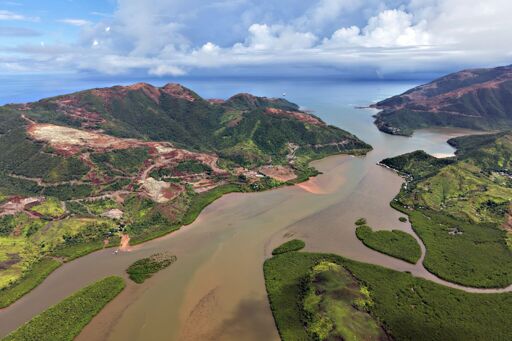
While these communities grapple with the fallout of extraction, Southeast Asia is racing to an electric-vehicle future.
ALBAY, Philippines — Crisologo Anino has spent his life reading the waters off Ayoki Island in Surigao del Sur.
But now the sea feels unfamiliar. “The seas are now more dangerous and rougher than before,” he said.
In the past, fishers like Anino would stay close to shore during bad weather. Now, pollution from nearby nickel mines forces them farther out.
In Madrid town, Alberta Arnego Cuartero put it bluntly: “Our land is being taken and shipped to other countries — that’s how they’re making money.”
Across the channel on Dinagat Island, conservation specialist Mavic Hilario saw the same pattern on land. “Some say mining brings jobs. But it destroys fishing grounds, farmland, and water sources that sustain these communities long-term.”
These voices anchor the 2025 Climate Rights International (CRI) report, which documents displacement, polluted waterways, and rising climate risks in these major nickel mining communities.
A projected 60-percent rise in global nickel demand by 2040 is colliding with the growing harm from mining and climate change, leaving coastal communities more exposed and prompting urgent calls for fairer energy transition mineral governance.
Hidden cost of booming EV market
While these communities grapple with the fallout of extraction, Southeast Asia is racing to an electric-vehicle (EV) future.
Ember’s new analysis shows ASEAN emerging as one of the fastest growing EV markets. Singapore and Vietnam are nearing 40 percent EV sales, Thailand has reached 20 percent, and Indonesia has now surpassed the United States.
Southeast Asia is becoming a major driver of a global market where more than a quarter of new cars sold in 2025 are electric, according to the energy think tank.

Fisherfolk in polluted water in Dinagat Island. October 2025. Photo by Ivy Mangadlao for Climate Rights International.
Report author Euan Graham called it “a major turning point,” noting that emerging markets are now leading the shift to electric mobility.
“This momentum reflects the clear economic and environmental benefits increasingly recognised by both consumers and policymakers,” Ember’s Asia Energy Analyst Lam Pham said in a statement.
But Ember’s dataset exposes a deeper contradiction of the same governance gaps harming communities in the Philippines that now shape a global supply chain feeding China’s fast growing EV industry.
As cheap Chinese electric vehicles flood these markets, the nickel powering their batteries increasingly comes from places like Dinagat and Surigao del Sur where oversight is weak and communities say they are paying the price.
Leopoldo Urquia of Surigao told CRI that fishers sometimes go missing after risking rougher seas just to catch enough fish to buy rice. “It is a danger that would not exist if nearby waters were clean.”
Anino related the rougher seas to both mining pollution and climate change which now compound each other and expose them more to coastal risks like storm surges.
Blurry trail for where the nickel goes
An earlier CRI shipment-tracking analysis with Empower showed that once Philippine nickel leaves the country, the harms communities endure disappear from view because it becomes nearly impossible to trace where the ore (raw nickel-bearing rock) ends up or who is responsible for the conditions under which it was mined.
Empower followed 3,473 export shipments from 13 mining companies and found that 92 percent of Philippine nickel ore is exported to China or to Chinese-run processing hubs in Indonesia.
After that point, the trail goes dark.
Political control in Dinagat
According to the CRI–Empower investigation, the Philippine nickel industry is largely controlled by a small group of politically connected families. The study says three key figures — Hilario G. Pagauitan, Antonio L. Co, and Ferdinand (also referred to as Francisco Borja in some filings) S. Borja — hold ownership or leadership roles in at least eight of the 13 companies it examined. This level of control, reinforced by shared board seats and overlapping company ties, creates what the report describes as an industry that is difficult to trace and tightly linked from mining to export.
The report urged closer scrutiny of firms whose ownership appears fragmented on paper but may be shaped by the same political or familial interests, including operators in Dinagat and politically connected companies in Surigao del Sur like Oriental Vision Mining Philippines Corp. (OVMPC) and Kafugan.
This concentration of control highlights the need for stronger oversight, a point echoed at the Fourth Dialogue under the Just Transition Work Program in Addis Ababa in September 2025, where government delegates, labor groups and civil society organizations called for fairer benefit-sharing, more local value addition, and better social and environmental protections.
Lacking safeguards
According to the same analysis, inside China’s processing system traceability becomes “highly limited.”
Ore from multiple Philippine mines is mixed, aggregated, or relabeled, making it difficult to assess if it was extracted responsibly. The report said that opacity persists not because traceability is impossible but because the system lacks safeguards like segregation and disclosure.
This opacity deepens further downstream. Major Chinese refiners such as Tsingshan Holding Group and Ningbo Lygend dominate this stage of the supply chain. Their large processing parks in Indonesia receive ore from multiple sources and operate with limited public disclosure, further reducing mine-level traceability.
For global automakers and battery manufacturers, this means that even companies with strict sourcing policies cannot verify whether the nickel in their supply chains is linked to environmental damage or human rights harms in the Philippines.
For communities like Ayoki and Madrid, the consequences are immediate. A father from Ayoki Island described days when his family survived only on breadfruit because pollution made fishing impossible. A mother from Tubajon said, “It is now hard to feed my family. We are hungry most of the time.” (DAA)
The post ASEAN’s EV surge runs on untraceable Philippine nickel appeared first on Bulatlat.
From Bulatlat via This RSS Feed.