

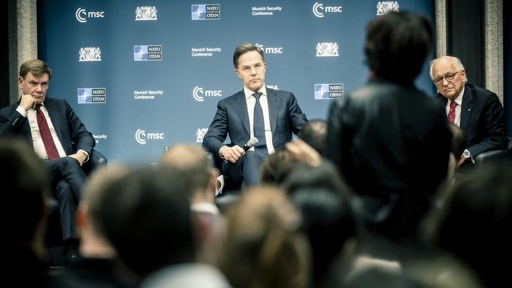
Sitting in a lively room in the University of Amsterdam, I ask a question about the respect accorded by students to their former prime minister and now head of the North Atlantic Treaty Organization (NATO), Mark Rutte. The room is animated and funny. No one seems to accord Rutte with the respect that he might deserve. They see him as an empty suit who served as prime minister from October 2010 to July 2024, a total of over five thousand days (the longest serving head of government in Dutch history). Under Rutte’s leadership, the Netherlands cannibalized its social welfare state and strengthened its repressive apparatus: more money for guns and less for children’s health. I asked them about Rutte not only because of his tenure in Holland, but also because of his role at the helm of NATO. He had just made a startling observation at the Munich Security Conference on December 11, 2025:
Conflict is at our door. Russia has brought war back to Europe, and we must be prepared for the scale of war our grandparents or great-grandparents endured. Imagine it, a conflict reaching every home, every workplace, destruction, mass mobilization, millions displaced, widespread suffering and extreme losses.
The picture Rutte painted of total war seems bizarre in Amsterdam, a city of less than one million which received about 20 million tourists in 2024 and looks to be beating that number this year. The streets are packed, the museums crowded, and a general nonchalance in the air as Christmas approaches. I was sitting down at the University to have a conversation with Chris De Ploeg, the author of “De Grote Koloniale Oorlog” (The Great Colonial War), a contemporary classic in Dutch, and the lead candidate of the left-wing De Vonk formation that will go together into the Amsterdam local elections next year (with Chris as the lead candidate). Chris is clear: during Rutte’s tenure, anytime there was a discussion about needing funding for human needs, Rutte’s government would say that there were no funds but the moment the discussion came to raising military spending … well, the funds become immediately available. “This is not about economics,” Chris says, “but about politics. This is about political choices.”
Currently, the Netherlandsranks seventh amongst NATO countries in terms of military spending. The country spends €24 billion annually on the military, which amounts to 2% of Gross Domestic Product (GDP) or 3.7% of total government spending (2022 data). The Netherlands has met the previous 2% target but is far short of the new 5% of GDP target for military spending. To get to that amount, the Netherlands will have to triple military spending to €60 billion. This will mean to reduce government investment in social security, in healthcare, in education, and in public services as well as to increase public debt. This would be a fundamental shift in national priorities. “Without a strong left-wing breathing down their necks,” De Vonk argues, the liberals and the right-wing “will sell our entire welfare state to the military”. That is already on the cards, and without formations such as De Vonk, the train to militarization has already begun. Amsterdam will no longer be the city of tourists. It will be further hollowed out.
The current mayor of Amsterdam Femke Halsema is from the Green Left (GroenLinks) party. She might be interested to know that if the NATO states, including the Netherlands, increase their military budgets to 5%, this will not only impact their fiscal policy but it will have an enormous carbon footprint. According to Scientists for Global Responsibility’s rubric, any addition of a USD 100 billion to the military will result in 32 million tons of carbon dioxide emissions. An increase by NATO by 5% would amount to a military budget of USD 2.54 trillion (in 2024, NATO spent USD 1.15 trillion). This increase would generate 365 million tons of carbon dioxide emissions, which is almost the total annual emissions of countries such as Italy or the United Kingdom. The matter of the carbon footprint from the 5% military spending has been raised by no major European politician.
Shadow of war
A day after Rutte made his speech, British Armed forces minister Al Carnstold The Telegraph, “For the last 50 to 60 years, we have been reliant on US security guarantees and now, with multipolar threats facing the US, they may not be as forthright as they have in the past.” Due to this US military umbrella, Carns said, the UK had “outsourced our lethality to others. We’ve got to make sure that we increase our lethality.” Then, he made the following interesting observation: “The shadow of war is knocking on Europe’s door once more. That’s the reality. We’ve got to be prepared to deter it. Collectively, in NATO, we’ve got to remember that numerically – we outmatch Russia significantly.”
There are two points to consider here: first, whether Russia is a real threat to Europe, and second, whether Europe can “outmatch” Russia.
In mid-November 2025, German Federal Minister of Defence Boris Pistorius told Frankfurter Allgemeine Zeitung that Russia would attack Europe in 2029 or “as early as 2028, and some military historians even believe we’ve had our last peaceful summer.” A few weeks later Russian President Vladimir Putin attended the Collective Security Treaty Organization summit in Bishkek (Kyrgyzstan), where he denied that Russia had any desire to attack Europe. He said such ideas were a “lie”, were “nonsense”, and were “ridiculous”. When pressed by reporters about intentions to invade Europe beyond Ukraine, Putin said: “The truth is, we never intended to do that. But if they want to hear it from us, well, then we’ll document it. No question.” In other words, Russia was prepared to give a guarantee in writing. Not only has Russia said that it does not intend to invade Europe, but there is no reason for Russia to do so.
The language of war is reckless. Russia is a nuclear weapons power, and it will certainly not hesitate to use these weapons if it feels threatened. But beyond that, the European countries have themselves admitted that they simply do not have the strength to carry on a long war. The former UK Armed Forces Minister John Spellar told parliament in March 2024 that the UK had the ability to last ten days of conflict, and the UK’s own Defense Committee wrote that it would take many years to build up stockpiles of ammunition. It is probably the case that the combined force of the NATO armies, even without the United States, can withstand a Russian invasion. And Russia would be foolish to test the nuclear weapons umbrella that is held by France and the UK.
Is there really a shadow of war? Or is this talk of war merely a way for anachronistic politicians such as Rutte, Carns, and Pistorius to feel relevant in a changed world? It is time for people such as Rutte to step off the stage of history and hand that stage over to people who are within formations such as De Vonk, sensitive people such as Chris De Ploeg, Suzanne Lugthart, Freya Chiappino, Carlos van Eck, Niels Moek, Hidde Heijnis, David Schreuders, Nina Boelsums, and Jazie Veldhuyzen. They are interested in humanity. Not in the hallucinations of permanent war.
Vijay Prashad is an Indian historian, editor, and journalist. He is a writing fellow and chief correspondent at Globetrotter. He is an editor of LeftWord Books and the director of Tricontinental: Institute for Social Research. He has written more than 20 books, including The Darker Nations and The Poorer Nations. His latest books are On Cuba: Reflections on 70 Years of Revolution and Struggle (with Noam Chomsky), Struggle Makes Us Human: Learning from Movements for Socialism, and (also with Noam Chomsky) The Withdrawal: Iraq, Libya, Afghanistan, and the Fragility of US Power. Chelwa and Prashad will publish How the International Monetary Fund is Suffocating Africa later this year with Inkani Books.
This article was produced byGlobetrotter.
The post The fabulous hallucinations of the European leaders appeared first on Peoples Dispatch.
From Peoples Dispatch via This RSS Feed.
I mean… russia is making war and invaded a sovereign nation
