

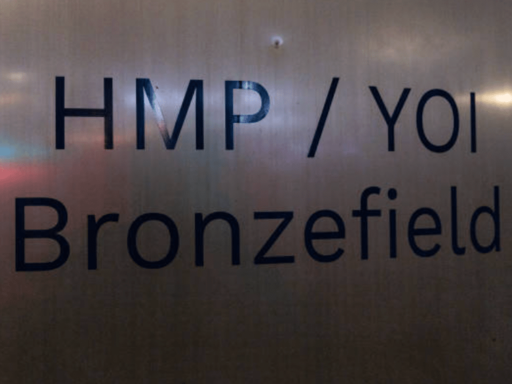
The actions of both prison and police officers at HMP Bronzefield have been nothing short of disgusting. MP Zarah Sultana and other concerned activists rallied outside the prison to ensure that an ambulance was called for prisoner Qesser Zurah. Prisoners for Palestine explained:
Qesser was arrested in a dawn raid on November 19th by counter-terrorism police in the third wave of Filton arrests. She was held and interrogated under counter-terrorism powers, and then remanded to prison for a non-terrorism related offence on allegations of being connected to the Filton action, which saw over £1 million in damage caused to Elbit’s research centre for Israeli weapons, making her one of the Filton 24.
Qesser is one of the 8 hunger strikers was detained at HMP Bronzefield in Surrey, the biggest women’s prison in Europe. It is run by private company Sodexo. Zuhrah, 20-year-old actionist and hunger striker was left alone on her cell floor for hours on Thursday 11th December, ignored till the early hours of the morning. What then ensued was, as the Canary extensively reported, was a protracted standoff between people outside begging for Zuhrah to be seen by paramedics and prison and police officers refusing to do so.
HMP Bronzefield has form for this
The anti-genocide hunger strikers have been abandoned by the British state and by the mainstream media. However, it’s important to recognise that the treatment of Qesser is not an anomaly. Instead, it follows a pattern of sickening treatment from both HMP Bronzefield, and the prison system more broadly.
The recurrence of medical negligence in British prisons towards prisoners the hunger strikers and actionists are experiencing is not an anomaly. I have been working with prisoners on an ad-hoc basis since 2007 and supported various campaigns demanding justice for people who have died at the hands of the British state in prison and in custody in various capacities.
Two women died in HMP Bronzefield this year alone on 27th and 31st July 2025, days apart. Prisoners feared going to sleep, afraid of not waking up, and concerned over why women were dying unnecessarily in Bronzefield.
A Ministry of Justice (MoJ) report stated HMP Bronzefield was the most expensive women’s jail in the country, costing over £65,000 a year to keep a woman in jail. And, the facility is the largest women’s jail in Europe despite severe concerns over treatment of prisoners. The MoJ themselves said the “sobering” report was:
yet another example of how the prison system is not working for most women
Unacceptable failures
In September 2019, 18-year-old Rianna Cleary a Black young vulnerable care leaver, was imprisoned at HMP Bronzefield whilst heavily pregnant. She had alerted prison staff who ignored her calls for support for 12 hours. She had been left to give birth alone, forced to chew her own umbilical cord to sever her baby from her. Her baby Aisha had died due to medical negligence by HMP Bronzefield. The numerous failures against her cannot be forgiven, nor baby Aisha Cleary forgotten. Not only had Rianna been ignored and unsupported for complex PTSD and grief, the prison officers guilty for ignoring her calls were given counselling instead of her.
Natasha Chin aged 39 was also denied medical care and died 36 hours after being admitted into HMP Bronzefield on 18th July 2016. The prison’s excuse was that they were unaware the cell bell was faulty. She had a history of documented complex needs. Healthcare staff had failed to ensure she had taken her medication and not checked in on a newly admitted prisoner. She had been left to vomit alone for at least 9 hours.
Inquest importantly highlighted over 17,000 people are held on remand in prisons in Britain without being found guilty of a crime which should concern us all – not solely their families. At least 59 people have died whilst on remand in prisons in England and Wales this year. The British state is prepared to allow the hunger strikers to add to this statistic.
Connecting the dots
During Qesser’s hunger strike around day 30, she wrote a beautiful letter, a show of solidarity to amplify people seeking asylum whilst also on hunger strike to fight their threatened deportations. “From one hunger strike movement to another” is a searing letter that shows just how horrific prison systems are – not because something is wrong or broken, but because that’s how they’re supposed to be. A hunger strike is the last resort of people who have no other option.
Just as Qesser showed with her letter, it is incredibly important that we continue to connect the dots and join in solidarity with prisoners often forgotten who remain marginalised from our movement spaces. That means both the anti-genocide hunger strikers andother prisoners who are even more forgotten by mainstream media, politicians, and society at large.
Featured image via the Canary
From Canary via This RSS Feed.