

It was a moment that those of us old enough to remember will never forget. On the evening of March 20, 2003, untold numbers of people were being massacred by U.S. missile strikes in Baghdad and the carnage was being triumphantly broadcast live by every major television outlet in the country.
As rockets continued to rain down on apartment buildings and city centers in Iraq over the next few days, the U.S. media was celebrating what it described as a campaign of shock and awe that was sure to quickly topple the hated Saddam Hussein regime. What we got instead was a protracted war of attrition that traumatized an entire generation of Iraqis and took the lives of hundreds of thousands of people, including thousands of U.S. soldiers, leaving Iraq in a state of political and economic disaster.
The media coverage of that first wave of attacks was especially hard for the millions of us who had opposed and marched against the war even before it had begun, but we knew all along that we were being lied to. Throughout 2002 and 2003, we had watched and seethed as the media — CNN and the New York Times in particular — joined the George W. Bush administration in making the case for invading Iraq. From false reports of Hussein’s ties to the perpetrators of the attacks on the World Trade Center, to unsourced, unverified, and fake claims that Hussein was stockpiling weapons of mass destruction, the media seemed to have unanimously agreed that war with Iraq was a great idea, especially when it could be streamed live to millions and sponsored by GM or Procter & Gamble.
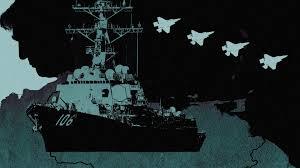
Fast forward to 2025 and it’s alarming how little has changed. The for-profit media sphere, with few exceptions, continues to parrot the larger talking points of U.S. imperialism even as it pretends to question and challenge the Trump administration. And this is nowhere clearer than in its recent reporting on Venezuela. From the New York Timesand the Wall Street Journal to the Washington Post, U.S. media outlets have helped justify U.S. actions against Venezuela by both propagating false narratives and actively advocating regime change and war. Fighting these false narratives and organizing a united front of labor and the social movements, including the movement for Palestine, are essential for stopping the war this time.
Misleading Reporting and False Narratives
One of the most insidious aspects of the bourgeois press is its careful cultivation of the appearance of being an unbiased watchdog of power and an objective source of truth. Unlike honest propaganda, bourgeois journalism claims to have no political agenda. But such disavowals of politics are always nothing more than a mask for a true politics of the status quo. As the literary critic Terry Eagleton astutely observed,
Literary theories are not to be upbraided for being political, but for being on the whole covertly or unconsciously so – for the blindness with which they offer as a supposedly ‘technical’, ‘self-evident’, ‘scientific’ or ‘universal’ truth doctrines which with a little reflection can be seen to relate to and reinforce the particular interests of particular groups of people at particular times.
What is true of literature is true too of that strangest form of literature we call journalism. Indeed, bourgeois-owned publications like the Washington Post and the New York Times provide just enough criticism of the powers that be to maintain their air of intellectual objectivity, without ever challenging the deeper underlying premises that limit that criticism to a narrow band of acceptable discourse. When it comes to Venezuela, this means sometimes questioning and even contradicting the specifics of the Trump regime’s claims about the country and its leader, Nicolas Maduro, while simultaneously affirming and helping to construct the larger bipartisan narratives and assumptions upon which the U.S. imperialist agenda rests.
For instance, while the Times has done a fine job of correcting some of the Trump administration’s more unhinged claims about Maduro, such as the accusations that he is associated with Tren De Aragua, or Cartel de Los Soles (an organization that does not actually exist), they continue to perpetuate the idea that Maduro and Venezuela are somehow part of a larger threat to global democracy and to the United States, and that the country is acting in violation of international law.
One way this is achieved is by consistently emphasizing the connections between Venezuela, Iran, Cuba, and China, as if trade relations with these countries makes Venezuela part of some nefarious “axis of evil.”
A November article in the Times, for instance, begins thus:
Cuban bodyguards, Chinese radars, Iranian gunboats and Russian missiles.
Venezuela’s government has spent billions of dollars over the years on weapons and security services from America’s adversaries as it deepened its standoff with the United States.
Sounds terrifying, doesn’t it? But in its rush to paint Venezuela as part of a global coalition of anti-American forces, the article fails to mention that up until the imposition of increased U.S. sanctions in 2017, Venezuela continued to purchase weapons and weapons systems from several U.S. allies, including the United Kingdom, which supplied Venezuela with millions in arms exports between 2012 and 2022, and Spain, which in 2005 signed a $2 billion contract for military vessels and aircraft that was still being fulfilled in 2010.
In fact, even as late as 2004, five years after Hugo Chavez was first elected, the U.S. itself sold $8 million in weapons to Venezuela in a last-ditch attempt to get the country to cooperate with its so-called anti-drug efforts in the region. And of course, the country still owns several F-16s it purchased from the U.S. in the 1980s. While such sales are small compared to purchases from other states, the fact remains that Venezuela’s trade relations and military contracts with China, Russia, and Iran are largely a product of U.S. sanctions, not part of a larger global alliance.
But it is the country’s connections to Cuba that has really captured the imaginations of the media. The latest obsession with so-called “Cuban bodyguards,” a Washington talking point that suddenly every media outlet seems to be parroting, is especially telling, drawing as it does upon cold war tropes of a Soviet threat right in the U.S. backyard. But the Soviet Union is long gone, and Cuba is hardly a threat to the U.S. or any country for that matter. So why emphasize their connections to Venezuela so much and so often? After all, despite the embargo, Cuba maintains trade relations with several U.S. allies, including the European Union, which is Cuba’s largest trading partner. The answer is that demonizing Venezuela and Cuba as breeding grounds of global espionage is an essential part of a bipartisan policy toward Latin America. The characterization of the two countries as common enemies of the U.S. therefore becomes an essential part of the largely unquestioned editorial framework for those reporting on the region who can’t help but jump on the bodyguard connection as evidence of some kind of wrongdoing.
This same bias is also applied to discussions of U.S. sanctions, which are largely treated as legitimate law. This has become especially clear in the wake of Trump’s illegal seizure of a Venezuelan oil tanker in the Caribbean last week. Since then the Times has repeatedly reported on what it has called a dark fleet of smuggling vessels that “secretively move oil from sanctioned countries.” But this is a total fabrication. Those so-called smuggling vessels are not breaking any laws, except for the arbitrary sanctions imposed by the U.S. government itself, which has no legal jurisdiction in international waters. This is not to imply that international law is any more just in most cases than mere might, but it does show the hypocrisy of the media which, like the United States, seems to pick and choose which laws it thinks matter and which don’t.
Reading the Times, or practically any other U.S. media outlet*,* you would think that Venezuela was part of some global conspiracy (perhaps alongside Cuba and Iran) to flaunt international law, and that the U.S. is rightly holding them accountable. But there are no internationally recognized laws against Venezuelan oil exports to Cuba or China or Iran, only U.S. and European sanctions driven by imperialist foreign policy.
Unfortunately, that important distinction is rarely made in the media. When the Times reports about the efforts of Venezuelan vessels to avoid detection, they fail to explain that these vessels have perfectly legitimate reasons to evade interception or attack by the U.S. military, which itself regularly subverts actual international laws as it sees fit. The dozens of attacks on Venezuelan vessels since September is perhaps the most obvious example of this. In this sense the hijacking of the Venezuelan oil tanker has nothing to do with law and is little more than an act of war and blatant military aggression. The fact that the U.S. media has worked so hard to say everything but that simple fact is damning evidence of their complicity in the war already being waged against Venezuela.
And of course there are the repeated accusations that the Maduro regime and Venezuela is full of narco-terrorists and that the actions against Maduro are somehow part of a larger war on drugs. While the State Department claims that Maduro and the Venezuelan military are connected to the drug trade in Colombia and Venezuela, these claims have been significantly overblown by the U.S. media, which has swallowed hook, line, and sinker the ridiculous idea that one can wage a war on drugs or that drug abuse and overdoses are somehow a product of supply.
In a rambling and fact-free editorial published the same day as Trump’s first boat strike in the Caribbean, The Wall Street Journal‘s editorial board not only promoted the debunked claim that “the Maduro regime owns the Cartel de los Soles,” but also argued that the Maduro government maintains its power more through money collected from its connections to drug trafficking than its sale of oil. The fact that such a claim is completely unverifiable is by design, but it nonetheless fits nicely with the newspaper’s attempts to bolster the Trump administration’s position that Venezuela is a narco-terrorist state hell-bent on flooding the United States with dangerous drugs, when in fact, Venezuela is but a street kid when it comes to global drug distribution.
Meanwhile, it is the demand for, not the supply of cocaine — a widely acceptable drug of choice for many of the most wealthy in the United States, including several politicians — that is actually driving drug production in Latin America, not corrupt leaders like Maduro, who are scrambling to maintain power. But Venezuela produces and traffics only small amounts of the world’s cocaine, most of which actually comes from Colombia and only a portion of which is trafficked through Venezuela. Ironically, the United States is also listed as a major transit country for cocaine to the European Union, and yet you don’t see Le Monde calling for regime change in Washington or an embargo of U.S. oil tankers.
Open Advocacy for Intervention and Regime Change
Such deceptions are only the tip of the iceberg, however. Both the Times and the Wall Street Journal, like other media outlets, have recently given ample space in their opinion pages and podcasts not only to demonize the Maduro regime, but to directly argue in favor of regime change and further military strikes against Venezuelan assets, including so-called drug cartel sites within Venezuela.
On November 17, the New York Times, for instance, published an editorial by columnist Brett Stephens titled “The Case for Overthrowing Maduro.” In that article, Stephens trots out the tired trope of Venezuela’s ties to China, Russia, and Iran, claiming, from a purely nationalist U.S. perspective, that Maduro’s regime in Venezuela provides America’s enemies “a significant foothold in the Americas.” In other words, the biggest problem with Maduro is that his government is not sufficiently subservient to U.S. imperial interests.
Stephens then explains how to go about getting rid of Maduro and replacing him with someone more amenable to the United States. Unsurprisingly, he argues for direct force, claiming that there are important differences “between Venezuela and Iraq or Libya,” and this time it will be different. Stephens’s solution is giving Maduro the “Noriega treatment,” and seizing the country’s major military bases, a move that would likely require thousands, if not tens of thousands of troops to pull off.
Such adventurism is easy for bourgeois armchair pundits like Stephens who believe that might makes right and who have nothing to lose in the event of war. But for the working people of Venezuela, such an outcome — becoming a vassal state of the U.S. — would be a disaster.
Not to be outdone, on December 11, guests on the Journal‘s daily podcast, Potomac Watch, gleefully argued in favor of further attacks on Venezuelan oil vessels and strikes within the country as part of a plan to depose Maduro and install the right-wing freemarketer María Corina Machado. Opinion columnist and right-wing hawk Mary O’Grady admitted she wasn’t an expert on the law, but nonetheless said she was “all in favor” of the seizure of the Venezuelan tanker and that “we should do more of it.” She and the podcasts host Paul Gigot then donned their military strategy caps to talk about the need for “kinetic strikes” on supposed drug facilities in the country, and covert actions by the CIA in order to remove Maduro from power, implying that anything less would be a disaster for Latin America. Echoing the Journal‘s previous support for upstart Juan Guaidó, Gigot then argued that deposing Maduro would:
Not be a coup d’etat; it would not be an act of American imperialism. It would be American assistance to a democratic opposition to actually obtain their rightful place running the government in Caracas.
Paul, it seems, “doth protest too much.”
Indeed, the idea that Machado, now in Europe, is the rightful heir to the presidency is little more than a repackaged Washington talking point that is not grounded in facts. This is because the majority of the people in Venezuela have had no true democratic options since Maduro took power. While it is true that Maduro is head of an authoritarian regime, one which has heavily cracked down on working class organizations, replacing him with a right-wing bourgeois servant of U.S. imperialism is no solution and it is not the place of the U.S. to impose such changes. Only the working class of Venezuela have the means to confront and replace Maduro with a legitimate leader that represents the interests of the working class and not U.S. imperialism. Of course this is anathema to everything the Wall Street Journal and most U.S. media stand for.
The Working Class Needs a Working-Class Press
While all of this will come as no surprise to regular readers of Left Voice, the explicit bias and nationalist editorial policy of the vast portion of the U.S. media is a perfect example of Marx’s dictum that “the ideas of the ruling class are in every epoch the ruling ideas.” The for-profit media operates always within a very narrow band of acceptable discourse, and any ideas that challenge capitalism or the premises of U.S. imperialism are beyond consideration.
Just as happened in 2003, the U.S. media cannot help but advocate, inadvertently or directly, for regime change or war with Venezuela, because it is fundamentally incapable of confronting the myriad assumptions and contradictions upon which the whole profession is based. Primary among these is the fact that, as privately owned for-profit enterprises, newspapers like the New York Times or the Washington Post, and news networks like Fox and MSNBC, operate in the service of the ruling class itself. And no amount of supposed editorial autonomy can change that.
The only solution is for working people themselves to produce their own media, of and for the working class. This is what Left Voice does and this is what we will continue to do, fighting to defend the global working class, and to build working-class power and organization from within the heart of the imperialist beast. Towards this end we will continue to advocate in our pages and on the streets for a united front of labor unions, social movements, and the working class and oppressed to confront Trump and the U.S. state at every turn. In particular, the Palestine movement — which knows a thing or two about confronting the U.S. media propaganda machine — needs to unite with sectors that oppose intervention in Venezuela and build a strong anti-imperialist, anti-war movement against the war and U.S. imperialism more broadly.
The post The U.S. Media Is Pushing for Regime Change and War in Venezuela appeared first on Left Voice.
From Left Voice via This RSS Feed.