

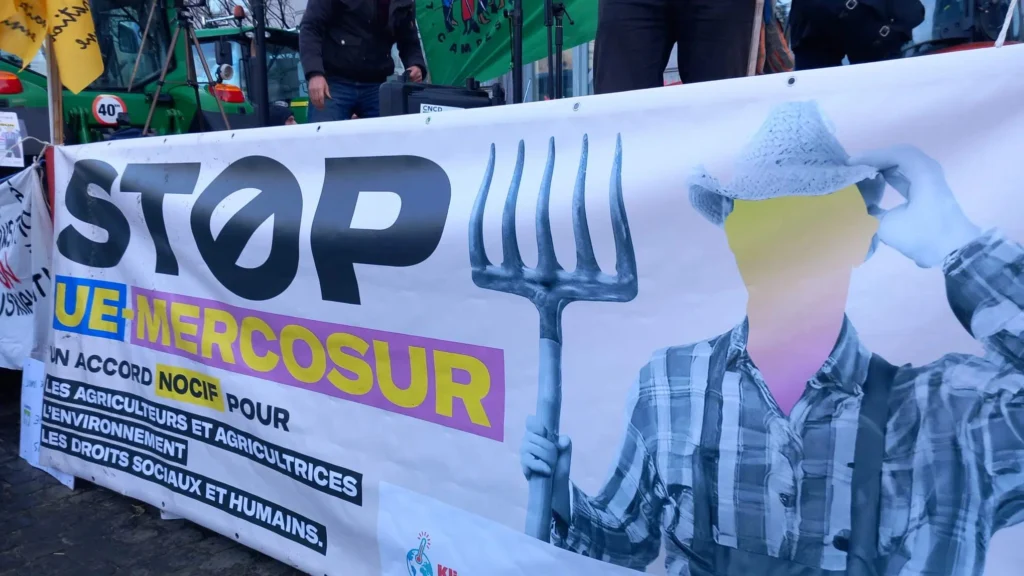
A cross-border rural alliance challenges a neoliberal deal that boosts corporate power, accelerates deindustrialization, and undermines democratic control over food systems.
From Paris to Brussels, a growing “street coalition” of farmers is denouncing what they call a “stab in the back” and a “death sentence” for family farming: the EU – MERCOSUR Partnership Agreement.
RELATED:
EU Advances Trade Agreements With MERCOSUR and Mexico
This is more than a trade dispute; it exposes a failing neoliberal model in which European elites seek to turn Latin America into a “Green Fortress”, a supplier of cheap raw materials and a captive market for high-tech cars, laying down the rural working class on both continents to protect multinational profits.
Behind a green discourse of environmental protection, the agreement advances a classic extractivist agenda that treats Latin American sovereignty and the livelihoods of small European farmers as collateral damage.
French farmers blocked a highway near Paris with tractors, warning that the EU-Mercosur trade deal will devastate European agriculture.
Follow: https://t.co/7Dg3b41hTx pic.twitter.com/sxGYjv7Aur
— PressTV Extra (@PresstvExtra) December 17, 2025
From Brussels to Montevideo
To understand today’s anger on the streets, it is necessary to look at the long and unequal history of these negotiations. The process has two key milestones that reveal the EU’s persistent drive for dominance.
The first is the June 2019 “Agreement in Principle”: after 20 years of intermittent, often opaque talks, a political deal was announced in Brussels to coincide with the G20 summit in Osaka, and leaders celebrated what they framed as “the end of the road” despite growing warnings from social movements.
The second is the “Final Conclusion” of December 6, 2024, in Montevideo, when the European Commission president and MERCOSUR leaders declared the technical talks closed and unveiled new sustainability annexes—the so-called “Green Annex”—which had kept the pact frozen since 2019.
The delay was about making the deal politically acceptable in Europe. Researchers and farmers alike argue that the new sustainability requirements are mostly cosmetic and fail to guarantee that South American producers will be held to the same strict environmental rules imposed on Europeans.
‘Hope Macron, Meloni aren’t afraid to lose competitiveness with Brazil!’ – Lula urges EU states to ratify Mercosur-EU deal worth $22 trillion in global GDP
The free trade zone faces French opposition over ‘unfair competition,’ with lobbying focused on Italy as the dealbreaker. pic.twitter.com/tHi6ogvuHD
— Viory Video (@vioryvideo) December 17, 2025
Three pillars of asymmetry
The EU – MERCOSUR it is a broad Partnership Agreement meant to reshape intercontinental relations across three pillars:
At its core lies the Commercial Pillar, designed to create one of the largest free trade areas in the world, covering some 780 million people.
The plan is to eliminate tariffs on 92% of MERCOSUR exports to the EU and 91% of EU exports to MERCOSUR. Europe seeks to flood South American markets with high-value machinery, automobiles, chemicals, and pharmaceuticals freed from today’s high tariffs.
While MERCOSUR countries gain “preferential access” above all for raw materials and agro‑exports such as beef, poultry, sugar, ethanol, and wine.
This arrangement risks locking Argentina, Brazil, Paraguay, and Uruguay into a renewed cycle of deindustrialization, where local SMEs cannot compete with the technological and financial power of German or Spanish industrial champions.
Farmers to block Brussels on Thursday, protesting the EU-Mercosur trade deal they say endangers European agriculture and local markets. Authorities warn of major disruptions.#BrusselsMorning #BrusselsProtest #FarmersUnite #EUMercosur
Read More: https://t.co/OYhFODGPjK pic.twitter.com/evCWByAqWu
— Brussels Morning Newspaper (@BrusselsMorning) December 17, 2025
Green Annex and regulatory power
Within the so‑called Sustainable Development pillar, the controversial “Green Annex” has become a central fault line.
On paper, it obliges both parties to honor the Paris Agreement and adopt commitments against deforestation, especially in the Amazon, which EU officials present as proof of their climate leadership.
European farmers, however, describe these clauses as purely cosmetic because they do not prevent “unfair competition” from imports produced under looser rules than those enforced within the EU.
On the other side of the Atlantic, MERCOSUR governments denounce what they call “regulatory imperialism”: a framework that allows Europe to impose its standards extraterritorially and use environmental criteria as a disguised trade barrier.
A “democratic coup” in slow motion
As opposition grows in the streets of Paris and inside the French Senate, the European Commission is exploring a legal maneuver that critics describe as a “democratic coup”: the so‑called “splitting” strategy.
Under the original “mixed agreement” model, the treaty requires unanimous approval in the EU Council and ratification by all 27 national parliaments, which gives any member state, such as France, the power to block the deal.
To neutralize this veto power, Brussels proposes dividing the text into two separate instruments. A political component would still require unanimous backing, but the trade component would be reclassified as falling under the EU’s “exclusive competence” and therefore could pass with a qualified majority in the Council.
A qualified majority needs at least 15 of 27 countries representing 65% of the EU population, which means that if Germany, Spain, and Italy vote “yes”, France alone cannot bring down the trade deal.
Paris would have to assemble a “blocking minority” representing at least 35% of the population—an uphill battle that would force it to win over partners such as Poland or Italy.
🌫️💥 Enough smoke and mirrors! EU-Mercosur Agreement remains unacceptable!
Two days before the large-scale farmers protest on the streets of Brussels, Copa-Cogeca, supported by @AvecPoultry @SugarBeetEurope @SugarEurope @ePURE_ethanol, SELMA, iEthanol, EUWEP and @CEPM_maize… pic.twitter.com/wu1ZeHQdKj
— COPA-COGECA (@COPACOGECA) December 16, 2025
Mirror clauses or green imperialism?
At the heart of the current deadlock are the so-called mirror clauses (clauses mirrors), which have become the banner of French resistance and the central knot of trade diplomacy between Brussels and MERCOSUR.
In essence, these clauses would require all imported products to be produced under the same environmental, health, and animal‑welfare standards enforced on European farmers.
International reports highlight three critical elements.
- Pesticide bans: if a chemical is prohibited in the EU for being carcinogenic or harmful to biodiversity, mirror clauses would require that imported products not only arrive without residues, but also never have been treated with that substance at any stage of production.
- Animal welfare: South American meat would have to come from cattle never treated with growth hormones or antibiotics used as growth promoters, practices that remain common in parts of MERCOSUR but are banned in the EU.
- No deforestation: every kilogram of beef or soy would need digital traceability to prove it does not originate from land deforested after a set cut‑off date.
Rural class war in Europe
This December 2025, the protest map across the EU shows a coalition of farmers determined to force Brussels to abandon the pact.
France remains the epicenter of resistance. Unions such as the FNSEA and the Confédération Paysanne have blocked roads and highways around Paris, Lyon, and Toulouse, denouncing the agreement and forcing President Emmanuel Macron to harden his public stance against the current text.
Discontent, however, has spread far beyond French borders.
- In Poland, farmers already hit by Ukrainian grain imports now call the EU–MERCOSUR deal “morally unacceptable” and warn of a flood of cheap agricultural products.
- In Italy, farmers have marched in Rome to defend dairy and meat producers, with political backing from the Meloni government.
- In Spain, despite the Sánchez government’s support for the pact, organizations such as COAG and ASAJA have mobilized in Madrid, accusing officials of sacrificing small producers to the interests of multinationals.
- In Ireland and Belgium, protests focus on beef, with farmers recently surrounding the European Commission in Brussels ahead of key December 2025 summits.
Their core demands are clear. They want an end to “unfair competition” and refuse to comply with the costly rules of the European Green Deal if they must compete with imports that do not follow the same standards.
They demand laws that prohibit buying their production below cost and automatic safeguards that would immediately halt imports if MERCOSUR goods crash prices in EU markets.
Next week, leaders could seal the #EUMercosur deal — fueling animal cruelty, deforestation & climate destruction.
This would undermine Europe’s sustainable food ambitions.
📢 Member states must block it until EU welfare standards apply to all imported products.#StopEUMercosur pic.twitter.com/qvqOwWmTS6
— Compassion in World Farming EU (@CIWF_EU) December 12, 2025
Economic and environmental fallout
For MERCOSUR, the pact promises a short-term agro‑export boom but also a wave of deindustrialization: industrial unions in Argentina and Brazil warn that competition from cheaper and more advanced European manufactures could bankrupt local SMEs.
For the EU, the deal is an industrial victory but a structural threat to its peasant and family‑farming model; projected savings of around 4 billion euros a year in tariffs benefit corporations, while rural regions dependent on livestock and sugar face an existential crisis.
Environmentally, critics warn of “imported deforestation”. Higher export quotas for meat and soy are likely to expand the agricultural frontier into critical biomes such as the Amazon and the Cerrado, despite formal bans on products from recently deforested land.
Towards people-centered integration
In its current form, the EU–MERCOSUR agreement functions as an instrument of extractive neocolonialism and regulatory imperialism that entrenches a neoliberal order favoring transnational corporations.
The voices of the rural working class and small‑scale producers on both sides of the Atlantic are heard only when tractors block highways and capitals.
Any fair integration project would require a massive transfer of technology and funds so that small farmers can adapt to environmental challenges without going bankrupt, along with strong, enforceable protections for labor and ecosystems.
Sources: Al Jazeera – teleSUR – Página 12 – European Parliament – Celag – TRT World – San Francisco Chronicle – France 24
From teleSUR English via This RSS Feed.