

Mexico City, Mexico, December 17, 2025 (venezuelanalysis.com) – Venezuela accused US President Donald Trump of threatening its sovereignty and violating international law, rejecting Washington’s efforts to seize its natural resources and impose a naval blockade.
“Donald Trump launched a reckless and grave threat against the Bolivarian Republic of Venezuela, violating international law, free trade, and free navigation,” read the statement by the Venezuelan government in response to a social media post by the US president.
Trump threatened a “total and complete blockade of oil tankers” going in and out of Venezuela, claiming that the Caribbean country had “stolen land, oil and other assets” from the US. He did not add any explanation to his claims.
Caracas said in its statement Tuesday that it will denounce the United States at the United Nations (UN) after Trump’s de facto naval blockade and his attempt to claim ownership over Venezuela’s oil and mineral wealth.
The UN Charter expressly prohibits all Member States from using or threatening force against the territorial integrity or political independence of another state. Blockades imposed without a declaration of war or that are not sanctioned by the UN Security Council are not considered legal.
Ryan Goodman, professor at NYU Law, affirmed that Trump’s actions were not only a violation of the UN Charter but actually constituted a “crime of aggression” against Venezuela.
The Wall Street Journal reported that Trump’s order for a complete blockade of sanctioned oil tankers, as well as last week’s seizure of a Cuba-bound tanker, had resulted in the disruption of Venezuela’s oil traffic, with several vessels reportedly idling in port or diverting away from the region.
Venezuela’s state oil company PDVSA likewise reported a cyber attack on Monday. Nonetheless, PDVSA said in a statement that crude and refined product exports are continuing normally and that tankers are operating under full security and legal guarantees. Chevron’s activities allegedly have been unaffected, with the WSJ reporting that two vessels carrying US-bound crude for the US oil company departed from Lake Maracaibo.
Venezuela insisted that despite Trump’s “warmongering threats” it would continue to “exercise its freedom, jurisdiction, and sovereignty.”
In its statement, Caracas urged “the people of the United States and the peoples of the world” to reject Trump’s threat, framing the standoff as a global fight over international law, free navigation, and the plunder of sovereign resources rather than a narrow bilateral dispute.
Trump’s attempt to impose a naval blockade came amid the largest US military deployment in the region in decades. US assets include the Gerald R. Ford, the world’s largest aircraft carrier, and US warplanes have repeatedly flown close to Venezuelan territory in recent weeks. The White House has declared that the military buildup aims to combat drug trafficking.
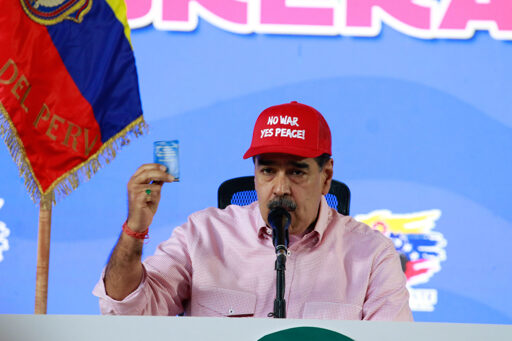
Speaking before a labor congress at Caracas’ Teresa Carreño Theater, Venezuelan President Nicolás Maduro called for an international protest by oil, gas, and merchant marine workers against what he described as US piracy.
Trump’s aggressive actions against Venezuela have prompted a large-scale mobilization of the country’s armed forces. In a statement to mark the 47th anniversary of the Venezuelan Integral Airspace Defense Command (CODAI), Defense Minister Vladimir Padrino reiterated the commitment of the Armed Forces to defend the Caribbean nation’s airspace amid an escalating US military buildup and provocations.
The rhetoric has extended beyond state institutions, with the Fuerza Patriotica Alexis Vive issuing its own statement that cast Trump’s remarks as an act of “naked expression of an imperialist policy of war, plunder, and punishment.” The statement invoked Venezuela’s revolutionary tradition of popular resistance, and warned that any escalation would trigger consequences the US could not control.
“In the face of this imperialist offensive, the Venezuelan people respond with the war of all the people, not as an abstract slogan but as a concrete practice of defending life, territory, and sovereignty,” read the statement issued from the El Panal Commune in Caracas. “The war of all the people is organized communes, conscious neighborhoods, and territory in resistance. It is civic–military–police unity in the service of the working people.”
Trump’s announcement of a blockade of Venezuela also drew criticism from US lawmakers, with US Representative Joaquin Castro calling the order “unquestionably an act of war” and warning that it represents an unauthorized and dangerous escalation with potentially catastrophic consequences.
Representative Jim McGovern also labeled Trump’s threats as potential “acts of war.” Meanwhile, Representative Nydia Velazquez called on Congress to exercise its constitutional authority to prevent a unilateral military escalation.
“This is not about drugs or making America safer; it’s about regime change,” wrote Velazquez. “Americans do not want war with Venezuela. Congress must act now and stop this.” Recent polls have shown that a majority of the US public rejects military attacks against Venezuela.
The seizure of a Venezuelan oil tanker had already drawn bipartisan backlash. Congress is expected to vote Wednesday on two War Powers resolutions, including one to block Trump’s military actions related to the blockade of Venezuelan oil tankers.
Edited by Ricardo Vaz in Caracas.
The post Venezuela Condemns Trump’s Blockade as Illegal, Popular Organizations Vow Resistance appeared first on Venezuelanalysis.
From Venezuelanalysis via This RSS Feed.