


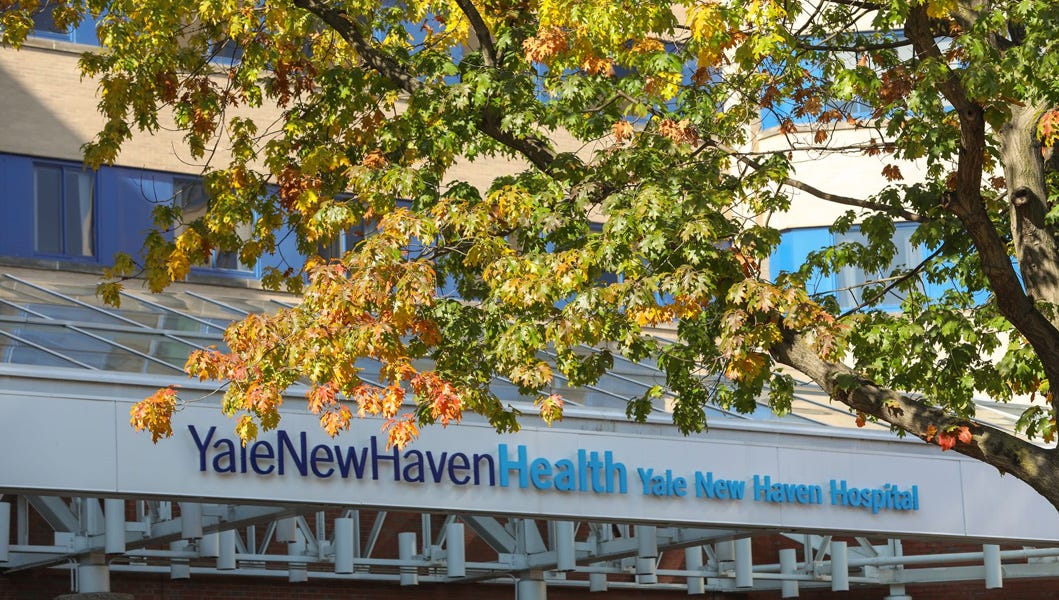
Yale New Haven Hospital, obtained from newhaven.edu
Erin In The Morning is a reader-supported publication. To receive new posts and support my work, consider becoming a subscriber.
On Wednesday, GLAD Law, a major LGBTQ+ legal advocacy group in New England, filed a formal complaint with the Connecticut Commission on Human Rights and Opportunities over the decision by Yale New Haven Health and Connecticut Children’s Medical Center to end gender-affirming care for transgender youth. Both hospital systems halted care following threats from the Trump administration, based on an executive order asserting that such care would be banned. Critically, no law in the United States currently bans gender-affirming care for transgender youth, meaning the hospitals cannot credibly claim federal preemption of state law. Instead, the cessation of care appears to be driven solely by fear of retaliation from the Trump administration. This is particularly significant in Connecticut, which—like several other states where hospitals have dropped care—has strong statutory protections for transgender people, raising the possibility that these decisions violate state civil rights law, a question GLAD is now seeking to resolve.
The challenge is brought on behalf of 10 people whose care has been directly impacted by the decision of Yale New Haven Health and Connecticut Children’s Medical Center to acquiesce to Trump’s threats. One of the families involved moved to Connecticut specifically because of the state’s strong civil rights protections, only to see their child’s care abruptly cut off. Another challenger is an 18-year-old—legally an adult—who lost access to his healthcare as a result of the policy change. Collectively, the challengers argue that the hospital systems are violating state law by banning gender-affirming care for transgender youth while continuing to provide the same medications to cisgender youth for other medical conditions.
“The families we represent are living through a nightmare, being told with no warning their trusted doctors can no longer provide the care that has stopped their children’s suffering and allowed them to thrive,” said Hannah Hussey, GLAD Law Staff Attorney. “These families have been forced to scramble for a new place to get the care their kids need, which means navigating issues such as delayed care, risks to their physical and mental health, new health care costs and time-intensive travel, and having to start all over to establish relationships with new providers – if they can find them.”
This is the second attempt to file a formal complaint against hospitals that have complied with the Trump administration’s purported ban on transgender care. In September, the Women’s Law Project filed a discrimination complaint against the University of Pittsburgh Medical Center (UPMC), the largest healthcare provider in Western Pennsylvania. In both cases, the complaints were filed with the respective state human rights commissions. This approach is common in healthcare-related civil rights challenges, with the National Women’s Law Center noting that pursuing a complaint through a state commission is often a prerequisite before a case can proceed to state court.
The legal challenge comes in an especially fraught week for transgender healthcare nationwide. Two congressional bills are expected to be heard today and tomorrow targeting trans youth care: one from Marjorie Taylor Greene that would enact a national felony ban on transgender healthcare for minors, and another from Dan Crenshaw that would ban Medicaid coverage for trans youth care. At the same time, further action is expected from the Trump administration aimed at pressuring hospitals to end care through renewed threats to Medicaid funding. Importantly, neither bill is likely to pass the Senate. Nevertheless, the administration continues to push forward with these efforts, showing little regard for the actual limits of federal law when it comes to transgender healthcare.
As of late December, at least 20 major hospital systems have ended gender-affirming care for transgender youth. While a handful of providers have attempted to absorb displaced patients, many families have been left without appointments, continuity of care, or any clear path forward. Talk of smaller, independent clinics stepping in to shield large hospital systems from Trump’s threats has largely failed to materialize, leaving patients to shoulder the consequences of institutional fear. At the same time, some hospitals have chosen a different path—challenging the administration in court and winning. Lawsuits like this one change the legal calculus. They make clear that discrimination is not the risk-free option hospitals hoped it would be, and that transgender patients will not quietly disappear when care is taken from them. Institutions that chose capitulation may soon learn that abandoning their patients was neither the safest nor the easiest choice after all.
Erin In The Morning is a reader-supported publication. To receive new posts and support my work, consider becoming a subscriber.
From Erin In The Morning via This RSS Feed.