

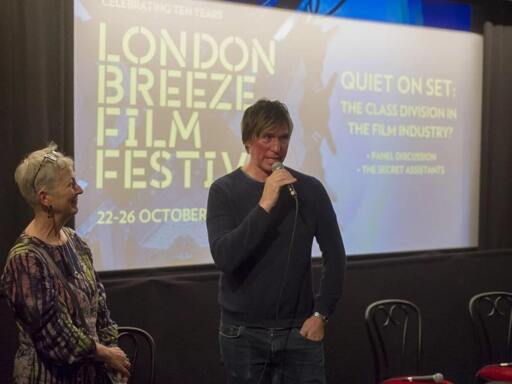
The UK film industry has historically and systemically failed to represent people from working-class backgrounds. This is the focus of Scottish filmmaker Mark Forbes’ new documentary Quiet On Set: The Class Division in the Film Industry?
Through interviews and testimonies, Mark examines the barriers that working class people have faced accessing and maintaining a career in film. We hear from well known champions of this issue: Paul Laverty, Maxine Peake, Vicky McClure. He also delves into its natural consequence: the dearth of working class representation and storytelling on film. The result is an engaging and eye-opening documentary that paints a comprehensive picture of the systemic nature of exclusion.
So, I spoke to him for the Canary about the documentary and why classism is rife in the film industry.
A glass ceiling from birth in the film industry
Quoting a study by the Creative Industry Policy and Evidence Centre (PEC), a slide from the film reveals that only 8% of people working in the industry have working-class backgrounds. Working without any external funding, grants or crew, Mark is no stranger to the nepotism and elitism that plague this industry:
I didn’t realise that from the minute you’re born, you’re pigeonholed into an area where you didn’t go to university, you didn’t go to film school. You’re basically separated from the rest. And it wasn’t until I got a lot older and I had a lot more experience making films that I realised there was a ceiling, a class ceiling, where I was being judged because I didn’t have those connections, because I wasn’t rich and connected.
Working in film is ultimately about connections that people form in exclusive spaces. Accessing those spaces starts early on, through family and wider professional networks. Navigating those spaces – networking events, training, screenings – requires time and money. It also requires the right cultural capital. Professor Lee Elliott Major sums this up in this latest report by Creative Access:
If you don’t benefit from a financial safety net during the precarious early career years, or the know-how of navigating the middle class workplace norms, then you’re significantly less likely to make it.
Most industry jobs are located in big cities, with a high cost of living. Entry-level positions are usually poorly paid – or unpaid – and competitive. Even more senior jobs tend to be precarious with low salaries or day rates.
As a result, the bias is also regional. According to featured filmmaker Sean McAllister:
They’re all the bloody same. They’re not people from Doncaster or Hull… They’re people from Oxbridge.

Conditions have worsened in the film industry
The Creative Mentor Network’s (CMN) latest impact report includes data from DCMS that says working class representation across the creative industries fell from 26% in 2020 to 19% in 2023. It adds that working class representation in the film and TV industry has halved over the last 40 years.
Film school is exponentially expensive. Last time Mark checked, the London Film School course he’d already found expensive two decades ago now costs a cool £68,000. And that’s whilst the cost of keeping oneself alive has quadrupled.
The government has slashed funding across the board – Shooting Film has closed, the BFI has withdrawn funding from Film London. Recent research by entertainment and production union BECTU found that over half of the industry “workforce” is out of work.
Two additional factors compound the situation: the impact of Covid and the industrial strikes in the US. And that’s before factoring in the fallout of AI, the long term consequences of which are still murky. Following a screening of Mark’s film one voice over artist tells us:
Instead of clients paying me to voice characters, they’re now paying me to train AI models, so that it can generate my voice automatically. I can’t remember the last time I had an actual voice over job.
Fatima’s next job could be in cybersecurity
More generally, brutal DCMS cuts over the last decade are threatening to decimate the sector. Who can forget the ill-thought and viral governmental ad campaigns pushing aspiring artists to go into tech. Despite successive UK governments supposedly identifying the creative industries as a key growth sector, stakeholders such as the union Equity have been sounding the alarm for years, calling the cuts a “self-imposed injury”.
Unsurprisingly, industry professionals from a working-class background are feeling the impact most profoundly. It’s hard to avoid seeing the government’s active stifling of working-class voices in wide-reaching media as anything other than by design. In fact, they are likely to face fewer hurdles building a career in law or finance than film and TV.
A recent study by the BFI found that the support they provide for emerging filmmakers doesn’t extend to the top levels roles that decide what works get commissioned and shown. Middle class applicants are more likely to be awarded development and production funds when it comes to lead creative roles.
Ultimately, they will be the ones to decide which stories are told. Despite the self-congratulatory schemes and reports highlighting the obvious, Quiet on Set is one of surprisingly very few films about this. In reality, it’s still a very taboo subject. As Mark says, even major festivals don’t want to “rock the boat”.
There is some push back
There is hope in the number of makers taking matters into their own hands. Many are finding ways to self-produce and self-distribute, much like Mark himself. In the face of governmental inaction, other groups are creating a more accessible scene. Organisations like Reclaim the Frame provide advocacy and training, and actively programme marginalised perspectives. Speaking to the Canary, director Melanie Iredale says:
With people who are Black, people of colour, disabled, women, or based in the nations and regions statistically more likely to face economic disadvantage, we cannot begin to address barriers to inclusion without confronting the class ceiling.
As a result, huge swathes of the population remain under-served as audiences, limiting both audience choice and audiences themselves. As 20 years of Reclaim The Frame (formerly Birds’ Eye View Film Festival) has demonstrated, culturally relevant and relatable films can reach new audiences. And when those audiences feel ‘seen’ on screen, the impact can be profound.
Marc speaks highly of initiatives run by places he’s touring to discuss his film, including GMAC in Glasgow and the University of Manchester:
I went to an event organised by Manchester Uni about a week ago where they were talking about what they what can they do to make it more accessible for working class people. And, it was an amazing event. First of all, there were no ticket costs. By comparison, the Edinburgh TV Festival charges hundreds of pounds. […] 97% of the people were working class, but it wasn’t about that. It was about everybody having a voice.
You can follow Mark Forbes on Instagram to find out about coming screenings of Quiet On Set: The Class Division in the Film Industry?
Featured image via the Canary
From Canary via This RSS Feed.