

The International Rescue Committee on Tuesday released its annual humanitarian crisis forecast, along with a stark warning that civilians in the countries on its watchlist “are on the front lines of a disintegrating international order and global action is needed to reverse course.”
Sudan, Palestine, and South Sudan topped IRC’s Emergency Watchlist for 2026, followed by Ethiopia, Haiti, Myanmar, Democratic Republic of Congo (DRC), Mali, Burkina Faso, and Lebanon. Afghanistan, Cameroon, Chad, Colombia, Niger, Nigeria, Somalia, Syria, Ukraine, and Yemen also made the list.
People in some of those countries—including Sudan, Palestine, and Myanmar—are enduring genocidal violence and privation, while nearly all of the other nations on the list are experiencing war or other unrest. Some are also ravaged by climate-driven extreme weather, hunger, and other crises.
“This year’s watchlist identifies a dangerous divergence: surging crises and shrinking support,” IRC said on Tuesday. “Home to just 12% of the global population, watchlist countries account for 89% of those in humanitarian need and are projected to host more than half of the world’s extreme poor by 2029.”
IRC noted that “117 million people are forcibly displaced” and “nearly 40 million people are facing such severe hunger” in the watchlist countries.
“While crises grow, global humanitarian funding has shrunk by 50%,” the group said. “What remains is a humanitarian system underfunded, undercut, and unprepared to meet unprecedented humanitarian crises in 2026.”
The world has retreated from humanitarian aid—but violence, hunger and climate threats haven’t slowed down. We must not forget about the people for whom crisis is a daily reality. This is our 2026 Emergency Watchlist: www.rescue.org/watchlist2026
[image or embed]
— International Rescue Committee (@rescue.org) December 16, 2025 at 6:28 AM
IRC continued:
This “New World Disorder” is replacing the post-WWII international system once grounded in rules and rights. Defined by intensifying geopolitical rivalries, shifting alliances, and transactional deal-making, this disorder is driving a cascade of crises and eroding global support for the world’s most vulnerable. Global cooperation is unraveling; together with major aid cuts, the [United Nations] Security Council has seen a surge in vetoes, stalling responses to atrocities in Sudan, Syria, and the occupied Palestinian territory. Conflict is increasingly used as a tool for power and profit. In Sudan, warring parties and their backers are profiting from the gold trade, deepening violence and devastating civilians. Meanwhile, impunity is enabled on a dangerous scale. 2025 is on track to be the deadliest year for humanitarians. Attacks on schools have risen nearly 50%, and in Gaza, hospitals, shelters, and essential infrastructure have been bombed or cut off from aid.
“What the IRC is seeing on the ground is not a tragic accident. The world is not simply failing to respond to crisis; actions and words are producing, prolonging, and rewarding it," IRC president and CEO David Miliband said Tuesday in a statement. “The scale of the crisis in Sudan, ranking first on this year’s watchlist for the third year in a row and now the largest humanitarian crisis ever recorded, is a signature of this disorder.”
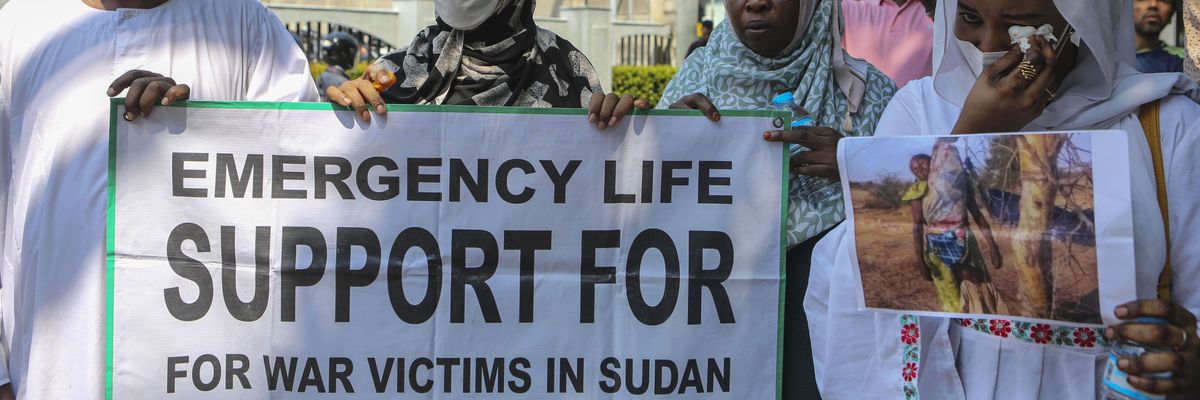
Fighting between the Sudanese Armed Forces and the Rapid Support Forces—a paramilitary militia born from the Janjaweed co-perpetrators of the first Darfur genocide—continues, with all warring parties, especially the RSF, committing war crimes and crimes against humanity, according to human rights groups. The conflict in Sudan has fueled one of the world’s most acute humanitarian catastrophes, with more than 12 million people displaced and famine confirmed in Darfur’s largest refuge camp last year. More than 20 million people are facing acute hunger.
In order to respond more efficiently to global humanitarian crises, IRC recommends:
- Reinvigorating diplomacy, including by empowering the UN to collectively address global challenges by supporting the suspension of Security Council veto power in cases of mass atrocities;
- Protecting civilians and fighting impunity, including by withholding arms sales when violations occur or are at risk of occurring and supporting UN accountability mechanisms; and
- Improving the allocation and delivery of aid, including by reorganizing allocation, prioritizing most vulnerable populations when planning climate adaptation finance, and expanding donor bases.
“This year’s watchlist is a testament to misery but also a warning: Without urgent action from those with power to make a difference, 2026 risks becoming the most dangerous year yet," Miliband said.
That urgent action won’t be coming from the United States, where the Trump administration has dramatically slashed international humanitarian assistance despite warnings that such cuts would cause millions of deaths. One of many examples stands out for sheer crassness: As South Sudanese babies and others died of cholera following the closure of local health clinics, US officials celebrated successfully slashing aid budgets and services with congratulations and cake, according to a report published Monday by ProPublica.
“Civilians in watchlist countries are paying the price today. The IRC stands with them to deliver practical solutions that save lives and restore hope,” said Miliband. "But the New World Disorder is here, and winds are picking up everywhere. Disorder begets disorder. The question is whether to respond with vision, an opportunity for reinvention—or with further retreat.”
From Common Dreams via This RSS Feed.