

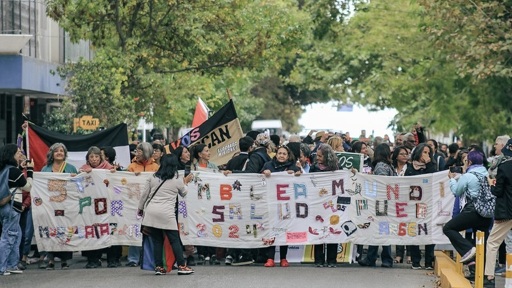
The People’s Health Movement (PHM) is marking its 25th anniversary this month, reflecting on its founding assembly in Savar, Bangladesh, and on decades of struggle for the right to health that followed. In 2000, activists from around the world gathered in Savar, united by the vision of Health for All. Twenty-five years later, many of those activists are still present in the struggle, joined by hundreds of younger comrades inspired by the movement’s legacy.
“We celebrate this milestone with double feelings: deep pride in the endurance and vibrancy of our movement, but also profound concern that, a quarter of a century later, the dream of Health for All remains unrealized – and in many ways, further away than when we began,” PHM wrote when announcing an event to mark the anniversary. “Still, we are here, alive and fighting, and that is something to celebrate.”
“We won’t achieve Health for All unless we confront capitalism”
Today, PHM’s work expands on global, regional, and national levels. Its main programs include the flagship publication Global Health Watch, whose seventh edition was recently released; International People’s Health Universities; programs focused on global health governance such as WHO Watch; the decentralized global campaign Health for All; and the People’s Health Assemblies, five of which have taken place since 2000. Additionally, regional and country circles engage with local struggles ranging from health worker migration and extractivism to food sovereignty.
From its early days, PHM sought to confront threats to the right to health posed by neoliberalism and imperialism. “We continue to face many of the same challenges; our struggles are still relevant,” said Roman Vega, PHM’s Global Coordinator. “We won’t achieve Health for All unless we confront capitalism,” he added.
Vega’s call to confront capitalism echoes the legacy of many PHM activists who have passed away over the past decades, including Amit Sengupta, David Sanders, and Marcela Bobato – figures who played a crucial role in defending the right to health globally as political and economic pressures grew.
Watch: The clarion call of Health for All!
The anniversary discussion was centered around political analysis looking into how the global health landscape has changed since 2000, and featured interventions by Fran Baum (Australia), Abhay Shukla (India), Juliette Mattijsen (the Netherlands), Ubai Aboudi (Palestine), and Lauren Paremoer (South Africa). They highlighted how developments such as the globalization of private health providers, rising militarization, and the erosion of democratic mechanisms have added to concerns first articulated in the People’s Charter for Health, PHM’s founding document.
“To be honest, our analysis has not changed all that much,” noted David Legge, physician and longtime PHM activist. “Capitalism is destroying civilization, it is degrading nature; imperialism can be overcome; eco-socialism is possible and necessary.” He added: “What has changed since December 2000 is that PHM has been much more explicit in this narrative about capitalism, about imperialism, and an eco-socialist alternative.”
Local victories and solidarity with Palestine
Speakers emphasized concrete achievements from PHM’s country and regional work. In India, Jan Swasthya Abhiyan (JSA), PHM’s country platform, recalled a campaign for the right to health carried out with the National Human Rights Commission in the early 2000s, which helped spark rural health programs. Other milestones included dozens of local actions against privatization and hundreds of public health hearings, as well as interventions against private sector overcharging during the COVID-19 pandemic.
But breakthroughs also happened inside the movement itself. In this context, Lauren Paremoer and Juliette Mattijsen pointed to the entry of a new generation of activists, including through activities like the Global Health Governance program, and the expansion of debates into areas including Public Pharma. Speaking from the point of view of a “second-generation PHM activist”, Mattijsen stressed that the network offers a special space for young activists to develop political analysis while simultaneously drawing inspiration for action.
Read more: Health activism is now more important than ever
Solidarity with Palestine has been another consistent thread throughout PHM’s history, including during Israel’s genocide in Gaza. Ubai Aboudi highlighted how PHM’s work has contributed to advocating for the right to health under conditions of settler colonialism, referencing collaboration with the Palestinian Medical Relief Society and Awda Association, as well as participation by PHM activists in initiatives such as the Global Sumud Flotilla and the Conscience. Beyond its impact in Palestine itself, Aboudi emphasized, PHM has played a key role in raising international awareness and strengthening global solidarity.
As technologies tested on Palestinians are increasingly embraced by political elites around the world, and militarization shapes policy agendas in the Global North, Aboudi and Mattijsen argued that PHM must deepen alliances across movements. Looking ahead, Shukla added that it is necessary to combine critique with concrete alternatives – adopting a “struggle and create” approach – to build toward genuine mass mobilization for health rights.
While imperialism becomes more explicit in its methods, Fran Baum concluded, it paradoxically opens new space for movements like PHM to articulate alternative visions of society. In this context, Shukla added, PHM’s struggle for health is inseparable from the struggle to defend democracies under attack. While repression seeks to close such spaces for dissent, it also creates new ones. “Eventually, hope will win over fear,” he concluded.
People’s Health Dispatch is a fortnightly bulletin published by the People’s Health Movement and Peoples Dispatch*. For more articles and to subscribe to People’s Health Dispatch, click* here.
The post People’s Health Movement at 25: the struggle for Health for All continues appeared first on Peoples Dispatch.
From Peoples Dispatch via This RSS Feed.