

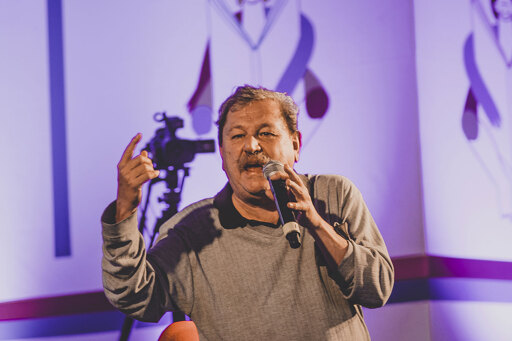
This interview by Alejandro Páez Varela and Álvaro Delgado Gómez of author, Morena founder and head of Mexico’s parastatal publisher Fondo de Cultura Económica, Paco Ignacio Taibo II, originally appeared in the December 16, 2025 edition of Sin Embargo.
Mexico City. Paco Ignacio Taibo II, historian, founder of Morena and director of the Fondo de Cultura Económica , warned about the risks of minimizing and avoiding self-criticism within the Fourth Transformation movement, noting that this could be more damaging to the left than a possible internal division.
The writer reviewed the Latin American political landscape and, in an interview with Los Periodistas, a program on SinEmbargo Al Aire, stressed that the search for unity at all costs can be counterproductive.

Senator Pedro Haces (middle) with El Limones (right). Pedro Haces was in the news recently for attempting to re-start a parliamentary friendship group with israel that had been shut down earlier this year after protests.
“Many times the righteous decision not to cause a split, a division, not to leave cracks due to a lack of unity, becomes a negative phenomenon because it allows for errors within your own forces,” he stated, speaking about the presence of figures who have “entrenched” or “tied down” within Morena, such as Deputy Pedro Haces Barba, Ricardo Monreal’s right-hand man, linked to the financial operator of the criminal group.
Since last week, the capture of Edgar “N,” alias “El Limones,” a member of the Los Cabrera criminal group, has put Pedro Haces, who is also the national leader of the Autonomous Confederation of Workers and Employees of Mexico (CATEM), in a difficult position. Haces has tried to distance himself from the extortionist leader, but his claims that he doesn’t know him have been refuted with photographs and videos of the two of them.
Taibo II explained that in recent sessions of Morena’s Advisory Council, it was agreed that the Commission of Honor and Justice should act ex officio in cases like this. “It was agreed that the Commission of Honor and Justice should de facto investigate any complaint generated where there has been… the commission should take its own hands and investigate it,” he emphasized.

Adrian Rubalcava, a fiscally incompetent former mayor of a borough with no subway, with no experience in public transportation, accused of ties to organized crime, from the right wing of Mexico’s political class, was appointed head of one of the world’s most important public transit systems earlier this year.
He explained that the objective of this action is “to distinguish between slander and reality,” so that the Commission can “ascertain whether these accusations are substantiated and conduct an examination,” without needing to wait for a formal complaint, since “this change in Morena’s behavior can be useful in the coming months, where a cleanup is undoubtedly necessary.”
For Taibo II, the problem of “lowering self-criticism and self-reflection is even more dangerous than the problem of unity.” In this sense, he explained the “Swiss cheese theory”: “If you leave an information vacuum, the right wing will fill it. Don’t worry. If there’s a hole in the cheese, they’ll fill it.” Therefore, he maintained that the response to the systematic slander of the right-wing media is not silence, but rather rigorous self-criticism.
One of the points of internal criticism that Paco Taibo II identified is the resurgence of practices associated with “old politics,” such as opacity regarding personal fortunes. “Morena was born with the aim of destroying the PRI’s method of mobilizing supporters. It wasn’t about mandatory coercion, pressure, blackmail…,” Taibo II recalled, but he warned that these methods “are being reproduced within our ranks again; they are a clear indicator that something is rotten.”
One of the figures who has resorted to this type of mobilization is Haces himself with the members of CATEM and, for example, Adrián Rubalcava, the former PRI member and aggressor of journalists who today directs the Collective Transportation System, the Metro, who has also mobilized his “dragons”.

Manuel Vázquez Arellano, Ayotzinapa survivor & MORENA deputy who confronted Pedro Haces’ over his israel friendship group also expressed concerns over a false unity with disreputable figures this past Monday.
“I sometimes find myself thinking, ‘I don’t trust this guy…’ What I can say is that he should clearly explain the relationship between his wealth, right? And his knowledge, and where it came from,” Taibo II stated. “Every member of Morena should have an ethical obligation to answer this question: How much do you spend, and where did you get it?”
Furthermore, he criticized the “aesthetics of the old power” visible in some paintings, which consists of the accumulation of money to accumulate political power and distribute employment, a “factory of distributing loyalty for employment” of the PRI right.
The director of the FCE also expressed his discontent with the dismissal of Salvador Zarco as director of the Railway Museum and a long-time supporter of the Vallejo faction, an act that “bothers him greatly” and which he considers an institutional error. However, he insisted that the main focus should be on internal reform.
“I ask myself the same two questions that someone who has been an activist for 50 years asks: I knew Salvador when he was underground, persecuted, starving to death at the hands of the corrupt union bosses of the railroad workers, witnessing the resurgence of Vallejo’s movement. When we came to power, in an act of justice, Salvador was sent to direct the railroad museum, which immediately fulfilled two functions. It served the purpose of a museum dedicated to the railroad, but also the defense of the heroic Vallejo movement, which at the time represented some of the best of this country,” he noted.
When social democratic governments, to call them something, implement neoliberal policies, the people hold them accountable by saying, ‘Neoliberal policies are done better by the right than by you.'”
Taibo II also addressed the adverse electoral landscape for the left in Latin America with the victory of the Pinochet supporter José Antonio Kast in Chile, a victory for the far right that adds to that of Javier Milei in Argentina; Daniel Noboa in Ecuador, Rodrigo Paz in Bolivia, as well as the rise of José Jerí in Peru.
“When social democratic governments, to call them something, implement neoliberal policies, the people hold them accountable by saying, ‘Neoliberal policies are done better by the right than by you,'” he commented.
“ There are other factors that also have a degree of desperation observed from the outside. The Bolivian phenomenon of cannibalism—how do you analyze it? There came a point when the infighting among the different factions of the left was more intense than any criticism the right could generate. It’s not easy for the left to consolidate a proposal, make it the majority view, sustain it over time, and root it in the hearts of the majority of the population. In fact, in Mexico, what surprises us time and again is that the left continues to be a majority option in terms of public sentiment, and this is demonstrated constantly by opinion polls regarding Claudia Sheinbaum’s public image.”
-

Cultural Promoters: Demand for Zaco’s Resignation at Railway Workers Museum is “Arbitrary”
December 16, 2025
The trade unionist was fired by Mexico City’s Ministry of Culture, who still have yet to recover sculptures of Fidel Castro and Che Guevara that were stolen by ultra-right wing mayor Alessandra de la Rojo Vega.
-
Taibo II: Suppressing Self Criticism in 4th Transformation More Dangerous Than a Rupture
December 16, 2025December 16, 2025
In an interview, the writer and Morena founder emphasized the pursuit of unity at all costs can be counterproductive, as it hinders the purging of those who replicate the practices of “old politics.”
-

Trump Classifies Fentanyl as Weapon of Mass Destruction
December 16, 2025
The US President also revived a military medal originally created to recognize US soldiers who fought against Pancho Villa’s forces, to be awarded to troops “defending” the border with Mexico.
The post Taibo II: Suppressing Self Criticism in 4th Transformation More Dangerous Than a Rupture appeared first on Mexico Solidarity Media.
From Mexico Solidarity Media via This RSS Feed.