

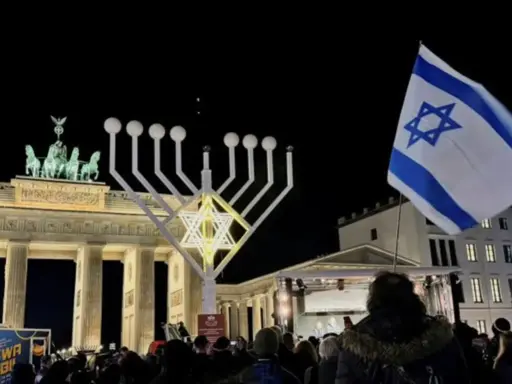
The Al-Aqsa Mosque compound in occupied East Jerusalem has been invaded for the second day in a row. Illegal Israeli settlers stormed the compound, and performed prayers, under the protection of Israeli occupation police. This was to celebrate the beginning of the Jewish holiday of Hanukkah, marked from 14-22 December.

Illegal settlers storm the al-Aqsa Mosque compound on Hanukkah under police protection
For Muslims, Al-Aqsa is the third holiest site in Islam. And it is a central symbol of religious identity and Palestinian presence in Jerusalem. For Jewish people, the same area – known as the Temple Mount – is the holiest place in Judaism.
Since Israel occupied East Jerusalem in 1967, Jewish visitors can only enter during specifically designated hours and are not permitted to pray within the compound. Many of the illegal settlers and religious nationalist groups openly oppose this arrangement and argue for Jewish prayer rights at the compound.
When settlers enter the Al-Aqsa compound, what they are doing is a political act. They are attempting to advance Israeli occupation control, rather than undertake a purely religious visit. These visits almost always occur under heavy Israeli police protection, during which Palestinian worshippers are often restricted, removed, or even arrested. This behaviour reinforces the sense that power is being used to impose change on this Muslim holy site.
These incursions are part of a broader Israeli occupation policy to erase the compound’s Arab-Islamic character. Over time, repeated settler incursions raises fears of a gradual takeover, where Zionist presence becomes normalised, and prayer restrictions are challenged. They could also signal possible future changes to control over a site that carries profound religious and national significance for Palestinians and Muslims worldwide.
IOF light torches on the remains of the Indonesian Hospital – which they intentionally destroyed earlier in the genocide
Israeli occupation forces (IOF) have also celebrated Hanukkah by lighting torches on what is left of the once busy and incredibly important Indonesian Hospital in Northern Gaza.
‘Israeli’ military celebrates Hanukkah atop ruins of Gaza’s Indonesian hospital pic.twitter.com/k2U7YGlNQv
— Roya News English (@RoyaNewsEnglish) December 15, 2025
During the genocide, the Indonesian Hospital was one of the last large health facilities still operating in northern Gaza. It has now largely been reduced to ruins. It has been repeatedly targeted by the occupation’s military operations****.**** The IOF besieged the hospital, surrounding it with tanks and restricting access for medical staff, supplies, and patients.
Israeli airstrikes hit parts of the hospital, including power generators, causing fires and cutting off electricity. This critically undermined the Indonesian Hospital’s ability to treat patients. At various points, the hospital lost essential services, including electricity, water, fuel, food, and medicines, and could no longer function normally because of the siege and damage sustained during the attacks. In January 2025 the IOF forcibly evacuated all medical staff and local volunteers from the Indonesian Hospital.
Hospital staff were imprisoned and killed. Head of orthopaedics, Dr. Akram Abu-Odeh, was one of the staff abducted by the IOF in late November 2023. He remains in Israeli occupation prisons today. Earlier this year, the Israeli occupation intentionally targeted and killed Dr Marwan al-Sultan, director of the Indonesian Hospital, and his family.
IOF committed war crimes and crimes against humanity against Palestinians in Tulkarm refugee camp in 2025 – now they light Hanukkah candles on the ruins of their homes
Hanukkah candles were also lit in the ruins of Tulkarm refugee camp in the West Bank. In January 2025, Tulkarm, Nur Shams, and Jenin refugee camps were raided by the Israeli occupation, during Operation Iron Wall. Hundreds of homes were damaged or destroyed, and 32,000 Palestinians were forcibly displaced. They are still not permitted to return to what remains of their homes.

Zionist Hanukkah celebrations are unfolding against a backdrop of dispossession, destruction, and loss of life. What is presented as religious observance – in East Jerusalem, Gaza and the West Bank – is inseparable from the realities of occupation. Here, power determines who can pray, who can heal, and who can remain on their land.
These acts deepen the sense that Palestinian holy sites, homes, and institutions are systematically being erased, while suffering is normalised. These scenes are part of a broader pattern in which religious imagery is used to demonstrate control over occupied territory. When sites of worship, medical centres, and shelters become places to display power, the message for Palestinians is one of marginalisation and disappearance.
Featured images via author
By Charlie Jaay
From Canary via This RSS Feed.