

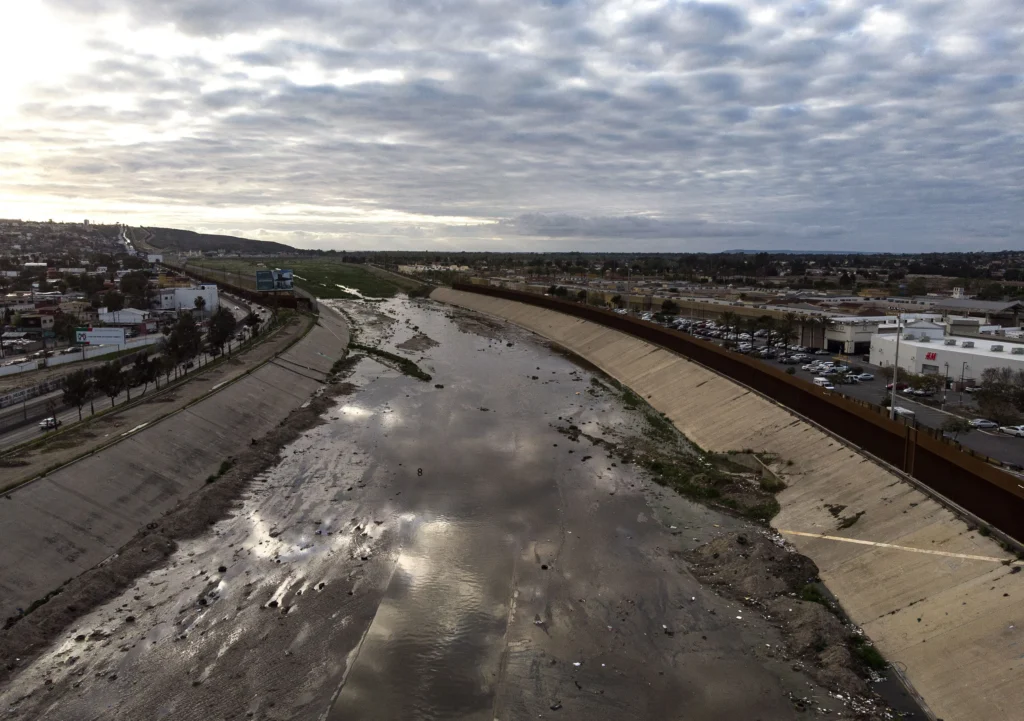
It includes plans to ensure the operation and maintenance of critical sites.
On Monday, the U.S. Environmental Protection Agency (EPA) announced that Mexico and the United States signed a new agreement to address the Tijuana River wastewater crisis through joint actions carried out by the International Boundary and Water Commission (IBWC).
RELATED:
Trump Threatens 5% Tariff on Mexico Over Delayed Water Deliveries
The agreement was negotiated and signed in record time, surpassing the December 31 deadline, as stipulated in the Memorandum of Understanding signed in July by EPA Administrator Lee Zeldin and Mexican Environment Secretary Alicia Barcena.
U.S. and Mexican sections of the IBWC carried out the signing and sought urgent and permanent solutions. Zeldin highlighted that the agreement is necessary to address the population growth of Tijuana and its surrounding areas.
The EPA explained that for decades, wastewater from Mexico “has affected Southern California,” which caused beach closures, foul odors, environmental degradation, economic losses, and illnesses in border communities.
Trump demands Mexico ‘take care of its water and sewage problem IMMEDIATELY,’ labeling it a ‘true threat’
In a somewhat ominous post on Truth Social, President Donald Trump accused Mexico of posing a cross-border sewage contamination issue hazardous to the United States, branding… pic.twitter.com/h7ggyXgZ8y— MaggieWise ⭐️⭐️⭐️ (@maggiewise111) December 11, 2025
The plan includes infrastructure projects in Mexico, research programs, and planning to ensure the operation and maintenance of critical sites, aligned with international best practices in wastewater management.
Act 333 does not commit new U.S. taxpayer funds, but rather prioritizes the effective execution of projects previously agreed upon in the Memorandum of Understanding signed in July by both nations.
The plan initiatives will be developed between 2026 and 2027, with an additional project in 2028, which seeks to reopen beaches, eliminate odors, and reverse the environmental degradation of the Tijuana River Valley.
At her morning press conference, Mexican President #ClaudiaSheinbaum calls for reflection on the unity of popular movements in #LatinAmerica and cites #Mexico as an example, since its movement is committed to the people, delivers results, and thus gains popular support. pic.twitter.com/gy25fAqtkU
— teleSUR English (@telesurenglish) December 15, 2025
teleSUR: JP
Source: La Jornada – EFE
From teleSUR English via This RSS Feed.