

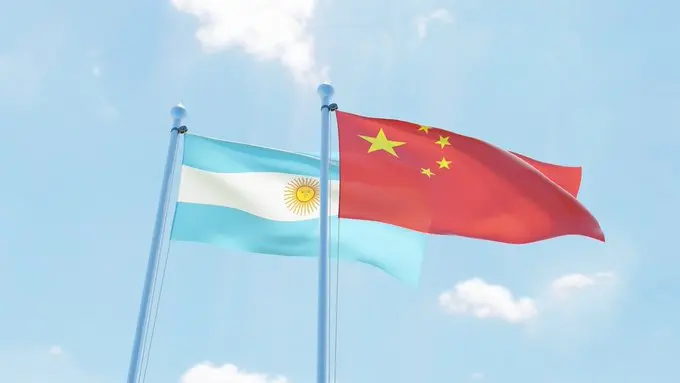
Despite Argentina’s political realignment toward the United States under President Javier Milei, China continues to consolidate its economic presence in the country, expanding investments in strategic sectors and maintaining its position as a long-term partner.
RELATED:
Argentina: Union Headquarters Attacked Days Before National Mobilization
According to U.S.-based outlet Bloomberg Línea, Chinese companies have continued to strengthen their footprint in Argentina even as Buenos Aires signals closer ties with Washington and former U.S. President Donald Trump. The developments highlight the persistence of bilateral economic relations despite shifting geopolitical rhetoric.
Chinese investment remains active in sectors considered central to Argentina’s development, including energy, infrastructure and mining. Chinese firms are involved in major projects such as hydroelectric dams, solar power plants, lithium mining and telecommunications, reinforcing Beijing’s role in Argentina’s productive and technological landscape.
Patricio Giusto @patriciogiusto, executive director of the Sino-Argentine Observatory, said Xi’s remarks reaffirm China’s role as "a staunch defender of an open economy and multilateralism to address global problems and resolve disputes, opposing unilateral impositions and…
— Xi’s Moments (@XisMoments) November 3, 2025
From Beijing’s perspective, relations with Argentina are framed within a comprehensive strategic partnership aimed at mutual benefit and sustainable development. China has emphasized the use of yuan-denominated financing and technological cooperation as mechanisms to support Argentina’s economic sovereignty, offering alternatives to reliance on the U.S. dollar and to external financial pressures. Chinese authorities underline that their foreign policy is based on respect for national self-determination and cooperation oriented toward shared growth.
Within Argentina’s domestic political sphere, the Justicialist Party has rejected U.S. interference in Latin America and the Caribbean and has called for the defense of regional sovereignty, adding an internal political dimension to the broader international context.
While Washington seeks to reaffirm its influence across the region, Beijing maintains that its engagement in Argentina is guided by pragmatic and peaceful cooperation, without political conditions. Chinese officials argue that joint projects demonstrate that bilateral relations can advance beyond ideological differences, grounded instead in concrete economic interests and the need to diversify sources of investment.
The expansion of Chinese companies in Argentina reflects Beijing’s ability to sustain its broader economic strategy in Latin America, positioning itself as a reliable partner amid intensifying global geopolitical tensions.
Argentina continues to maintain close relations with the United States, but China has been a strategic partner in trade and investment since 1972. As global competition between major powers deepens, Buenos Aires navigates a delicate economic and diplomatic balance between both actors.
From teleSUR English via This RSS Feed.