

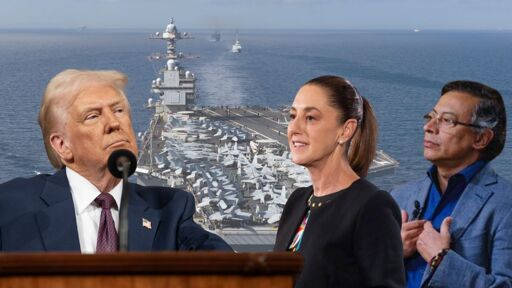
Many believe that the US military deployment in the Caribbean could be seeking even more than what many believe to be its primary agenda of pressuring the Venezuelan government to resign and thus reposition itself as the main beneficiary of the South American country’s oil.
Recent statements by US President Donald Trump seem to affirm these fears. According to the Republican leader, “[Gustavo] Petro is going to get into big trouble if he doesn’t wake up… Colombia is a major drug producer… If Petro doesn’t open his eyes, he’ll be next. I hope he’s listening.”
Trump also stated that ground attacks against “narco-terrorists” will take place “very soon”, and that they will not only happen on Venezuelan soil, which has set off alarms throughout Latin America.
In an interview on December 9, Trump also said he would be willing to order attacks on Mexican territory.
The statements come after the recent armed seizure of a Venezuelan oil tanker carrying fuel to Cuba, which has been denounced by Caracas and Havana, claiming that the action constitutes “international piracy” and “theft”.
Read more: “Piracy”: Venezuela responds to the US seizure of its oil tanker
In this way, Washington seems to be gradually abandoning all caution with its operations in Latin America, moving toward an open warning against Latin American presidents who are not to its liking.
The response of Petro and Sheinbaum
In response to what many are calling a “threat” by the United States to Colombian sovereignty, President Petro told his Council of Ministers, “Trump is a man who is very misinformed about Colombia. This leads him to make statements and take actions that cannot be directed at a president who was democratically elected by the majority of Colombian society.”
In addition, the Colombian president, in a measured and diplomatic tone, personally invited Trump to see the reality of the South American country with his own eyes: “Let Trump come to Colombia to see firsthand and in reality what cocaine laboratories are like. Let him see how nine laboratories are destroyed every day.”
Furthermore, on X, Petro stated that his government’s efforts in the fight against drug trafficking are backed up by hard facts: “There have been more than 1,446 ground battles against the mafia carried out by our military forces during my government and 13 bombings in an attempt to locate their leaders, many of these battles with shared military intelligence. My government has seized 2,700 tons of cocaine, the largest seizure in world history. That is 32 billion doses that did not reach the US or other consumer countries.”
Finally, he referred to the US Army’s bombing of boats: “But it is not true that missiles fired at boatmen are fighting narco-terrorists, when the boatmen are poor people and when there is no international sea in the Caribbean and when the drug lords live on yachts near Dubai, in Madrid, etc. I have requested a plan to fight and pursue the capital and assets of drug traffickers worldwide.”
Criticizing Trump’s move to pardon former Honduran president and convicted narco-trafficker Juan Orlando Hernández, Petro added, “It is not by pardoning them; I do not agree with those decisions. Negotiating sentences with drug traffickers is the job of the justice system, not governments. If we can save lives, all the better, but the goal is to dismantle the drug trade, not encourage it.”
Read More: US deploys aircraft carrier and threatens invasion of Venezuela, while expanding “drug” war to Colombia
For her part, Mexican President Claudia Sheinbaum also referred to the recent statements by the US president and rejected them outright. “I would never accept foreign intervention. It’s not going to happen,” the president told reporters on December 10.
In addition, Trump said in recent days that he is considering imposing a 5% special tariff on Mexican imports in light of a long-standing dispute between the two countries over water in the Rio Grande, Colorado, and Tijuana river basins. Trump threatened economic measures if Mexico does not release 200,000 acre-feet of water, or about 65 billion gallons, to the United States by the end of 2025.
In a clearly conciliatory tone, Sheinbaum said that both governments will find a solution “that does not obviously put the population and agricultural production in Mexico at risk, but that also allows us to help the United States,” although she also clarified that it is impossible to immediately satisfy Trump’s demand due to the limitations of the pipeline that carries water from Mexico to the United States.
The post Trump threatens military operations in Colombia and Mexico appeared first on Peoples Dispatch.
From Peoples Dispatch via This RSS Feed.