

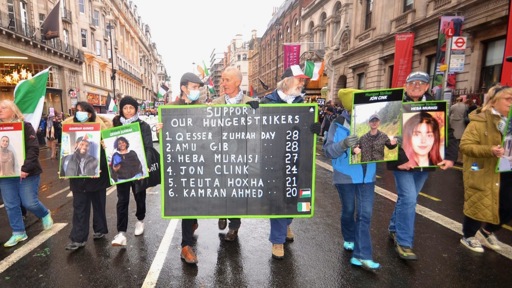
In Britain, pressure is mounting on the Labour government to respond to demands put forward by dozens of activists imprisoned for direct action in support of Palestine, many of whom have been on hunger strike since early November. “The hunger strike, which involves eight prisoners for Palestine, is now on day 40,” the campaign Prisoners for Palestine wrote on Friday. “They are in the danger zone, where irreparable harm is likely, and their health becomes critical.”
Even before launching the strike, the prisoners had pressed for a set of demands, including fair trial, deproscription of direct action group Palestine Action, and an end of Elbit Systems operations in the country. “Until our demands are met, we will resist,” wrote Qesser Zuhrah, one of the prisoners. “We ask our government now: are you willing to let us die before you stop arming a genocide?”
Read more: Protests continue as court prepares to review Palestine Action ban
Judging from the government’s lack of response until now, the answer to that question might be positive. Zuhrah, who has been on hunger strike the longest, along with Amu Gib, has reported worsening health conditions. Last week, after experiencing chest pain, she sought medical help but was left waiting for hours, her family told local media.
The prisoners’ deteriorating health status has been a major cause of concern for their friends and solidarity groups since the beginning of the strike. They stress that both prison authorities and the government have failed to provide adequate care to the prisoners as they suffered significant weight loss. Five people have been hospitalized already, two of them twice, Prisoners for Palestine warned.
More than 100 health workers warned in an open letter to NHS England at the end of November that the health consequences facing the prisoners could be devastating. At the time, they reported that several hunger strikers were already exhibiting low blood sugar, electrolyte imbalances, and other signs of deterioration. Since then, the list of medical risks has grown to include potential organ failure, neurological damage, and death.
“The risk of death is clear and increases with each passing day,” health workers emphasized in a new letter dated December 12 and addressed to Justice Secretary David Lammy. “Each individual’s physiological response is different, and one cannot generalize the experience of previous hunger strikers, but we draw your attention to Martin Hurson, one of the IRA hunger strikers, who died after 46 days on hunger strike in 1981. He was 24 years old.”
Government ignores calls for action
Health workers’ letters, along with responses from the broader Palestine solidarity movement, condemn the treatment the activists are receiving in prison. Beyond reports of prisoners being left waiting hours for medical attention, medical professionals warn that the level of care available inside the prison system is unlikely to meet the complex medical needs of people on prolonged hunger strike, including in the case when refeeding becomes necessary. Increasingly, health workers and other activists alike insist that, to ensure the prisoners’ safety, they must be released on bail while awaiting trial.
“The treatment of prisoners associated with Palestine Action while awaiting trial in British prisons is a disgrace,” the Palestine Solidarity Campaign (PSC) said. “Urgent action is needed to protect the lives of the hunger strikers. They clearly do not pose any threat to the public and should be immediately released on bail. It is the perpetrators of genocide, and the British politicians and companies arming them, who should be facing trial.”
Several of the activists have been held for more than a year awaiting trial, and some of the trials are only scheduled to begin in 2027. Throughout their imprisonment, the prisoners reported serious rights violations, including the censorship of correspondence and restrictions on family visits. Their cases have been raised by MPs from Your Party, the Greens, and progressive Labour figures, yet calls for bail and fair trial conditions have been repeatedly ignored despite the clear risk to life.
This month, Jeremy Corbyn and Zarah Sultana, along with Green Party deputy leader Mothin Ali, visited imprisoned activists. In November, Corbyn had requested a meeting with Lammy to discuss the hunger strike; his request was rejected nearly a month later. “The government is letting the hunger strikers die,” Corbyn wrote on December 12. “This is a national scandal – and should be on the front page of every newspaper in Britain.”
All of those imprisoned are young activists arrested following actions targeting UK-based sites linked to Israel’s genocide in Gaza, including Elbit Systems facilities and a Royal Air Force (RAF) base. The latter was used by Keir Starmer’s government as justification to proscribe the direct action group Palestine Action, a move that has sparked a widespread civil unrest campaign and a legal process that could bring even more embarrassment for the Labour administration.
Read more: Amid mass protests in the West, Israel’s military footprint expands in Eastern Europe
Last week, demonstrations were held against the treatment of the hunger strikers, including at the Ministry of Justice, where protesters sprayed red paint on the building, and outside the BBC, which has been heavily criticized for failing to report on the situation. Over the weekend, further actions took place, including protests at HSBC branches over the bank’s investments in Elbit Systems.
People’s Health Dispatch is a fortnightly bulletin published by the People’s Health Movement and Peoples Dispatch*. For more articles and to subscribe to People’s Health Dispatch, click* here.
The post Is the Labour government willing to let Palestine activists on hunger strike die? appeared first on Peoples Dispatch.
From Peoples Dispatch via This RSS Feed.