

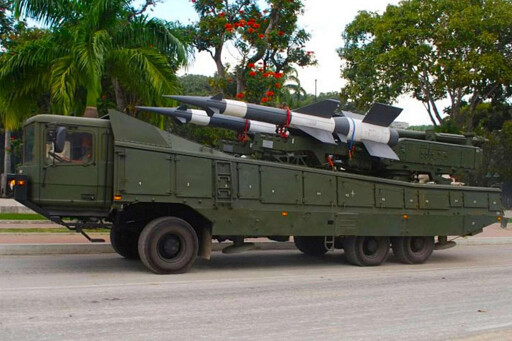
Caracas, December 15, 2025 (venezuelanalysis.com) – The Venezuelan Armed Forces reiterated their commitment to defend the Caribbean nation’s airspace amid an escalating US military buildup and provocations.
Defense Minister Vladimir Padrino issued a statement Sunday to mark the 47th anniversary of the Venezuelan Integral Airspace Defense Command (CODAI), hailing the system’s “effective and immediate” response capabilities against “imperialist threats.”
“With its modern radars, missile systems and surface-to-air artillery, CODAI has become the vanguard of the country’s defense,” Padrino wrote on social media. The defense minister went on to highlight CODAI’s “technological independence.”
Padrino’s comments occurred amid a large-scale US military buildup in the Caribbean in a self-declared anti-narcotics mission. The Trump administration has repeatedly threatened to launch strikes against purported drug targets inside Venezuelan territory.
After moving their largest US aircraft carrier, the USS Gerald R. Ford, to the region in November, US forces have likewise ramped up warplane deployments to bases in Puerto Rico. According to reports, the US Navy moved six EA-18G Growler electronic warfare jets to the island’s Roosevelt Roads naval station.
Designed by Boeing, the EA-18G Growlers have advanced capabilities to disrupt and deceive enemy military electronic systems, including air defenses.
Open-access flight tracking websites have shown EA-18G Growlers operating in the Caribbean in recent days. On Tuesday, F/A-18 Super Hornet fighter jets flew for 40 minutes close to the Gulf of Venezuela in the country’s west. Analysts argued that the warplanes could have been mapping air defense systems spotted in the region days before.
On Friday night, social media users watching flight trackers reported that a Growler, codenamed GRIZZLY2, and a Super Hornet, codenamed RHINO61, were flying over Venezuela’s Los Roques archipelago and continental mainland, respectively. However, the false positions were a consequence of trackers such as Flight Radar 24 extrapolating an aircraft’s position for a limited time after losing signal on the basis of the last measured position and speed.
The Venezuelan government and armed forces have consistently denounced the US military maneuvers, accusing Washington of attempting to fabricate a false flag incident to justify an open conflict.
The US’ increased military activity has also affected commercial aviation. On Sunday, JetBlue denounced that an airplane on a Curaçao-New York had to halt its ascent due to the presence of a US Air Force refueling tanker in its path. Curaçao is 40 miles away from Venezuela’s coast.
US authorities have also issued a Notice to Airmen (NOTAM) urging extra caution to planes flying in Venezuela’s Flight Information Region (FIR). For his part, Trump wrote on social media that Venezuela’s airspace should be “considered closed.”
International airlines flying to and from Caracas have suspended their services. Venezuelan companies continue to offer connections to regional destinations including Panama City, Bogotá and Santo Domingo.
ALBA alliance condemns US threats
Amidst the ongoing US military threats and buildup, the Nicolás Maduro government has received diplomatic backing from its main allies. Last week, the Venezuelan leader held phone calls with his Russian, Iranian and Brazilian counterparts to discuss bilateral relations and the threats to peace in the region.
On Sunday, the Bolivarian Alliance for the Peoples of Our America (ALBA-TCP) held a virtual summit and issued a statement condemning the Trump administration’s declared intentions to enforce the Monroe Doctrine in the hemisphere.
The regional body likewise condemned recent US hostile actions, including the seizure of a tanker carrying Venezuelan crude last week. The US Treasury Department followed by imposing new sanctions, blacklisting shipping companies allegedly involved in transporting Venezuelan oil.
Venezuela’s state oil company denounced a cyberattack targeting its operational capabilities but stated that its effects had been minimized. According to Bloomberg, the reported attack caused loading delays in Venezuela’s main oil terminal.
The White House has justified its military buildup and coercive measures escalation with “narcoterrorism” charges against Maduro and other top Venezuelan officials. However, US agencies have not provided court-tested evidence to back the claims, while reports from specialized agencies have shown Venezuela to play a marginal role in global drug trafficking.
International leaders and foreign policy analysts have stated that Washington’s ultimate goal is regime change to seize control of Venezuela’s natural resources.
Edited by Cira Pascual Marquina in Caracas.
The post Venezuelan Armed Forces Vow to Defend Airspace as US Increases Warplane Deployment appeared first on Venezuelanalysis.
From Venezuelanalysis via This RSS Feed.