

By Jian Zharese Joeis Sanz
MANILA — On a busy day as a worker, while crafting slippers that people you’ll never know will buy and wear, you suddenly heard a scream.
Working in a factory, you didn’t have to experience the feeling of safety in the boiling pot of exploitation. But the scream felt different. You stood up. Other workers also did. Suddenly, someone had the guts to scream what was happening. A worker you’ve only known for days after the previous worker before her was fired shouted “Fire!”
Time slowed down. In your peripheral vision you saw people running toward the factory’s entrance. You, despite wanting to run for dear life, didn’t have the energy nor the adrenaline from working all day long for a hundred pesos or more.
With all your might, you pushed your feet to move. Suddenly, you found yourself running. The gate was wide open but you and 71 others were locked inside!
The steel railing your boss wanted built stood in your way to safety. As the boss told the underpaid workers before, it was well-built. You were stuck inside, screaming, pleading, afraid.
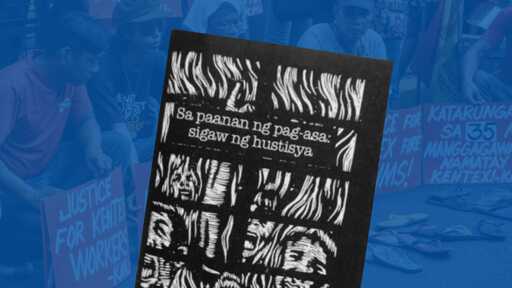
Gama Collective’s zine for Kentex 72 titled Sa Paanan ng Pag-asa: Sigaw ng Hustisya does not just remember this kind of fear each worker of the Kentex fire tragedy experienced, it also demands justice. The zine, published days before the 10th year of the Kentex fire tragedy, serves as a reminder not just of the tragic fate of the workers but also of how labor exploitation kills and continuously takes lives.
Remembrance
More than poems, the zine presents the facts first—allotting its first pages for the timeline of the road to justice for the killed workers and a list of all 60 recognized Kentex factory workers. These help ground readers for the grief and resistance that’s about to interlace.
Each poem stresses the need to remember every name burned to ashes, accountable fire officers, managers, and even politicians. Every line shows the grotesque inhumane orchestration of the tragedy. From Atty. Sol Taule’s “Tsinelas” to MJ Rafal’s “Pagkat ito ang katotohanan: ni hindi na natin”—each line unpacks justice and grief.
In Emman Halabaso’s “Sa Pagawaan ng Tsinelas”, the poem illustrates the tragic experience of workers inside the factory. Not just during the fire itself, but under extreme and exploitative labor conditions. It serves as a time machine, putting the reader in the worker’s shoes, making them feel the slow death approaching since day one.
Each poem is also paired with black and white illustrations and photographs, amplifying the sense of remembrance and tragedy. Overall, despite the zine being pocket-sized, it contains a whole world of justice, memory, and resistance.
Exploitative
On May 13, 2015, on a usual day of extreme working conditions inside Kentex Manufacturing footwear factory in Valenzuela, Manila, a welding-triggered explosion occurred. One hundred fifty of the factory’s around 200 workers were inside at the time of the fire. There were 74 workers trapped and burned alive as the railing prevented their safe escape. Sixty of them were identified.
Following the tragedy, unions revealed the company’s exploitative working conditions and poor health and safety procedures. In an article from The Daily Guardian, Jobert Canino, one of the survivors of the fire, said, “We work for 12 hours, [and] for eight hours we get 202 pesos (USD 3.42) and then the next four we get 49 pesos for each hour. We have no benefits, but the company deducts our supposed benefits from our wages. We know because of the payslips that there is a deduction, but we don’t receive those benefits.”
Moreover, Canino stressed the absence of fire escapes and proper storage for chemicals that are also unlabeled. Canino’s narrative revealed the reality of Kentex workers. Aside from this, the Bureau of Fire Protection (BFP) refused to issue a fire permit to the factory owners around 2014 and 2015, noting a failure to service the fire extinguishers and a lack of fire drills, alarm systems, and sprinkler systems in their report.
For years, kin of Kentex fire victims were fighting for justice. The then Valenzuela Mayor Rexlon Gatchalian, Bureau of Fire Protection officials, and Kentex Factory Manager Ong Kin Guan faced criminal charges. Gatchalian and the BFP officials were charged with issuing a business permit to Guan, despite its delinquent status.
On December 15, 2026, the Sandiganbayan cleared Gatchalian of criminal liability, sparking protests. In 2019, the Supreme Court ordered the contractor of Kentex to pay PHP1.44 million (USD 24,365) to 57 underpaid workers. This meant that each person only received PHP25,263 (USD 427.46). Until 2020, Sandiganbayan acquitted the charges of the involved officials and the company.
To this day, justice remains elusive for the Kentex tragedy victims, reflecting the rotting justice system and impunity.
Art as medium
The zine for Kentex fire victims doesn’t just demand. It screams justice not just for the 72 workers burned alive during the fire but also for all workers still chained under a system that views its workforce as commodities.
It protests to end the exploitation that kept the workers inside the burning factory. Lastly, it demands accountability for all people involved.
And despite the state’s attempt to silence the very same movement, the zine protests, resistance continues to sprout in art, in the streets, and inside factories.
The protests that followed the Kentex fire opened the decade-long issue of occupational health and safety (OSH) for workers. In an International Labour Organization (ILB) report, two million workers are reportedly dying each year from work-related accidents and diseases. Moreover, 17 out of every 18 workers in the nation’s 38.8 million worker population do not have acceptable working conditions.
Beyond protests, labor movements have continued to strengthen. This is why the Kentex zine exists, not just to demand justice but also to support the people who continue to resist. (DAA)
The post Flames of memory in Kentex tragedy zine appeared first on Bulatlat.
From Bulatlat via This RSS Feed.