

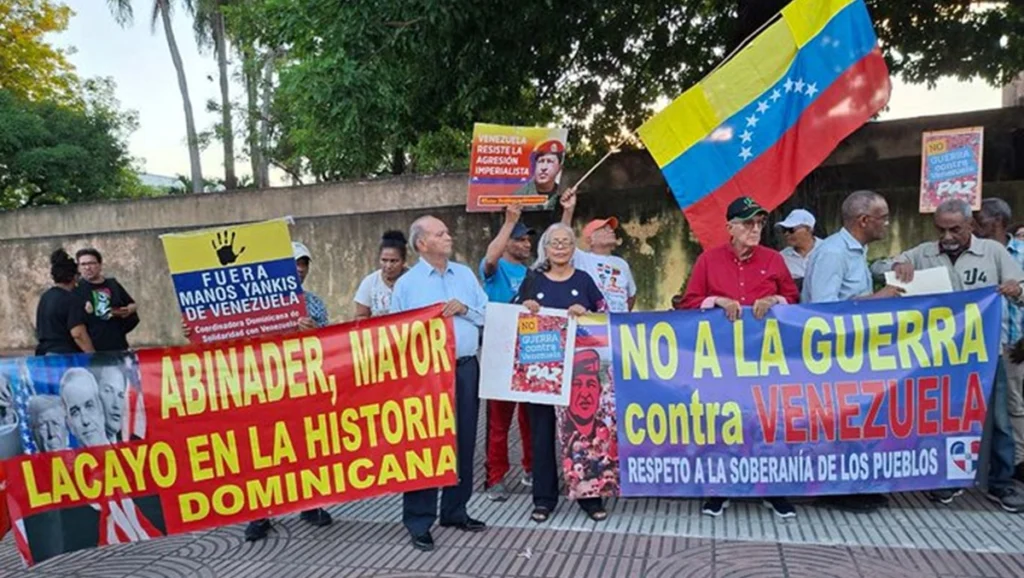
‘Yankees out of the Caribbean’ was the chant shouted at the protests in Santo Domingo.
Following the Dominican government’s recent decision to temporarily grant the U.S. access to an air force base and the country’s main international airport under the pretext of “combating drug trafficking,” several U.S. military aircraft have arrived in the Dominican Republic, drawing widespread attention.
RELATED:
Dominican Republic President Enacts Law to Reform Criminal Procedures
Experts have said the latest U.S. military deployment in the Caribbean is vast in scale and has heightened regional sensitivity. Dominican society, shaped by the historical memory of the 1965 U.S. military intervention, has reacted with unease to the presence of foreign troops.
In recent days, large military aircraft have landed at Dominican airports. Fuel tanker trucks, buses, vans, light vehicles, communications equipment and other military supplies were seen in surrounding areas under tight security measures.
Many sectors argue that although the operations are presented as part of anti-drug cooperation, their impact goes far beyond technical law enforcement.
F-35A stealth jet fighters, EA-18G Growler electronic warfare planes, HH-60W rescue helicopters and HC-130J rescue planes are being staged in Puerto Rico. Tanker aircraft have been moved to the Dominican Republic. https://t.co/xHZKoiDOgD
— Ed (@Wiski1) December 13, 2025
Following the arrival of the first military aircraft, the National Popular Coordination staged a civic protest in the capital, Santo Domingo, where demonstrators chanted slogans such as “Yankees out of the Caribbean.”
The group said the U.S. military presence at airports and strategic infrastructure constitutes an “unacceptable intrusion” that could embroil the country in regional tensions and jeopardize peace in Latin America.
Manolo Pichardo, former president of the Central American Parliament, said public concern is shaped by historical memory, noting that U.S. military interventions have left deep scars, with memories of the violence and loss in 1965 still passed down across generations.
“These painful events remain present … in the collective memory of Dominicans,” he said, addint that the controversy over the U.S. military presence extends beyond drug control, human rights or democracy, and reflects Washington’s broader regional and global geopolitical strategy.
He warned that alleged anti-drug operations, which may involve violations of international law such as extrajudicial killings, could entail future legal consequences for both the United States and the Dominican Republic — an aspect often overlooked in such debates.
Central American Parliament lawmaker Esmeralda Mancebo said the official justification of combating drug trafficking is unconvincing. “Paradoxically, they are fighting drug trafficking abroad when we do not see equivalent actions inside the United States, where the drugs ultimately arrive. Every power in a period of decline ends up in war,” she said.
🚨🇺🇸 This isn’t interdiction anymore; this is pre-strike positioning.
HH-60W Jolly Green II helos, HC-130Js, KC-135 tankers, F-35As and EW aircraft now forward-deployed to Puerto Rico & Dominican Republic for Venezuela operation.
Rapid-reaction forces are now 400 miles from… pic.twitter.com/Z2lAJH8JEo— Terror Alarm (@Terror_Alarm) December 12, 2025
Eduardo Klinger, a member of the Dominican Academy of Sciences, said the U.S. deployment represents “the largest armed positioning in the Caribbean since the 1962 Cuban Missile Crisis.” Although the operations are not officially described as military actions, he warned that they could escalate into confrontations, including indiscriminate attacks on suspected vessels.
Klinger added that the Dominican Republic has been internationally praised for its anti-drug efforts in recent years, raising questions about the necessity of granting U.S. access to Dominican airports and concerns about being drawn into a controversial regional operation that could worsen tensions with Venezuela.
Mihail Garcia, a senior leader of Fuerza del Pueblo, said the Dominican Republic has a tradition of mediating regional conflicts, recalling its role as the “Capital of Peace,” including hosting the 2008 Rio Group summit, which helped defuse tensions between Ecuador, Venezuela and Colombia. “That is the role the Dominican Republic should continue to play,” Garcia said.
Because of this tradition, many sectors fear the country could now be perceived as aligning itself with military escalation, a shift from its historical stance as a peacebroker. As U.S. logistical operations continue at the country’s San Isidro and Las Americas airports, the debate over the Dominican Republic’s role, regional stability and its historical memory intensifies.
Experts agree that amid a complex geopolitical landscape, it is essential for the Dominican Republic to preserve Caribbean stability and avoid becoming entangled in conflicts unrelated to its national interests.
The Prime Minister of #SaintLucia, Philip Joseph Pierre, speaks via videoconference at the 25th #ALBA-TCP Summit of Heads of State and Government, where he reaffirms his country’s position in favor of peace in the #Caribbean and against imperialist interference. pic.twitter.com/KzTqpxfl4k
— teleSUR English (@telesurenglish) December 15, 2025
teleSUR/ JF
Source: Xinhua
From teleSUR English via This RSS Feed.