


The Chile presidential runoff 2025 unfolds peacefully as voters choose between progressive unity and far-right nationalism—testing the nation’s democratic resilience.
Related: 15.7M Voters Decide Chile Runoff Election: Jara’s Bold Stand vs Kast’s Ruthless Surge
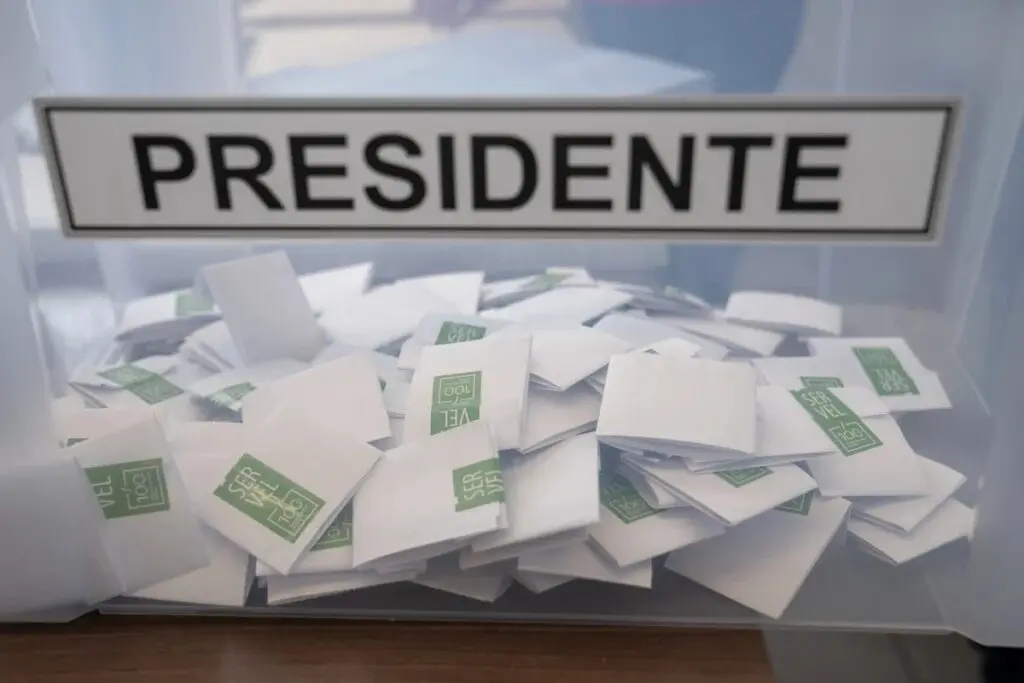
The Chile presidential runoff 2025 is proceeding with remarkable calm and institutional normalcy, as nearly 15.7 million eligible citizens head to the polls to decide the country’s next head of state. By midday, electoral authorities reported no major incidents, reinforcing Chile’s reputation for transparent, reliable, and orderly elections—a rare island of stability in a region often shaken by political turbulence.
Early voting began at 8:00 a.m. local time, with centers set to close at 6:00 p.m., though officials will allow anyone already in line to cast their ballot. In a move to boost participation, the government made public transportation free nationwide for the day and deployed over 2,000 special land, sea, and lake transport services to ensure even remote communities could access polling stations.
President Gabriel Boric was among the first to vote, casting his ballot in his hometown of Punta Arenas in Chile’s southernmost region. Speaking afterward, the outgoing president urged citizens to “defend democracy” and emphasized the strength of Chile’s electoral system.
“Democracy is the best tool we have to resolve our differences peacefully, through dialogue and agreement,” Boric said. “Chile is one nation. The flag wraps us all.”
He praised Chile’s voting infrastructure as “an example and a source of pride for the region and the world”—highlighting its speed, transparency, and the universal trust in its results. Preliminary official results are expected by 7:00 p.m. local time, just one hour after polls close.
Chile Presidential Runoff 2025: A Contest Between Two National Visions
The runoff pits Jeannette Jara, the progressive candidate backed by a coalition of left-wing, center-left, and Christian Democratic forces, against José Antonio Kast, the far-right leader of the Republican Party—a figure long associated with authoritarian nostalgia and neoliberal shock policies.
Jara, a former Labor Minister and the first Communist Party candidate to reach a presidential runoff, cast her vote midday and reaffirmed her commitment to national unity, regardless of the outcome. Should she lose, she vowed to work tirelessly to maintain the cohesion of the nine parties and movements that form her coalition.
“When elections go our way, unity is easier,” she acknowledged. “But even in defeat, nothing changes. I will play whatever role the people assign me.”
Jara also detailed her readiness to govern, revealing a preliminary cabinet list composed of experienced technocrats and emerging leaders. “We have strong teams—people with both experience and vision for the future,” she said.
Meanwhile, Kast voted around 10:00 a.m. in the rural town of Paine, projecting confidence in his victory and pledging to be “president of all Chileans.” In remarks to reporters, he signaled strong alignment with Argentina’s President Javier Milei, praising his economic model and calling their shared vision a “dream” rooted in deregulation, fiscal austerity, and regional cooperation.
Earlier in the day, however, Jara’s campaign raised concerns about potential electoral interference after thousands of Chileans received unsolicited text messages promoting Kast, allegedly sent via the customer database of Lipigas, one of the country’s largest gas distribution companies. The firm quickly denied responsibility, attributing the breach to “cyber pirates” and reporting the incident to electoral authorities.
Learn more about Chile’s electoral integrity from the OAS Electoral Observation Mission
Despite this anomaly, no widespread irregularities have been confirmed. The Electoral Service (SERVEL) confirmed that polling stations are operating smoothly, with high turnout already observed in urban centers like Santiago, Valparaíso, and Concepción.
Geopolitical Context: A Regional Referendum on Democracy
The Chile presidential runoff 2025 carries profound implications beyond national borders. As one of Latin America’s most institutionally stable economies, Chile has long served as a benchmark for democratic governance—even as it grapples with the legacy of dictatorship and rising inequality.
A victory for Jara would signal the resilience of the progressive wave that has swept across Brazil, Colombia, and Mexico in recent years, reinforcing a regional shift toward social rights, tax reform, and environmental justice. Conversely, a Kast win would mark a dramatic reversal—aligning Chile with the hard-right turn in Argentina and potentially deepening diplomatic rifts with leftist governments in Bolivia, Cuba, and Venezuela.
Critically, the election is unfolding under mandatory voting, reinstated for the first time since 2012—a measure expected to boost turnout among working-class and rural voters who historically participated at lower rates. With over 15.7 million registered voters, including foreign residents with five or more years of temporary status, the electorate is the most diverse in Chile’s democratic history.
This context transforms the runoff into more than a policy debate—it becomes a referendum on Chile’s post-dictatorship identity. Will the nation deepen its commitment to the social demands born from the 2019 uprising, or retreat toward a vision rooted in security, austerity, and national conservatism?
Adding to the stakes, Boric confirmed he will personally receive the elected president at La Moneda Palace to ensure a seamless transition of power—a symbolic gesture of institutional continuity in a polarized climate. The inauguration is scheduled for March 11, 2026, a date that marks both the anniversary of Chile’s return to democracy in 1990 and the 50th anniversary of the 1973 U.S.-backed coup against Salvador Allende.
Explore historical parallels in Chile’s democratic transitions via the UNDP Latin America reports
As polls close and counting begins, one message echoes across party lines: Chile remains united in its democratic practice, even as it remains divided in its political dreams. Whether the next president champions expanded social protections or radical market liberalization, the world will be watching—not just for policy outcomes, but for what this election reveals about the future of democracy in Latin America.
#ENVIDEO | Chilenos acuden a los centros de votación durante la segunda vuelta presidencial. pic.twitter.com/gzAF3H8oq9
— teleSUR TV (@teleSURtv) December 14, 2025
From teleSUR English via This RSS Feed.