Curtis Yarvin is a right-wing blogger, Peter Thiel protege, and self-described “monarchist.” I wrote about him here and here, and a few years ago I debated him in Chicago.
The current Vice President of the United States has described Yarvin as a friend and an influence. The current President of the United States has done quite a few things to nudge reality closer to Yarvin’s authoritarian fantasies. Somehow, though, none of it seems to be enough to cheer him up.1
In the most recent entry on his Substack (entitled “You Can’t Handle the Truth”), Yarvin writes:
For the past two decades, I’ve been watching the world wake up to the obvious. As Orwell said, nothing is so difficult as noticing the nose in front of your face. A few people, me among them, were seeing that the whole story of reality that we lived in was as false and narcissistic—at least!—as the Soviet Union’s narrative of itself.
Yet none of us could accept the darkest aspect of that truth.
Tonally, this sounds like an extract from a mediocre YA dystopia. Substantively, I’m amazed that someone like Yarvin can cite George Orwell as if they were on the same team without bursting into flames.2
But, see, that’s me expecting the universe to be just.
Yarvin knows better.
We all had the idea that we could stand up and speak the truth and, if it was true enough, it would flash around the world like lightning. Nothing could prevail against the truth. The Father of Lies could not stand against the Lord of Hosts. That this fantasy itself was part of the lie—that truth has no army, that no angels will ride to our rescue—was too much. Perhaps if I had known it, I never would have said anything… This truth is only available to the most advanced atheists and the most advanced Christians. The advanced atheist has purged himself of all traces of folk religion, and understands the world as it is—an infinitely cold universe of protons and electrons, whose fundamental rules are a few lines of mathematics with no concept of humanity. Our galaxy is not even special, let alone our planet.
So deep.
To the advanced Christian, God’s will is just as cold and his justice is just as inexorable, and evil is sent to punish evil. Maistre read the French Revolution as God’s punishment of the decadent liberals who brought it about, and the weak conservatives who failed in their duty to oppose it. Was he wrong? I love my protons and electrons, but I can’t see how he was wrong.
As tempting as it is to continue to make fun of Yarvin’s writing style, I’ll hold back and ask a serious question:
Does Yarvin actually think we should still be living under the semi-feudal system that immediately preceded the French Revolution? That the “decadent liberals” who were trying to even incrementally reform the pre-revolutionary ancient regime were wrong?
I know he’s on record as saying the American and French Revolutions were both very bad. But having a problem even with the “decadent liberals” trying to change the pre-revolutionary system a little bit at a time from the inside is several steps more insane. I get that on some level the joke is on me for even taking this stuff seriously enough to try to figure it out, but I am genuinely fascinated by how Yarvin’s worldview is supposed to fit together.
I’m a socialist. I like democracy so much I want to extend it into the economy through collective ownership and workers’ control of production. But forget that for a moment. Let’s just think about the status quo. Yarvin is clearly a big fan of capitalist economics. He practically seems to worship the “bold innovative” CEOs who helm tech start-ups. In fact, that’s one of his main arguments against liberal democracy. He thinks we need a CEO of the United States with the power to run the country like a corporation.
Well, does he think tech start-ups could have existed in the kind of world economy that existed before the American and French Revolutions? Even the basic conception of property rights we have now, never mind the kind of free-trade regime that makes it really easy for people in different parts of the world (or even in different parts of France!) to quickly and painlessly do business with each other is something that absolutely didn’t exist under the ancien regime. That’s all a product of what Marxists call “the bourgeois revolution.”
So, if Curtis was against that, and he’s even retroactively against the “decadent liberals” trying to loosen the screws of the old system a little, how on earth does he think we were supposed to go from a world of hereditary duties to landed aristocrats to a world of tech start-ups?
He goes on:
The second Trump revolution, like the first, is failing. It is failing because it deserves to fail. It is failing because it spends all its time patting itself on the back. It is failing because its true mission, which neither it nor (still less) its supporters understand, is still as far beyond its reach as algebra is beyond a cat.
Once again, let’s put aside Yarvin’s rhetoric about how he’s the Special Edgy Keeper of Hidden Knowledge and take this more seriously than it probably deserves to be taken. What’s he actually trying to say?
In the first year of his. second term, Trump has arrested legal residents of the country for writing op-eds and attending protests. He’s cut off funding to universities to force them to more harshly punish student protesters, and in some cases gotten them to hand over names of trouble-makers. He’s repeatedly deployed troops to liberal cities on the thinnest pretexts imaginable as a splashy show of force. He’s asserted the right to extra-judicially kill people who might be fishermen or might be drug dealers because he’s unilaterally decided we’re at “war” with drug dealers. He’s put out a National Security Policy Memo announcing his intention to investigate and disrupt people for having ideological views he dislikes. Apparently, though, all this is so far short of what Curtis wants that it inspires him to this little analogy disparaging the math skills of cats.
So:
What does he want? What would be enough to satisfy this person? Think about that long and hard about that and then think about the fact that the Vice President of the United States has called this person a friend and an influence.
Yarvin writes:
Because the vengeance meted out after its failure will dwarf the vengeance after 2020—because the successes of the second revolution are so much greater than the first—everyone involved with this revolution needs a plan B for 2029. And it is not even clear that it can wait until 2029: losing the Congress will instantly put the administration on the defensive.
What exactly was the “vengeance” meted out after 2020? Yarvin is talking as if roving mobs of Bidenists were going around beating people senseless for wearing MAGA hats after Trump lost in 2020. Is he talking about people to broached the Capitol on January 6th being too harshly prosecuted? If so, has there ever been another case where he objected to the book being thrown at people who participated in a riot?
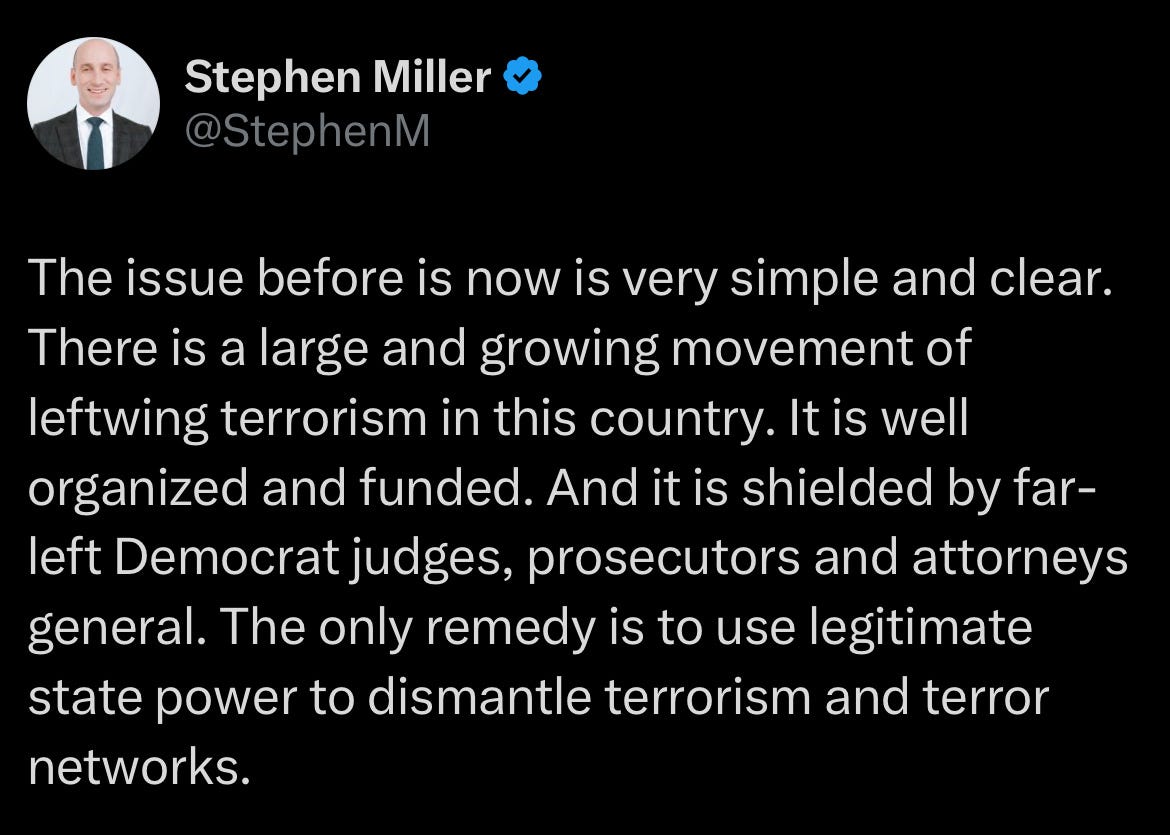
Here is a Twitter exchange that captures the situation perfectly. First, Stephen Miller of Homeland Security:
[](https://substackcdn.com/image/fetch/$s_!ufBD!,f_auto,q_auto:good,fl_progressive:steep/https%3A%2F%2Fsubstack-post-media.s3.amazonaws.com%2Fpublic%2Fimages%2F238a5a1e-d126-4863-8675-5416de718c06_1170x835.jpeg)
This country has a problem with a monkey. The monkey keeps biting people. And it is shielded by the organ-grinder. The only remedy is to punish the monkey. Logic!
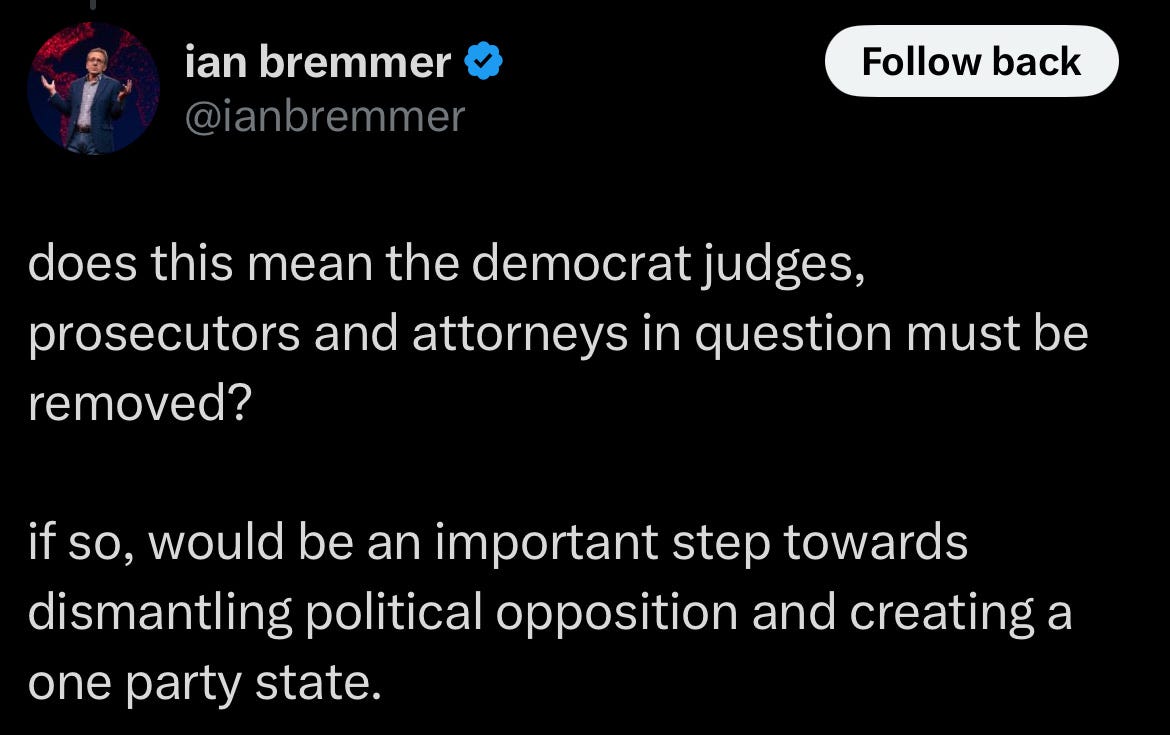
Ian Bremmer, a sort of latter-day Kissinger mini-me, whose NPR show I actually went on, has the perfect response:
[](https://substackcdn.com/image/fetch/$s_!MuOu!,f_auto,q_auto:good,fl_progressive:steep/https%3A%2F%2Fsubstack-post-media.s3.amazonaws.com%2Fpublic%2Fimages%2F5888d0ee-396a-4e5e-a364-b8a60c231f4d_1170x735.jpeg)
Indeed.
If you weren’t quite following what Yarvin was saying about the organ grinder and the money…that’s pretty much the intended effect.
His rhetorical posture about being the one guy who’s put on the glasses from They Live and glimpsed the forbidden truth about reality is reinforced by putting things in ways that are going to be confusing to the uninitiated and give the people who are gullible enough to think that “democracy sucks, race is real, we should let tech CEOs run everything” is the esoteric forbidden truth of the universe feel like they’re in on an exciting secret.
Let’s take this all a bit more seriously than it deserves and actually break it down, though. The context of Miller’s tweet was a legal battle about whether Trump could send federal troops to Portland. The case that a serious national emergency was going on in Portland was so thin that the government was reduced to making great hay about things like activists shining “bright lights” at ICE agents. The biggest real incident of “terrorism” Miller and his ilk can point to is the assassination of Charlie Kirk, and Kirk was killed not by a “network” but a single individual who will almost certainly spend the remainder of his life behind bars.
But Yarvin takes it as a given that Stephen Miller’s fever dream about lavishly funded well-organized left-wing terrorism is accurate. And he blames all this on what he’s elsewhere called “the Cathedral” which is just his pretentious term for the idea that universities and the media make people left-wing. That much is clear.
But, what exactly would going after the “organ-grinder rather than just the monkey look like? That last “indeed” makes it sound like Yarvin does favor “dismantling political opposition an d creating a one-party state.”
He doesn’t elaborate, though.
Instead, after a brief detour to make a cutesy observation about language:
(Note the subtly contemptuous mockery of “Democrat”—Democrats use “Democratic” as an adjective, Republicans use “Democrat.” Unclear when this little quirk originated.)
…he says:
Except that it is in public, almost the same thing happened in 1953, when the House Republicans had a rare 2-year window of power and used it to do the unthinkable: investigate the great foundations. Norman Dodd, chief investigator of the Reece Committee, visited the Ford Foundation to interview its head, Rowan Gaither.
According to an interview Dodd gave shortly before his death, Gaither asked him, off the record, if he knew the purpose of the Ford Foundation. Dodd was indeed curious. “We shall use our grantmaking power,” said Gaither, “so as to alter life in the United States so that it can be comfortably merged with the Soviet Union.”
Yarvin swallows this story whole, and marvels at it.
Imagine this in 1953. During the Korean War! “I nearly fell off my chair,” said Dodd, who did not fall of his chair, and managed to ask Gaither if he would say the same to the American people. “We would not think of doing any such thing,” replied Gaither.
He knew perfectly well that Dodd would tell the American people what he had heard—and no one would believe him.
This is maybe a good time to mention that in our debate, when we were arguing about the history of US meddling in Latin America, Yarvin faulted me for reading historians and believing what I read. He explained that procedure followed by edgy dangerous truth-seekers such as himself is to disregard the work of academic historians who spend their whole lives carefully researching their subject in favor of going on Google Scholar and reading some memoirs by right-wing cranks. In this case, the story comes from an interview rather than a memoir, but it’s a pretty good specimen of what Yarvin’s method of historical research gets you.
Indeed, “McCarthyism” was then at its high point and would shortly recede, thanks to the brilliant, hilariously obvious stratagem (used also in 1940) of running a Democrat on the Republican ticket. (This was made easy by the fact that the Republicans were America’s original left-wing party, a 19th-century alignment still barely visible in the Deep South and upper Northeast.)
I’m not sure whether Yarvin is talking about Einsenhower running for re-election in ’56 or Richard Nixon running in ’60. Those were the next two elections after 1953. I assume he must mean Nixon was secretly a Democrat running as a Republican, given that Eisenhower was already president in 1953.
That would be confusing, though, for a few reasons. First, Nixon was actually one of the most famously enthusiastic McCarthyites in Congress before he became Vice President. Second, McCarthy had been brought down long before the 1960 election. Finally, Nixon lost in ’60 so the chain of cause and effect in Yarvin’s story is hard to follow.
Maybe he means that Einsenhower was secretly a Democrat running as Republican and so the way we should parse the sentence is that McCarthyism would fall a few years after 1953 because of the sneaky strategy of running Einsenhower as the Republican candidate in 1952. It would be quite something to think Dwight Einsenhower wasn’t rabidly anti-communist enough. (Just for starters, google “Arbenz + United Fruit Company.”) But what I really can’t get over here is that Yarvin can’t seem to decide whether his claim is supposed to be that Eisenhower or Nixon or whoever wasn’t a real Republican or actually that the Republicans were always left-wing.
Bluntly, the man needs an editor.
From 1917 to 1989, at the highest levels of policy, convergence with the USSR was the goal of the US foreign policy establishment.
Got that?
When Woodrow Wilson sent troops to Russia to help the White armies and no president until FDR was willing to even diplomatically recognize the Soviet Union, when JFK responded to Cuba gravitating toward the Soviet sphere with the Bay of Pigs and a sweeping economic embargo, when the United States killed a couple million peasants in Southeast Asia to try to crush a communist revolution there, when we had multiple near misses at global thermonuclear war with the Soviets, when….etc….the goal of the highest levels of U.S. policy was for the U.S. and the U.S.S.R. to merge together just like that Ford Foundation guy said in that totally real conversation with Norman Dodd.
Indeed, “Cold War Studies” today does not study the origins of the USSR or the roots of the convergence policy. It studies why the convergence failed and the alliance broke apart in 1945.
It’s nice that Yarvin occasionally takes a break from reading memoirs on Google Scholar to glance at some academic research but I think he maybe should have taken a slighter longer glance. First, that “indeed” is separating two claims that not only aren’t identical to each other but actually directly contradict one another. The U.S. and the Soviets were allied during World War II. That much is true. At the time, everyone understood that Hitler and Tojo were a sufficiently grave threat to the rest of the world that everything else had to be put aside until they were defeated. And scholars doing Cold War Studies are indeed interested in studying why that alliance didn’t last after the end of the war and why it ruptured so dramatically by the late 40s when the Cold War really got going. That’s also true. But when Yarvin says:
From 1917 to 1989, at the highest levels of policy, convergence with the USSR was the goal of the US foreign policy establishment. Indeed, “Cold War Studies” today […] studies why the convergence failed and the alliance broke apart in 1945.
…the part after the “indeed” directly contradicts the part before it.
Yet almost everyone in America, even 35 years after the fall of the USSR, sees only the theatrical hostility. No one has, or had, any inkling of the basic structure of their own historical reality.
That’s why a Rowan Gaither or an Ian Bremmer can just tell the truth. The truth is: we can’t handle the truth. Stephen Miller can’t even handle the truth. The public of 1953 might even have known what to do with the truth, if they could handle it.
Only Curtis Yarvin can handle the truth!
For exactly the reasons that Miller describes, it is not possible to handle the “large and growing movement of leftwing terrorism in this country” like the Islamist terrorism of 2001, let alone the genuine political opposition of January 6.
Of course, all the people Yarvin is talking about did eventually get trials, and never doubted that they would get trials, even if they had to wait too long for their day in court. The contrast to the people Trump sent to CECOT in El Salvador is obvious enough that I won’t belabor it.
Even after 9/11, the Cold War Mutt-and-Jeff act kicked off instantly, as we searched for ‘moderate Muslims’ to love on.
He follows this up with a screenshot from an old article about Anwar Al-Alwaki being praised as a moderate Muslim after 9/11, which is ironic—get it?—because later on Al-Alwaki became increasingly radicalized by his horror at all the destruction being perpetrated by Bush’s wars in the Middle East, and he switched sides and became a supporter of Al Queda. Some people might look at that story and say, gosh, do you suppose weren’t exactly winning hearts and minds in the Islamic world? Like maybe, just maybe, the effect of bombing and invading a bunch of other people’s countries was to very dramatically increase anti-American sentiment all over the world, while not actually helping ordinary Americans in any way?
Nah.
Yarvin’s conclusion is just that all Muslims are bad.
I’m not sure what the practical upshot of that is supposed to be, though. If he had his way, would the United States have somehow done something to make an entire major world religion cease to exist?
I’d be fascinated to hear that plan.
Imagine responding to radical racist terrorism by seeking a new generation of moderate racists. Mr. Al-Alwaki soon became the leading imam of the jihad. When the good cop becomes the bad cop, what do? It’s okay. We needed a bad cop anyway, and there are always more good cops. The Cold War was exactly the same thing.
Putting aside the John Birch Society stuff about how he’s the only one who gets the secret truth that the two sides of the Cold War actually loved each other, it’s interesting that Yarvin never mentions that Anwar Al-Alwaki, who was never convicted of anything and whose main crime seemed to be giving a bunch of fiery sermons where he supported terrorism with his words rather than actually doing any terrorism himself, was extra-judicially assassinated with a drone. Given Yarvin’s level of concern with the civil liberties of Jan 6th rioters, perhaps he could spare a thought for the fact an American citizen was extra-judicially executed far from any battlefield to punish him for his speech.
Certainly, that’s worth keeping in mind when we read Yarvin (a) suggest that the organ-grinders of left-wing terrorism should be handled like Al Queda and (b) complain that we never really took the gloves off in the War on Terror.
When you see clips of masked DHS goons hauling off some equally masked anarchist, you may be tempted to cheer. Don’t. Yes, charges will be filed. No, it will not harm the anarchist—it will make his day, his year, and maybe his life. All the money and power in the world will be at his defense. He will not even need to lift a finger to organize his own lawyers, much less pay them. In the end, as with many of the BLM rioters, he will probably be well compensated, with taxpayer funds, for his trouble. Not to mention all the pussy and/or dick s/he will, as a martyr, be entitled to! For the Islamist, this reward is only in heaven. But for the leftist it comes on earth.
The reward for Stephen Miller and his ilk is also on earth. They look tough. They’re doing something. That they are not even doing 0.01% of what it would take to solve the problem—that, at much more risk to themselves, the most they could probably do is 0.05%—matters not. They can milk it as far as it goes. They, too, will sell books. I’m sure they understand this and are doing all they can! Yet this does not change the facts.
Once again, Yarvin can’t even stick string together an internally consistent narrative over the course of a few sentences. Midway through the second paragraph, Miller and his ilk are doing a fifth of what they could (01% rather than .05%). By the end of the paragraph, Yarvin is sure they’re doing “all they can!”
But also, if arresting legal residents for writing op-eds and announcing that “anti-capitalism” and “anti-Americanism” and the rest are grounds for investigation is only .01% of what Yarvin wants to happen, what does 100% look like?
His whole schtick is to sound edgy and radical but also be vague enough that he can brush off the implications of what he’s saying. I really don’t see how the arithmetic would work out, though, if 100% was anything short of a one-party police state.
But then in the next paragraph he weasels out of that:
Of course Bremmer is absolutely right, but some corrections are in order.
One: there is no risk of a Republican one-party state, because there is no actual Republican party. It is a label, not a party. To the extent that the Republicans are organized, it is only for election theater. There is not even a remote, nascent equivalent of the venerable and gigantic progressive institutions which have been running our country for a century.
And again, an editor might point out that if Bremmer was “absolutely” right there wouldn’t be a need for the corrects. You say “some corrections are in order” after saying someone is “mostly” right.
More importantly, though, what does Yarvin want if not a one-party police state? What does the 100% look like if everything the most authoritarian administration in recent American history has done in the last eleven months is only .01%?
Some people have some money, but would rather spend it on actually fun stuff. If you keep listening to the Dodd interview, he describes exactly how the Carnegie people took over the country in the first half of the 20th century. The playbook may work better on an innocent, defenseless nation, but it is still basically solid. By far the closest right-wing version this is the Koch machine. But the Kochs, like most right-wing Americans, are fundamentally interested in liberty, not power—and live in the thrall of centuries of bogus political science which has taught them that government can be “limited,” and power is not a zero-sum game. Unfortunately, though, it is.
Truly, if there’s one thing that’s clear when you look at the last eleven months of people being deported to life in prison in El Salvador on the basis of suspicion and supposed drug-runners being extra-judicially executed and legal residents being arrested for writing op-eds and Trump trying to take away citizenship from millions of people by reinterpreting the 14th Amendment and Trump sending troops to cities to back up ICE while they do helicopter raids to wrestle gardeners and dish-washers to the ground and shove them in the back of trucks, it should be very clear that the priorities of the American right are just about liberty and not even a little bit about power.
Two: it is not possible to remove the “Democrat judges,” etc, because there is no label sufficient to the purpose. Every time the Republicans attack a disposable label, I want to grind my teeth to powder and spit them out my nose. This is pure grift.
All that happens if you attack “woke,” “communist,’ ‘politically correct,’ etc, is that they stop saying these words. Then they label you as a rube who says these words. In biology, this is called ‘antigenic escape.’ If you want to attack a word, take on a ‘conserved antigen,’ like ‘progressive.’ They have a lot of trouble not saying ‘progressive’—but they would probably manage.
What on earth all this is supposed to have to do with whether Trump could remove judges appointed by Democrats is anyone’s guess.
Politics is fundamentally about power. In power, large things are easier than small things. Except for actual assassins, who do have to be thrown off the bus, but at least will not be executed, and will spend the rest of their lives in a safe comfortable place, answering huge stacks of perfumed notes from fans of the appropriate sex, their foot soldiers (who are of course disposable anyway) will be well taken care of. For the Trump administration to use its tiny, marginal power to try to punish its enemies, one by one, is so futile as to be barely worth trying—though it would certainly help if they prioritized this over “bread-and-butter governance.”
This is brings is to:
Getting rid of all the liberal judges is easier than getting rid of all one liberal judge. Getting rid of all the judges is easier than getting rid of all the liberal judges. Getting rid of the whole legal system is easier than getting rid of all the judges. Getting rid of the whole machine of government is easier than getting rid of the whole legal system. Getting rid of the whole philosophy of government is easier than getting rid of the whole machine of government.
Every sentence of this paragraph, laid down with equal confidence, manages to be at least little bit more absurd than the sentence before it. Like, yeah, impeaching a judge, that sounds pretty hard. Much easier to convince Americans that 1776 was a mistake and they should hate the very idea of democracy.
It is not about ‘dismantling political opposition.’ Politics is this establishment’s outer line of defense. It is not their source of power or money. Winning elections does not create liberal power. It protects liberal power. If they lose elections, it is fine, so long as their money and power is protected. While their power is feeling slightly annoyed, it is generally safe. Their money is completely safe—no one is even starting to talk about defunding the endowments, foundations, etc. In any case, even if these funds were taken, their billionaires would just refill them.
Reminder:
In real life, Yarvin is a personal friend of Peter Thiel.
Personal expropriation or even proscription/attainder is needed. Obviously, a violation of Our Vital Property Rights.
Would all these people, institutions and ideas need replacing? Of course they would. But that’s easy! At least, it’s far easier than impeaching one liberal judge. When the USSR fell, Yeltsin banned the Communist Party. He literally made it illegal as an organization. And, good democratic libertarian that I was, I disapproved. I was like: sadly, this is not getting off on the right track. It wasn’t—but not for that reason.
So, one party state after all. That party just won’t be the Republicans because they’re not a real party. We need something new. I’ll leave what that would look like, as academic philosophy papers sometimes say, as “an exercise for the reader.”
I’ll quote the last five paragraphs of Yarvin’s essay without interruption, so you can get the full effect:
No, the only danger to this bipartisan kabuki, which has gotten much, much realer in the last 20 years and especially the last 1, is that everyone realizes how fake it is. This is starting to happen—but only starting to happen.
I find myself in suburban North Carolina this weekend, about to head up to Yale for events with Jed Rubenfeld (on the 7th) and Garett Jones (on the 8th). (If you’re at Yale, give me a holler!) When I drive around the gated communities of the New South (if you’re in St. James Plantation today, give me a holler lol), I feel like I’m a doctor listening to the heart of a cancer patient.
All these million-dollar mansions, with perfect lawns maintained by illegal helots, with no visible children, with no one at all visible but a few old people on bicycles. How could there be any problems with the governance of this place? Of this country? In St. James, you don’t have to close your eyes or your ears to see and hear no evil. It’s fine. Everything is fine.
Yes, there is the cancer. A horrid black blotch. Growing. Everyone can see it now. Fox News will tell you all about the black blotch. Fox News will tell you all about the black blotch. But it’s superficial. Stephen Miller will get it off with a belt sander, then Pam Bondi will dig into her makeup bag and find some concealer. It’s fine. We’re winning.
My brothers in Christ: you cannot even imagine what winning looks like. This is literal. You literally can’t picture it. You can picture winning on this, winning on that, winning on the other thing. But winning overall? You can’t picture it, because you can’t handle the truth. Try anyway—then put yourself in that headspace, and look back at the things the Trump administration is trying to do today. Unfortunately, I rather expect you’ll laugh.
That last line, at least, shows a glimmer of self-awareness.
Honestly, I feel more than a little ridiculous about going through this entire screed line-by-line, as if I’d passed by a homeless woman standing on the street corner screaming about how the Martians and the Jews and the Trilateral Commission had put a microchip in her butt and I’d responded by slowing down, making eye contact, and trying to engage wither about the inconsistencies and logical leaps in her argument.
Then again, I would like it if some enterprising reporter asked the Vice President, “Hey, you’ve cited this guy positively in the past, you’ve called him a friend, you’ve said he’s influenced you, any thoughts about the unhinged calls for full fascism he keeps publishing?”
Thanks for reading Philosophy for the People w/Ben Burgis! This post is public so feel free to share it.
If you prefer watching to reading, most of what follows is adapted from here.
In his essay “Why I Write,” Orwell said:
”Every line of serious work that I have written since 1936 has been written, directly or indirectly, against totalitarianism and for democratic socialism, as I understand it.”
From Philosophy for the People w/Ben Burgis via This RSS Feed.
You must log in or # to comment.
Yarvin is trash and I hope he suffers some lonely, embarrassing, fate.
Curtis Yavin can choke on a dick. Fuck that guy.
The only reason anyone bothers with this guy is because a bunch of rich fascists like him. Otherwise he’s just some dude. He’s not philosopher, or a scholar. Jordan fucking Peterson is more qualified than him. Put him across any actual philosopher and watch him crumble.