

Originally published in Daily Struggle.
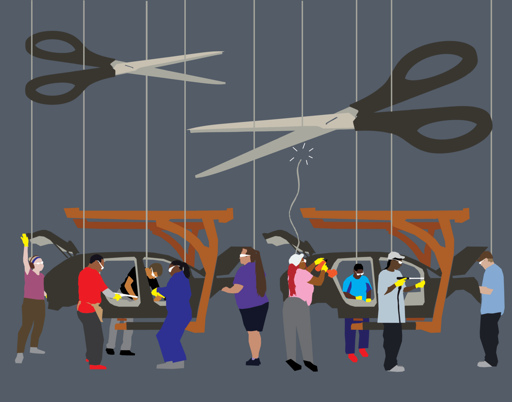
On the morning of October 29, autoworkers at Factory Zero, the GM electric vehicle plant in Detroit, received an urgent notification about the status of our two-month temporary layoff. For over 1,100 of us working in the plant, the news was that we would have to return to work on Thanksgiving week, only to be indefinitely laid off in January. As the bosses reduce production from two shifts down to one, the holidays are bringing uncertainty and precarity, rather than comfort and stability.
Over the past year, hundreds of workers at Factory Zero have already been impacted by rolling layoffs and termination of temporary workers, often announced without notice. And Factory Zero is not alone. Thousands of UAW-represented manufacturing workers across the US have recently been laid off or are facing an impending layoff.
While tariffs and policy reversals may have been a catalyst for this latest round, layoffs themselves are a constant feature of the boom-and-bust cycle that defines capitalism. Take Factory Zero, for example: all of the layoffs come just after a stretch of grueling mandatory overtime, lasting throughout most of 2024, during which we were forced to work 72 to 80 hours a week, and most workers in the battery department were forced to work every day of the week.
When bosses need to cut costs to protect their profit margins, the workers that make the products are the first “costs” to be cut. To maximize their profits, they need to be able to force us into dangerous mandatory overtime, lay us off, and bring us back, all whenever they see fit.
We’ve all heard it: “Well, that’s just the auto industry. It’s boom or bust. Take it while you can get it.” But in the past, workers have been able to fight and win much higher levels of job security, through the UAW’s jobs bank program and by sharing work during layoffs. To reclaim pay protections in the short run, we can fight to win back the jobs bank. To be able to win back our lives and stability in the long run, workers need to challenge the bosses’ unilateral control over production.
The jobs bank: protecting workers’ pay during layoffs
The jobs bank was developed in the 1984 Big Three national agreements as a program that would soften the hardship of layoffs for autoworkers. It guaranteed workers full weekly 40 hours pay when their jobs “fell victim to technological progress or plant restructurings.” These protections wouldn’t kick in until after workers were laid off for a period of time, typically about a year, meaning many laid off workers were never covered. Officially, the bank required workers to engage in some kind of activity, including training, education, community service, or sometimes simply being in the plant. While the jobs bank was a bandaid—a reform and not a solution for layoffs—it meant workers didn’t have to suffer the worst harms of being out of work when bosses changed production plans to chase profits.
When the UAW bargained for the program, it ceded the fight for shop floor control, acquiescing to management’s demand for “increased automation and more flexible manufacturing.” UAW leadership allowed the Big Three to claim more control over production plans in return for a protection that would make any layoff more costly, making it more expensive for management to offshore jobs.
The jobs bank was a point of controversy during the 2008 economic recession and congressional hearings on the Big Three bankruptcies, as corporate executives pleaded for taxpayer help. The bosses scapegoated it as one of the main causes of economic losses, arguing that it was for “lazy workers.” Corporate media often took the bait, labeling it the “notorious jobs bank.” In the bosses’ eyes, and the eyes of politicians and judges who sided with them, a worker was only worthy when their hands were making profitable products.
Despite its shortcomings, UAW leadership made a major concession when it agreed to the elimination of the jobs bank. Getting it back would be a win for workers.
Worker control over layoffs: a shorter workweek and work sharing
Instead of just seeking pay protections during layoffs, we should question why workers need to be laid off at all when the bosses decide that they want to produce fewer cars—or produce the same number of vehicles with fewer workers.
Worker control over production during reduced work hours as an alternative to layoffs was once commonplace, with contract provisions including voluntary layoffs, job sharing, and shorter work weeks, especially after union militancy peaked in the 1940s and ’50s. A 1956 Bureau of Labor Statistics (BLS) study describes a wide variety of different types of “work-sharing” provisions in collective bargaining agreements that gave unions control over how work reductions were managed. Another BLS study describes agreements requiring reduction in hours to 30 per week, or that days per week be reduced to 3 or 4, before any layoffs are imposed. It also cites agreements requiring that, during production slowdowns, “the number of shifts […] be temporarily reduced and work equally divided among remaining employees.”
In work-sharing models like these, workers act in solidarity and build the cohesion needed for further fights, instead of allowing management to lay off their coworkers. For a two-shift plant, an alternating schedule might mean that each shift works for two weeks, and then goes on unemployment for two weeks. Management bears minimal additional logistical costs, unemployment costs are the same, and there is no need to train new workers. Low seniority workers don’t suffer as big a loss of income due to indefinite layoffs, and high seniority workers don’t have to deal with the burden of switching shifts and training on new jobs. By banding together, workers ensure that neither shift has a long period of uncertainty without work, and that none of their coworkers need to relocate far from their home on short notice.
As long as our plants are privately owned, the bosses will determine how many hours of work are needed for production at any given time. But by establishing control over the shop floor, we can use our power to decide collectively how those hours are allocated, eliminating layoffs during work reductions and even fighting for a shorter workweek without loss in pay that would preemptively limit future layoffs.
A class struggle approach: fighting to win back control during work reductions
Layoffs are a constant of the boom-and-bust cycle of capitalist production, but they don’t have to be. The bosses have the power to dictate how many cars we produce and how many hours we work to maximize their profits. That means workers exerting control over work reductions to oppose layoffs is a battle line of the class struggle—a fight between the working class and the capitalist class, whose interests in controlling production are totally opposed.
We don’t need to accept the corporate logic that layoffs are as natural and inevitable as storms or droughts. For years, UAW leaders bargained away the slim protections we had, giving up the fight for shop floor control in return for the jobs bank, and then giving up the jobs bank to “live to fight another day,” while the companies screwed over younger workers with corrosive tiered and temp working conditions. In the upcoming 2028 Big Three national negotiations, UAW members can take direct aim at “management rights” provisions and gear up for a fight for control over the restructuring of the auto industry that threatens our future.
What would a class struggle response look like?
In boom times, while sales are up and mandatory overtime is being forced, UAW members can organize strikes to win provisions that force management to smooth work out over the years. What if, instead of a year of mandatory overtime followed by a year that ends in an indefinite layoff, we could expect regular work weeks year after year? That would give us more confidence in our collective power and the stability to plan for the big battles over the EV transition and automation that lie ahead.
We can also learn from the “work sharing” policies of the 1950s, which if revived would go a long way toward reducing worker uncertainty and protecting against job losses. Pairing control over how our hours are allocated with the jobs bank and a shorter workweek with no loss in pay would result in more jobs to go around. German and French autoworkers already have overtime pay beginning at 35 hours per week. Why can’t we?
Workers in the rest of the auto sector and in other industries have their eyes on what autoworkers at the Big Three are able to win. If we can successfully fight layoffs during turbulent times of trade war escalation and industry restructuring, it will inspire workers across the country to refuse the bosses’ boom-and-bust cycle and take back control over our lives.
The post Fighting Layoffs: Learning from UAW History and Taking Control of Work Reductions appeared first on Left Voice.
From Left Voice via This RSS Feed.